FabEagle®Connect is middleware for connecting machines, equipment, and IT systems via interfaces such as OPC UA, REST, MQTT, or TCP/IP. With two new features, Release 4.3 strengthens transparency and integrity at the integration layer in connected production environments. Companies in medical technology and the pharmaceutical industry in particular benefit from these enhancements.
Audit Trail for Tamper-Proof Traceability
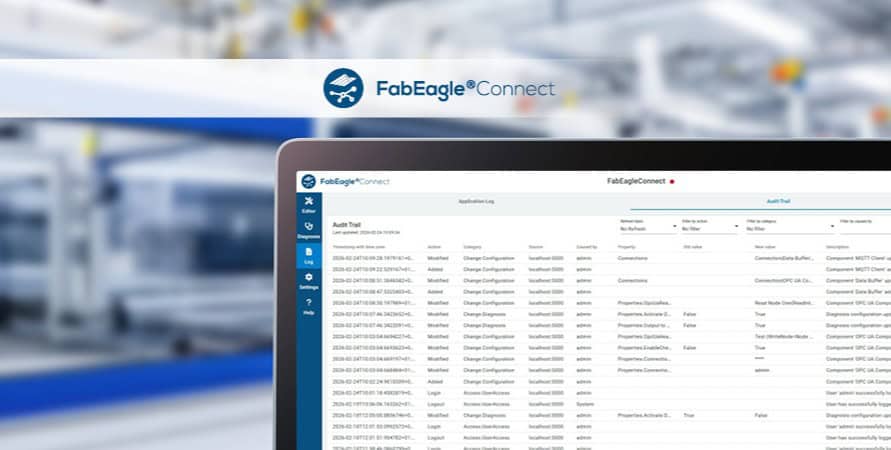
The new audit trail feature enables centralized logging of all security- and configuration-relevant events within the application. This includes logins, application start and stop events, as well as changes to system settings and interface configurations. FabEagle®Connect stores all events as structured log entries, ensuring complete traceability of all changes in a comprehensive changelog.
This level of transparency is essential, especially in highly regulated production environments. Companies in primary packaging, medical technology, and pharmaceutical manufacturing must clearly document all system changes. Requirements from GMP processes, validation frameworks, ISO/IEC 27001, IEC 62443, as well as IT and OT compliance strategies demand exactly this level of traceability. Structured event logging through audit trails ensures compliance with these requirements. At the same time, all audit events are clearly presented in the web client. Log entries are available in machine-readable JSON format and can be integrated into higher-level monitoring, SIEM, or compliance systems.
Enhanced OPC UA Configuration for Complex Production Networks
In addition to the audit trail, version 4.3 also introduces functional OPC UA improvements. The integrated OPC UA server now supports a configurable bind address. This allows multiple IP addresses to be defined explicitly, instead of relying solely on an implicit localhost binding. As a result, security is enhanced in production networks with segmented IT and OT structures. Especially in complex network environments, this enhancement ensures reliable integration of machines and systems into existing network architectures.