“The political debate about a more productive labor market is also a debate about tools that make us more efficient at work. That’s exactly what we’re committed to at IU: We teach students the necessary AI skills so they can apply them directly during their studies and in their careers,” says Dr. Sven Schütt, CEO of IU International University.
AI Is Part of the Curriculum, Especially at Private Universities
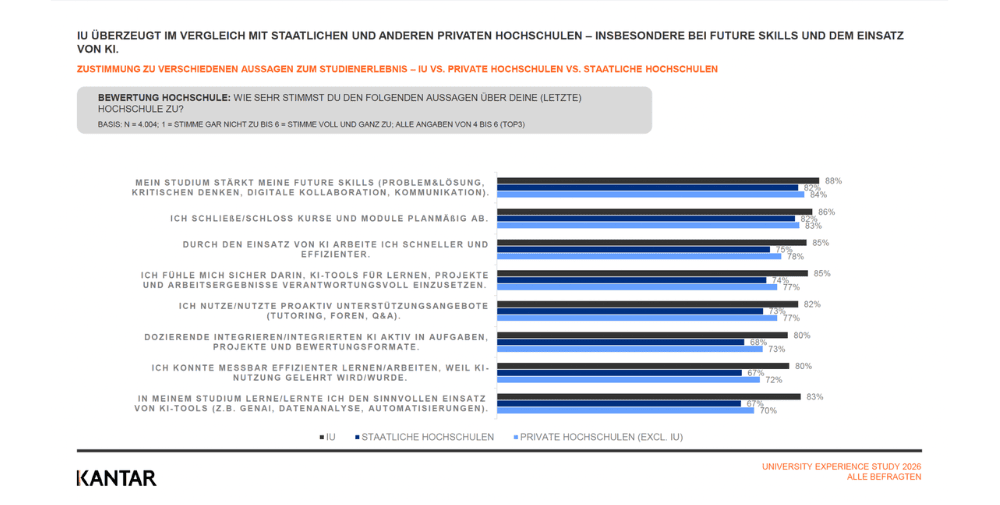
To ensure that these skills don’t remain abstract, students must practice and apply them in a hands-on way during their studies. While more than two-thirds of respondents from public universities report that artificial intelligence has found its way into assignments, projects, and assessment formats (68 percent), the figure at private universities (excluding IU) is nearly three-quarters (73 percent). At IU, as many as eight out of ten report that AI is an integral part of their education. Furthermore, the vast majority (83 percent) of IU students and graduates agree with the statement that they have learned how to use AI tools effectively. By comparison, the figure is seven out of ten at other private universities and two-thirds (67 percent) at public universities.
“In Germany, we still too often teach in a way that’s out of touch with reality. At IU, we’ve made it our mission to change that—and we’re proud that this message is resonating with our students and graduates,” says Schütt. “With our personal AI learning assistant Syntea, we’ve long been demonstrating how to meaningfully integrate AI into teaching,” says Schütt. “With our Job Readiness Framework, we’ve also been incorporating dedicated AI courses into our curricula as part of a large-scale pilot project since April. This allows us to address the needs of companies in a very practical way: We’re teaching today the skills that will be needed in tomorrow’s job market.”
In the survey, nine out of ten IU graduates state that they feel confident using AI tools responsibly, placing them ahead of other universities (benchmark: 73 percent).
Future Skills in Higher Education to Prepare for the Job Market
Ever since the widespread use of generative AI in the workplace, it has become clear that repetitive and standardized tasks, in particular, are increasingly being automated (WEF 2025). “Universities must therefore place greater emphasis on teaching students skills such as critical thinking, problem-solving, communication, and digital collaboration,” says Schütt. The vast majority of IU graduates agree: 96 percent state that their degree program strengthened their future skills (benchmark: 83 percent). “With these future-oriented skills, we’re preparing them for a workplace where it’s not enough to know what AI can do. What’s crucial is understanding where humans continue to have the edge—and how they can work together with AI to achieve better results,” says Schütt.
About the Study
The survey was conducted by Kantar Profiles from August 27 to October 20, 2025. A total of 4,004 students and graduates from public and private universities were surveyed, including 1,597 alumni, with a representative sample by age and gender. The target group consisted of alumni from the past five years, current students, and students who dropped out. The survey was commissioned by IU International University and conducted by Kantar Profiles. The data was collected independently by Kantar Profiles in accordance with its internal quality standards.
Regarding the methodology: To ensure the best possible comparability among the universities, three different comparisons were selected: a) Comparison of “Public Universities vs. Private Universities (excluding IU) vs. IU,” b) “IU vs. Benchmark,” and c) Public vs. Private Universities: In comparison a), IU is compared with public and private universities. Individuals who are currently studying or have studied at IU are considered separately and are not classified as private universities. When considering IU vs. benchmark (b), public and private universities are grouped into a single cohort and compared with IU students and alumni. In comparison c), all public and private universities are grouped together (including IU).
– – – – –
Related Links
👉 www.iu.de
👉 University Experience Study 2026
Photo: IU