The Problem: Complexity, costs, and a lack of scalability in data integration in subfabs
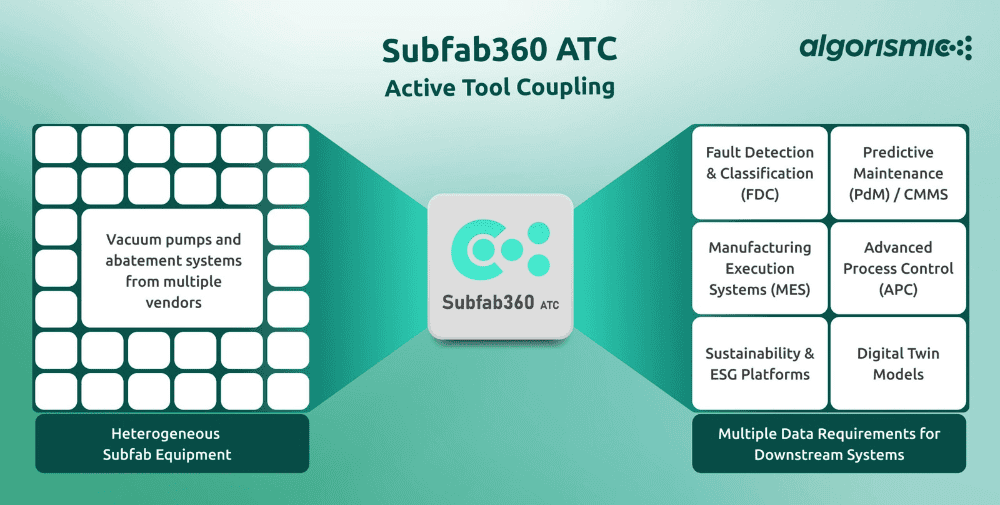
A typical subfab comprises a wide range of industrial equipment from various manufacturers, each providing different communication interfaces for collecting operational data. In addition, certain status information must be sent to Manufacturing Execution Systems (MES) and Enterprise Resource Planning (ERP) software in a platform-specific format.
While there are numerous ways to extract and process data using individual standardized and open communication protocols, the sheer scope and often fragmented nature of industrial hardware configurations can lead to the creation of numerous custom, one-off solutions. This requires significant upfront investment for each new device, and the effort required to maintain such heterogeneous systems increases disproportionately with the size of the subfactory.
The Solution: A scalable integration hub
Subfab360 ATC offers an all-in-one solution for connecting heterogeneous data sources (devices/equipment) to data consumers (MES, ERP, monitoring, analysis, and reporting systems) within the subfactory:
- On the one hand, Subfab360 ATC can communicate with devices via standard interfaces to read operational parameters.
- On the other hand, Subfab360 ATC consolidates these data streams into a single, unified format and forwards them—again via standard interfaces—to downstream data processing systems.
Subfab360 ATC can then proactively notify users via text message and email when predefined alarm or warning conditions are triggered.
A typical installation consists of a series of separate nodes, each implemented as a field controller and responsible for managing the devices at a specific field station within the Subfab. Each Subfab360 VFC (Virtual Field Controller) can be managed remotely via a web-based user interface (UI) or via a terminal using SSH, a network protocol for secure access to and management of remote devices.
In short, Subfab360 ATC acts as Subfab’s integration hub, seamlessly connecting field devices and enterprise systems. You can think of it as the Subfab’s “traffic controller”—it collects, normalizes, and distributes data to where it’s needed.
Implementation of Subfab360 ATC
The software takes a vendor-neutral approach:
- Several industrial standard protocols are natively supported, including OPC UA, Modbus, and Interface-A
- Data streams and status messages can be forwarded to a variety of messaging services and databases such as Kafka, Pulsar, InfluxDB, and MySQL.
- Once Subfab360 ATC is installed and configured, and the necessary network requirements are met, data begins flowing from the devices to the downstream systems.
The ability to expand to include new devices, communication protocols, and data consumers is firmly embedded in the architecture of Subfab360 ATC. algorismic collaborates with semiconductor equipment manufacturers to maximize the potential of the devices within the subfab data pipeline. At the same time, algorismic works closely with the fab operator throughout the entire process—from requirements analysis and integration to ongoing implementation support.
The Benefits: One Platform, Full Control, Maximum Flexibility
- Subfab360 ATC provides production managers with a single, comprehensive access point for capturing and visualizing all subfab operational data.
- A fully self-contained on-premises solution ensures full control over the data without the need for communication with external services.
- Thanks to flexible deployment options, Subfab360 ATC can be used as a plug-and-play solution with dedicated hardware or integrated into the existing IT infrastructure.
- Factory operators benefit from algorismic’s in-depth Subfab expertise and avoid setting up isolated solutions that are difficult to maintain.
- The modular architecture allows you to start with a small installation base and scale as needed across the entire subfab—no “all-or-nothing” approach.
- Most supported devices can be integrated without additional hardware.
- Minimal downtime thanks to standardized interfaces and flexible configuration, which enables easy reconfiguration and replacement of devices.
- Subfab360 ATC is vendor-neutral. The use of established standard interfaces prevents vendor lock-in and protects existing data pipelines.
Authors: Yaroslav Petrov, CTO, algorismic GmbH, and Hugh Wessel, Backend Developer, algorismic GmbH
– – – – –
Related Links
👉 www.algorismic.com
Photo: algorismic