To operate at the cutting edge of quantum computing, real-world applications require both high computational accuracy and speed. Speed is crucial because a quantum computer delivers its results in the form of samples: Each execution of a quantum circuit produces exactly one result. Applications increasingly require circuits with thousands of quantum operations on approximately 100 or more qubits, generating millions to billions of samples. While scaling and quality enable increasingly complex computations, speed determines whether these demanding workloads can be handled within practical timeframes—at a reasonable cost.
“The practical value of quantum computing depends on whether results can be delivered both accurately and quickly. Both are of fundamental importance,” said Jay Gambetta, Director of IBM Research and IBM Fellow. “Nighthawk is already demonstrating what that can look like today. As we scale this architecture to larger and more powerful quantum computers, the possibilities of quantum computing will reach new dimensions. At the same time, we are integrating quantum and classical computing resources ever more closely and consistently driving development toward fault tolerance.”
Nighthawk r2: Speed for Real-World Use Cases
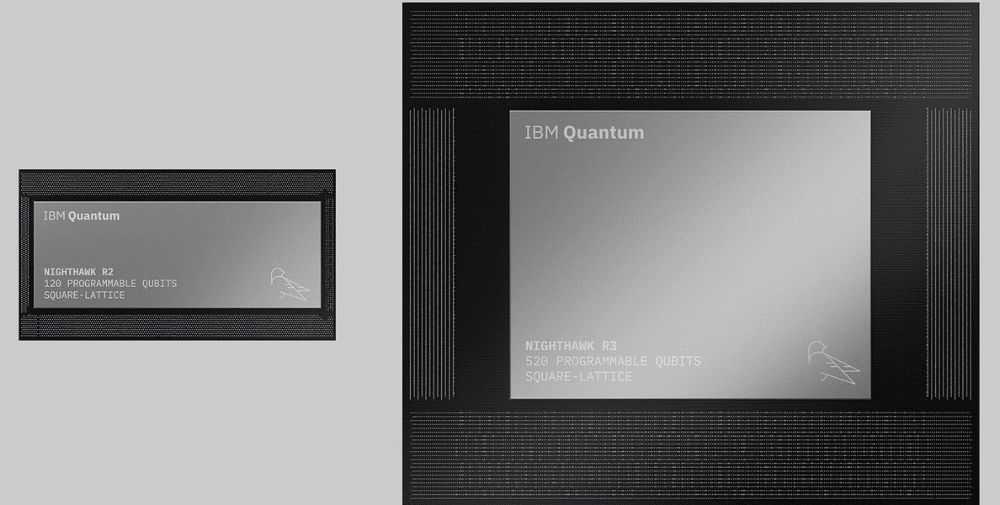
The IBM Quantum Nighthawk r2, unveiled in September, achieves up to 100,000 samples per second while supporting precise computations with more than 7,500 quantum operations on 120 qubits. Its high-speed qubit reset technology significantly reduces the time between individual circuit runs. This enables applications to generate the millions or even billions of samples required for complex calculations much more efficiently.
Customers and partners, including E.ON, Algorithmiq, and Q-CTRL, have executed a total of 34 billion circuits on the Nighthawk r2 to date. They report performance gains of up to 19 times while maintaining consistently high quality for scientific computations.
These results are already demonstrating tangible value across various industries. E.ON reported a 15-fold acceleration in quantum machine learning applications for optimizing energy grids on Nighthawk r2. IBM itself achieved a 12-fold speedup on Nighthawk r2 in an experiment conducted earlier this year in collaboration with Oak Ridge National Laboratory. The experiment simulated real magnetic materials and produced results that match data from neutron scattering experiments. Both performance improvements were achieved compared to earlier work on IBM Quantum Heron. Quantum Elements and ParityQC are also among the partners reporting significant performance improvements for their own workloads on Nighthawk r2.
The quantum advantage experiments that IBM and its partners published in July were originally conducted on IBM Quantum Heron. The circuits used and the results are openly available to the research community for independent verification via the community-run Quantum Advantage Tracker. An experiment conducted in collaboration with Algorithmiq to simulate a heterogeneous quantum material has since been scaled up to run on Nighthawk r2. In doing so, the system leverages its higher speed and improved connectivity to execute the circuits eight times faster than in the original Heron experiment. At the same time, the new circuits pose significantly greater challenges for classical computers: According to estimates, achieving comparable accuracy using leading tensor network-based simulation methods would require approximately 240 times more memory.
Nighthawk r3: Scaling to More Than 1,000 Qubits
Nighthawk r3, building on the performance of Nighthawk r2, will extend the same high-speed architecture to significantly larger quantum systems. The new processor was designed for up to 10,000 quantum operations on 520 programmable qubits and features a total of 2,034 physical qubits. It retains the square-lattice connectivity and fast operations of Nighthawk r2. New additions include ten chip-to-chip connections, known as l-couplers, which are designed to interconnect multiple processors into larger quantum systems.
IBM has already unveiled two key technologies that enable this modular approach. This year, the company connected multiple Nighthawk r1 processors using four l-couplers, achieving a 99.3 percent accuracy in the transmission of quantum states. This brings IBM closer to its target of 99.9 percent. In addition, IBM succeeded for the first time in connecting two cryogenic modules into a single system. The system reached its operating temperature in less than five days and could be cooled to below 15 millikelvin.
Taken together, these advances represent important milestones on the path to modular quantum computers and bolster confidence in IBM’s ability to scale the Nighthawk architecture to larger systems. By 2027, IBM plans to combine two Nighthawk r3 processors into a system with a total of 1,040 qubits. This will enable this powerful architecture to be used for even larger and more complex quantum computations.
IBM Quantum Platform Combines Quantum and Classical Computing
The advancement of quantum computers requires continuous progress in the collaboration between quantum and classical computers to detect and correct errors. Practical applications will require multiple levels of quantum error correction and error suppression in the future, supplemented by methods for noise modeling and post-processing of results. As quantum workloads grow in size, so does the demand for classical computing resources. The key challenge, therefore, is to scale this integration efficiently.
To bring these paradigms together, the IBM Quantum Platform unites high-performance computing (HPC) and quantum computing in a single managed environment. Users can now integrate quantum workflows directly with classical computing resources, whether on their laptop, on a powerful supercomputer, or using the HPC and classical computing resources that are now available on the platform.
These integrations are already yielding promising results. For example, using the new environment, scientists from IBM and RIKEN* were able to run their original workflow for sample-based quantum diagonalization (SQD) about five times faster, performing a hundred times more calculations than in the original study. The Cleveland Clinic and RIKEN also used the platform to automatically process 608 million samples for modeling biologically relevant structures—33 times faster than without workflow automation.
The enhanced capabilities are also expected to enable breakthroughs in quantum error correction. To this end, the IBM Quantum Platform provides pulse-level access. This gives researchers more precise control over how errors in quantum and classical architectures can be detected, analyzed, and corrected. This enables more precise timing of operations, faster resetting of qubits, and a more detailed evaluation of quantum measurements. As a result, researchers gain deeper insights into the fundamental mechanisms of error correction.
IBM recently unveiled a new co-design platform for quantum error correction in collaboration with Oak Ridge National Laboratory (ORNL) and AMD. To achieve this, Nighthawk was physically coupled with ORNL’s Umbra high-performance computing (HPC) system, which is based on AMD Instinct™ MI355X GPUs and 5th-generation AMD EPYC™ CPUs.
About IBM
IBM is a leading provider of global hybrid cloud and AI, as well as consulting services. We help clients in more than 175 countries leverage insights from their data, optimize business processes, reduce costs, and gain a competitive edge. Thousands of governments and companies in critical infrastructure sectors such as financial services, telecommunications, and healthcare rely on IBM’s hybrid cloud platform and Red Hat OpenShift to drive their digital transformation quickly, efficiently, and securely. IBM’s groundbreaking innovations in AI, quantum computing, industry-specific cloud solutions, and consulting provide our clients with open and flexible options. All of this is built on IBM’s longstanding commitment to trust, transparency, responsibility, inclusion, and service. For more information, visit https://research.ibm.com
– – – – –
Related Links
👉 www.ibm.com
Photo: IBM