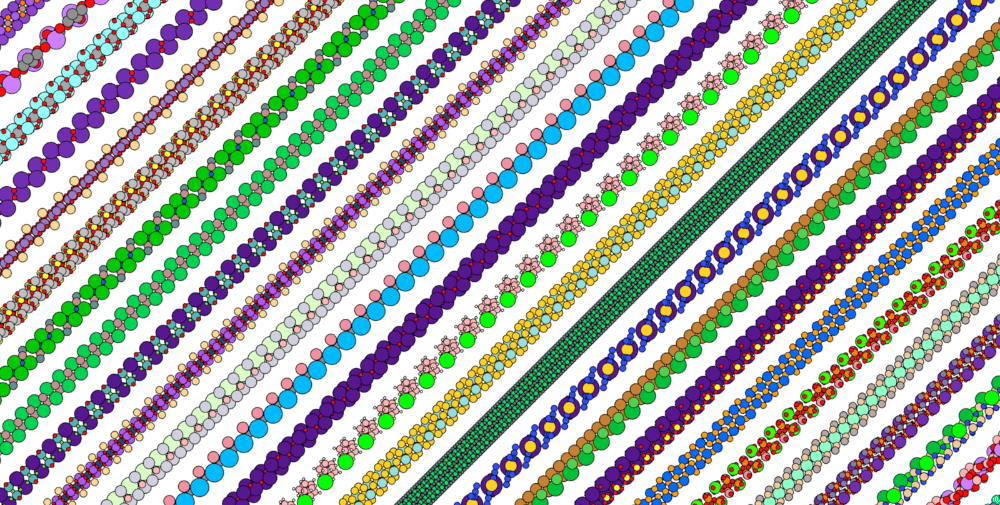
Since the synthesis of graphene in 2004, two-dimensional materials have attracted significant scientific and technological interest. Because they are only a few atomic layers thick—or even a single layer—they can exhibit unique electronic, magnetic, or chemical properties. This makes them attractive for applications such as electronics, catalysis, and energy storage.
Most known examples originate from so-called van der Waals crystals. Similar to a book, these consist of layers stacked on top of one another, with comparatively weak forces acting between them. Individual layers can therefore be peeled off relatively easily. In non-layered crystals, by contrast, the atoms form a three-dimensional network of significantly stronger bonds. Until now, it has been difficult to predict which of these solids can nevertheless be split into stable layers.
“The selection of suitable starting materials for experiments in this still-emerging class of materials was often based on experience and intuition,” explains Dr. Rico Friedrich of the HZDR Institute for Ion Beam Physics and Materials Research and TU Dresden. “With our universal method, we can now investigate for each material where a crystal can be cleaved preferentially and whether a stable two-dimensional structure can form in the process.”
Bond Strengths Instead of Merely Distances
At the heart of the new approach is the “eXfoliation and Cleavage Potential,” or XCP for short. Based on the chemical elements involved and their distances, the computational model very accurately estimates how strongly individual atoms are bonded to one another. Two complementary algorithms then either search for easily separable crystal planes or gradually remove the weakest bonds in the model until two-dimensional substructures remain. This allows the method to identify even atomically uneven cleavage planes.
“Electronic structure calculations for every conceivable surface would be extremely time-consuming,” says lead author Tom Barnowsky. “In contrast, our efficient model can search large material databases with minimal computational effort. Detailed calculations are only required for the most promising matches.”
Extensive tests with previously experimentally synthesized two-dimensional materials showed that the method can reliably determine the preferred cleavage planes. It is also freely available to interested parties as a web tool.
Thousands of Promising Structures
The team applied the method to more than 24,000 known, non-layered crystal structures from one of the largest experimental material databases. From these, the researchers selected 2,531 particularly promising candidates for more detailed calculations. In these structures, the chemical composition remains unchanged upon exfoliation, while the calculated bond ratios strongly favor the formation of a two-dimensional structure.
Further investigations confirmed the potential of the selection: For the majority of the candidates, the team calculated comparatively low detachment energies. Many of the structures also proved to be dynamically and thermodynamically stable—a fundamental prerequisite for technological applications. Experiments must now determine whether and under what conditions they can actually be produced.
The predicted 2D materials differ significantly from the entries in existing databases. Some might even undergo a fundamental change in their electronic properties when transformed into a thin film: Among other things, the calculations predict compounds that are semiconductors as three-dimensional crystals but become metallic in two dimensions. In other cases, a direct bandgap emerges, which could be of interest for optoelectronic devices. Magnetic candidates could also open up new possibilities for spintronics in data processing and storage.
“Our results significantly expand the horizons for two-dimensional materials,” Friedrich summarizes. “The method does not guarantee that every candidate can be synthesized in the lab. However, it does indicate which crystals may be particularly worth the experimental effort.”
Publication
T. Barnowsky, C. Timm, R. Friedrich: High-Throughput Prediction of Exfoliable Non-van der Waals Materials from a Universal Potential, Nature Communications (2026). (DOI: 10.1038/s41467-026-76806-8) (DOI: 10.1038/s41467-026-76806-8)
Contact
Dr. Rico Friedrich
Institute for Ion Beam Physics and Materials Research at HZDR
Chair of Theoretical Chemistry at TU Dresden
Tel. +49 351 260 3718 | Email: r.friedrich@hzdr.de
– – – – –
Further Links
👉 www.hzdr.de
Photo: Tom Barnowsky