October 21, 2026. New interface study on technological sovereignty and the potential for cooperation under the EU Chips Act 2.0, using South Korea as a case study
Categories

October 21, 2026. New interface study on technological sovereignty and the potential for cooperation under the EU Chips Act 2.0, using South Korea as a case study
Categories
Tags
Contact info
Silicon Saxony
Marketing, Kommunikation und Öffentlichkeitsarbeit
Manfred-von-Ardenne-Ring 20 F
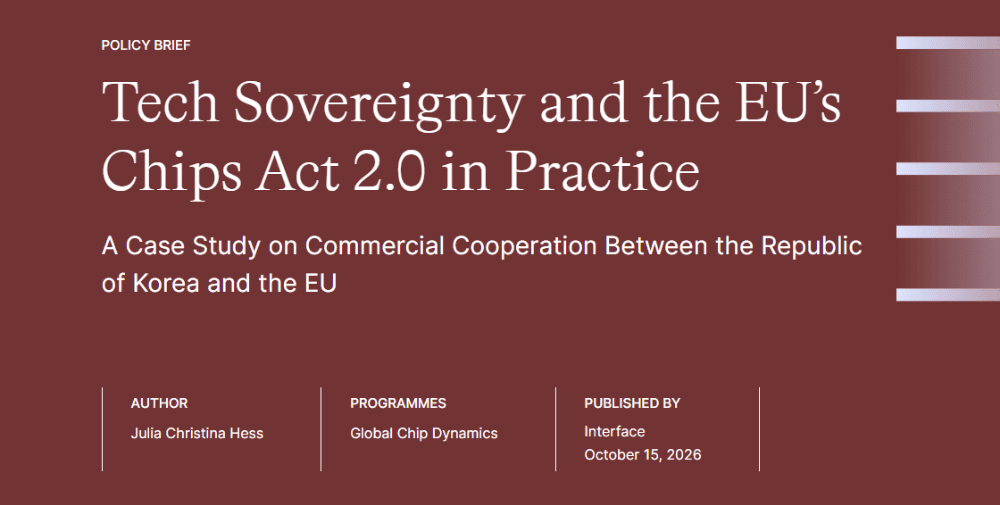
With the EU Chips Act 2.0, Europe aims to strengthen its competitiveness in the semiconductor industry, reduce technological dependencies, and improve its security of supply. In doing so, the European Commission is not relying exclusively on expanding its own production capacities, but increasingly on strategic partnerships with technologically advanced countries. But how can these partnerships be translated into concrete economic cooperation? A new policy paper by the Berlin-based think tank interface examines this question using South Korea as a case study and highlights opportunities, obstacles, and concrete courses of action for Europe.
The analysis takes as its starting point the European Tech Sovereignty Package presented on June 3, 2026, which includes the proposal for the EU Chips Act 2.0. While the first EU Chips Act was primarily aimed at strengthening European semiconductor production and research, its further development is also intended to promote the industrial application of new technologies, demand for European chips, and international cooperation.
At the heart of this is a revised understanding of technological sovereignty: Europe does not need to develop and produce all technologies on its own. Rather, the key is to build on its own strengths, systematically reduce critical dependencies, and structure partnerships in a way that benefits both sides economically and technologically.
A political framework for this already exists in the form of the EU-South Korea Competitiveness Partnership agreed upon in June 2026. The partnership is intended to expand existing cooperation in research and innovation to include trade, investment, economic security, and industrial policy.
The study highlights that Europe and South Korea are positioned differently within the global semiconductor value chain. South Korea is one of the world’s leading production hubs for state-of-the-art logic and memory chips. Samsung and SK hynix, in particular, hold a key position in high-performance memory, which is indispensable for modern AI systems.
Europe, on the other hand, has particular strengths in power semiconductors, analog and mixed-signal chips, microcontrollers, as well as in materials, manufacturing equipment, and research. Companies such as Infineon, Bosch, NXP, ASML, ZEISS, and TRUMPF, as well as research institutions like Fraunhofer, imec, and CEA-Leti, hold important positions on the international stage.
The strength of both regions thus lies in different but complementary areas of the semiconductor value chain. The study’s author, Julia Hess, sees considerable potential for deeper cooperation in this regard.
However, there are differing industrial policy priorities. While Europe aims to attract more international investment, South Korea focuses its semiconductor strategy on expanding domestic production capacity and securing its leading market position.
A look at Germany is particularly revealing. Although Germany has one of Europe’s most important microelectronics hubs in Silicon Saxony, there is as yet no independent bilateral semiconductor partnership with South Korea.
While research collaborations do exist, and a joint funding program for projects in the fields of semiconductors and AI-supported assistive robotics has been in place since August 2026, However, by European standards, other countries are further ahead: The Netherlands has maintained its own semiconductor dialogue with South Korea since 2023, which combines political coordination, research, industrial cooperation, and workforce development.
There are also significant differences in location conditions. According to the comparative data cited in the paper, labor costs for semiconductor manufacturing in Germany are about three to four times higher than in South Korea, electricity costs are two to three times higher, and construction costs are about 20 to 25 percent higher.
The author sees these as major hurdles to new large-scale Korean investments in Europe. Added to this are uncertainties regarding long-term funding opportunities, the demand for state-of-the-art chips, and South Korea’s geopolitical and economic ties to the U.S.
However, this does not mean that European locations are fundamentally unattractive. Silicon Saxony—and in particular the new ESMC plant in Dresden—are explicitly cited in the study as examples of Europe’s industrial strengths and investment potential. According to the report, progress on the ESMC project could send an important signal internationally regarding the attractiveness of Europe as a semiconductor hub.
Based on its analysis, the study identifies three possible development paths for European-South Korean semiconductor cooperation.
1. Continue existing research cooperation
Joint research programs and scientific exchange remain important foundations. However, these alone are hardly sufficient to fulfill the partnership’s new economic policy ambitions.
2. Attract major Korean investments in Europe
A new manufacturing facility by Samsung or SK hynix could significantly strengthen Europe’s position. However, the authors currently assess this step as economically and geopolitically unrealistic. High location costs, differing strategic interests, and unclear market conditions argue against implementation in the short term.
3. Gradually Expand Strategic Cooperation
The paper recommends smaller, concrete cooperation projects as the most promising path, as they create economic benefits, build trust, and ultimately enable larger investments in the long term.
To this end, the study identifies three key areas of action.
Make European strengths more visible
Through a systematic analysis of the semiconductor value chain and the concept of “Semiconductor Regions of Excellence” outlined in the EU Chips Act 2.0, European expertise, locational advantages, and investment opportunities should be better communicated internationally. Existing cluster organizations, such as Silicon Saxony, should also be more closely involved in this effort.
Strengthening the Link Between Policy and Industry
Proposals include a European-South Korean Semiconductor Business Council, joint working groups, and a stronger industry presence at events such as SEMICON Europe and SEMICON Korea. Specific areas of cooperation include sustainable semiconductor technologies, chip design, compound semiconductors, and defense applications.
Accelerating the Transfer of Research into Commercial Applications
Joint research programs should be more strongly focused on future AI hardware, industrial applications, and the so-called “Grand Challenges” of the EU Chips Act 2.0. Joint startups, joint ventures, and targeted investments are intended to facilitate the commercialization of research results.
The study views the EU Chips Act 2.0’s fundamental openness to international partnerships positively. At the same time, it sees a clear need for improvement in practical implementation.
For example, it remains unclear so far in which areas international companies can actually benefit from new European funding instruments. Additional obligations for funded companies—such as sharing information or giving priority to certain suppliers in the event of a crisis—could also deter foreign investors.
Furthermore, international cooperation has so far been only limitedly enshrined in the draft: Of the six planned priority areas for strategic projects, only one is explicitly open to international participation.
The key recommendation is therefore to align strategic partnerships more closely with specific shared economic interests. Europe must communicate more clearly which technologies and investments are particularly desired, what benefits international partners can expect, and how the various political levels should work together.
For European semiconductor regions such as Silicon Saxony, this approach opens up additional opportunities. After all, international competitiveness does not arise solely from new factories, but from the interplay of research, chip design, software, manufacturing, the supply industry, and industrial applications—and ultimately from partnerships that bring these competencies together.
The policy paper “Tech Sovereignty and the EU’s Chips Act 2.0 in Practice – A Case Study on Commercial Cooperation Between the Republic of Korea and the EU” was published on October 15, 2026, by Julia Christina Hess as part of the Global Chip Dynamics research program at the Berlin-based think tank interface. The analysis is based, among other things, on interviews with European and South Korean experts as well as an expert workshop held in Seoul in June 2026.
interface is an independent, nonprofit organization providing technology and policy consulting based in Berlin. It emerged in 2024 from the former Stiftung Neue Verantwortung and focuses, among other things, on semiconductor policy, artificial intelligence, cybersecurity, and digital sovereignty. Its goal is to support political decision-making through independent technological analyses and concrete recommendations for action.
👉 Read the full study: Tech Sovereignty and the EU’s Chips Act 2.0 in Practice
You need to load content from reCAPTCHA to submit the form. Please note that doing so will share data with third-party providers.
More InformationYou are currently viewing a placeholder content from Turnstile. To access the actual content, click the button below. Please note that doing so will share data with third-party providers.
More InformationYou are currently viewing a placeholder content from Facebook. To access the actual content, click the button below. Please note that doing so will share data with third-party providers.
More InformationYou are currently viewing a placeholder content from Google Maps. To access the actual content, click the button below. Please note that doing so will share data with third-party providers.
More InformationYou are currently viewing a placeholder content from OpenStreetMap. To access the actual content, click the button below. Please note that doing so will share data with third-party providers.
More InformationYou are currently viewing a placeholder content from Instagram. To access the actual content, click the button below. Please note that doing so will share data with third-party providers.
More InformationYou are currently viewing a placeholder content from X. To access the actual content, click the button below. Please note that doing so will share data with third-party providers.
More Information