The demand for certain raw materials could rise sharply in the coming years: Future technologies enable the transition to a climate-neutral and digitized economy, but at the same time lead to increasing demand for mineral raw materials. For the fourth time, the study “Raw Materials for Future Technologies” provides valuable insights and recommendations for policymakers, industry, and researchers.
The analysis by Fraunhofer ISI and Fraunhofer IZM for the German Raw Materials Agency (DERA) shows that emerging technologies such as electromobility, artificial intelligence, and renewable energy could lead to significant shifts in global demand for raw materials.
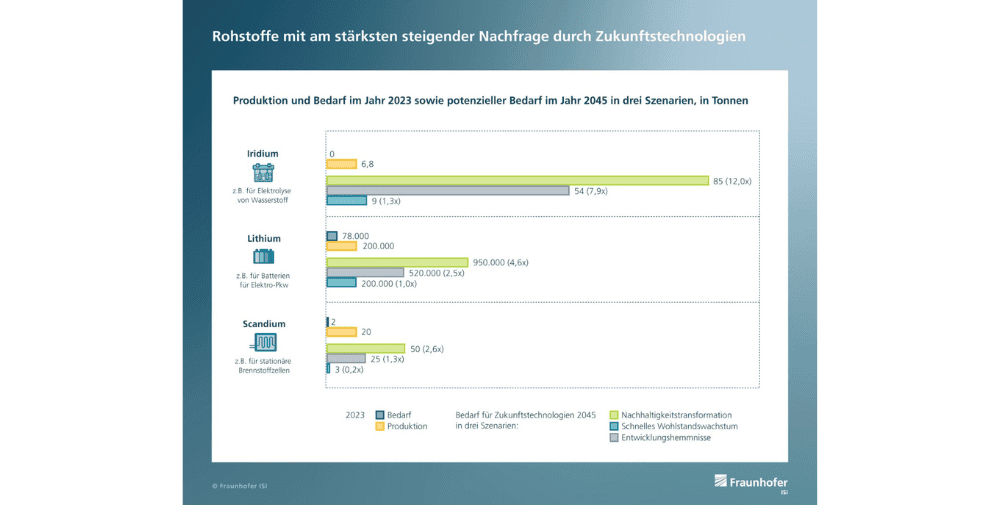
Fraunhofer researchers have determined that by 2045, demand for 34 future technologies under consideration could reach or exceed current global production levels for twelve metals.
Iridium and Lithium Likely to See Stronger Demand in the Future Demand for iridium could rise the most, primarily due to water electrolysis technology. In this process, water is broken down into its components—oxygen and hydrogen—using electrical energy. When using electricity from renewable energy sources, this method of hydrogen production is considered a key technology for the decarbonization of the chemical and steel industries.
Lithium ranks second. Analyses show that the demand for lithium for battery technologies—particularly for electric mobility—could increase fivefold by 2045. This corresponds to a demand for raw materials that is roughly four times higher than today’s global production volume. Scandium follows in third place, driven by high potential demand for stationary fuel cells. In one of the scenarios examined, demand for graphite used in high-performance lithium-ion batteries will also reach a level in 2045 that is significantly higher than global production in 2023.
Wind power, heat pumps, and data centers are driving up demand for raw materials
Other raw materials with potentially rapidly rising demand include the heavy rare earth elements dysprosium and terbium, which are needed for traction motors in electric passenger cars, wind turbines, heat pumps, and air conditioning systems.
Future demand for platinum could also be significantly higher than current total production. This is due to the potential demand for storage media in data centers. Digital technologies, including the further development of AI, are indirectly driving demand for platinum and ruthenium through the global expansion of data centers.
Given the expected growth in data—which could increase a hundred- to a thousand-fold, depending on how things develop—the demand for the raw materials needed to support this is rising significantly. This underscores the need for resilient, sustainable raw material strategies for digital technologies. “Digitalization is always a materialization, and ‘the cloud’ is a technology-based system that actually requires a great deal of raw materials—it’s not some fluffy, light cloud,” says Jana Rückschloss, a research associate at Fraunhofer IZM.
Conclusion: Transformation can only succeed with early-stage raw material policy measures
The analysis of future technologies through 2045 shows that the availability of raw materials will become a decisive factor in the success of the sustainable and digital transformation of the economy and society.
From the researchers’ perspective, measures are needed to secure raw materials, such as diversifying and securing supply chains, increasing efficiency in the manufacture and use of products, expanding the circular economy with more recycling, and developing new methods for substituting certain materials. Raw materials should be taken into account early on in the development of new technologies, for example in material selection and design.
“Our analysis does not present a forecast, but rather possible development paths,” emphasizes Dr. Sabine Langkau, head of the Sustainability Innovations and Policy division at Fraunhofer ISI. “The study can be understood as an early-warning tool that makes one thing clear: We need a strategic industrial and raw materials policy that secures the raw materials base for future technologies with foresight, so that we do not have to react to supply bottlenecks and price increases in the short term.”
Study Methodology
The study analyzed the impacts of 34 technologies for which exceptional demand growth is expected by 2045. The future technologies examined span the fields of mobility, aerospace, digitalization, power and data networks, as well as energy technologies and decarbonization. All technologies were analyzed across three scenarios to cover a wide range of possible future developments:
- In the “Sustainability Transformation” scenario, ambitious climate and environmental protection targets are met.
- The “Rapid Growth in Prosperity” scenario examines the effects of a development focused on consumption and economic growth without efforts toward environmental and climate protection.
- The “Development Barriers” scenario explores, against a backdrop of global tensions, how regional rivalry and a lack of international cooperation play out.
Future raw material requirements were determined for all technologies across the various scenarios. The Fraunhofer researchers then compared the projected demand for 2045 with raw material production in 2023.
Background on the Study
The new study updates the findings from the 2009, 2016, and 2021 studies, which were also conducted using the same study design. The study is an important component of the DERA Raw Materials Monitoring program, which is mentioned in the German federal government’s 2010 Raw Materials Strategy and has been implemented ever since. The two Fraunhofer Institutes combine expertise in applied research and future studies and possess interdisciplinary knowledge spanning a wide range of technologies. A preliminary version of the study is available for download; a final version will follow in the coming weeks.
About Fraunhofer ISI
The Fraunhofer Institute for Systems and Innovation Research ISI analyzes the emergence and impacts of innovations. We investigate the short- and long-term developments of innovation processes and the societal impacts of new technologies and services. Based on this, we provide our clients from business, politics, and academia with recommendations for action and perspectives to inform important decisions. Our expertise lies in our solid scientific competence as well as an interdisciplinary and systemic research approach.
– – – – –
Further Links
👉 www.izm.fraunhofer.de
Photo: Fraunhofer ISI