Neodymium magnets are among the strongest permanent magnets in the world. The compound of neodymium, iron, and boron is used in electric vehicles, as well as in wind turbines and electronic products such as speakers, smartphones, and hard drives. Global demand for permanent magnets is rising. According to estimates, the annual growth rate is as high as 8.3 percent. Therefore, it is important to recycle hard-to-obtain rare earth elements such as neodymium, although this is a very complex process.
Closing Material Loops, Securing the Raw Material Base
In order to reuse neodymium for new magnets, a very high level of purity is required. Establishing a process that meets this requirement while remaining economically viable is challenging. As a result, magnets are currently rarely recycled in Europe; instead, they are usually collected, sent to China, and reprocessed there. About 90 percent of materials such as neodymium are subsequently reimported.
As part of the EU project NEO-CYCLE, Dr. Sandra Pavón and her project partners are now developing processes that will allow valuable raw materials to be extracted in Europe as well: “We want to recover rare earth elements from electronic waste and use them for high-quality products such as green fertilizer or in the manufacture of pharmaceutical products,” explains the head of the Hydrometallurgical Recycling and Raw Materials Chemistry group at Fraunhofer IKTS in Freiberg. “This allows us to create a material cycle, protect the environment, and also promote global independence from strategic resources.”
Sustainable Production of High-Quality Products
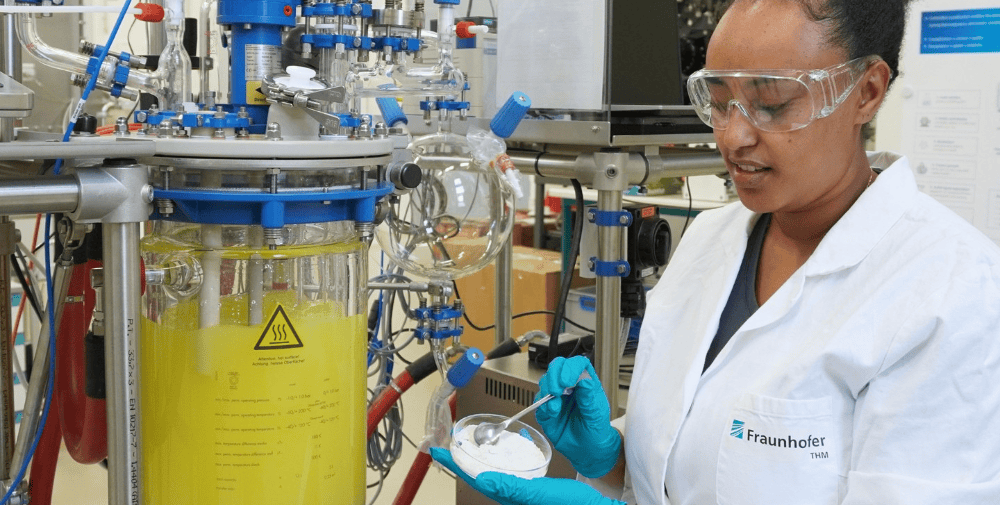
The upcycling process is applicable to various types of magnets. The NEO-CYCLE project focuses on hard disk drives (HDDs)—that is, hard drives from discarded computers and laptops that contain neodymium magnets. “We are testing two processing methods for magnets—solid-state chlorination and electrochemical processes—to subsequently identify the optimal technology,” explains Sandra Pavón.
In the solid-state chlorination process, carried out by project partner TU Bergakademie Freiberg, the neodymiumboron-iron mixture from the HDD waste is treated with ammonium chloride—instead of conventional hydrochloric acid—and converted directly into metal chlorides and a high-purity ammonia solution through a thermal process. The process is already patented and is currently used for fluorescent lamps. Now the researchers are testing whether this approach is also ideal for the upcycling of magnets. The results show that metal chlorides can be extracted from the magnetic material much more efficiently, resulting in nearly complete extraction of the metals with comparatively low chemical consumption.
In the second process tested, the researchers introduce powdered magnet waste into an electrochemical cell. An electrolyte such as diluted sulfuric acid serves as the reaction medium for the electrochemical processes. A boron solution is first extracted from the magnets, which is later concentrated. The solution can be used in both the chemical and pharmaceutical industries.
The researchers at Fraunhofer IKTS then further separate the products obtained from the two processes, drawing on their expertise in metal separation and process water treatment. Sandra Pavón and her team use a selective hydrometallurgical process to first extract neodymium and iron. The metal salts can then be recovered in their pure form. The separated materials are further valorized by the project partners and made available not only to the chemical and pharmaceutical industries but also to sectors such as the hydrogen economy and the fertilizer industry.
Aiming for a Zero-Waste Concept
The NEO-CYCLE project is funded by the European Union as part of the Horizon Europe program. NEO-CYCLE will run for a total of four years, and a pilot plant is already planned. Sandra Pavón is fascinated: “The process begins with products that have reached the end of their life cycle; by the end, we can supply four different industrial sectors with valuable, recycled raw materials.”
– – – – –
Related Links
👉 www.ikts.fraunhofer.de
Photo: Fraunhofer IKTS