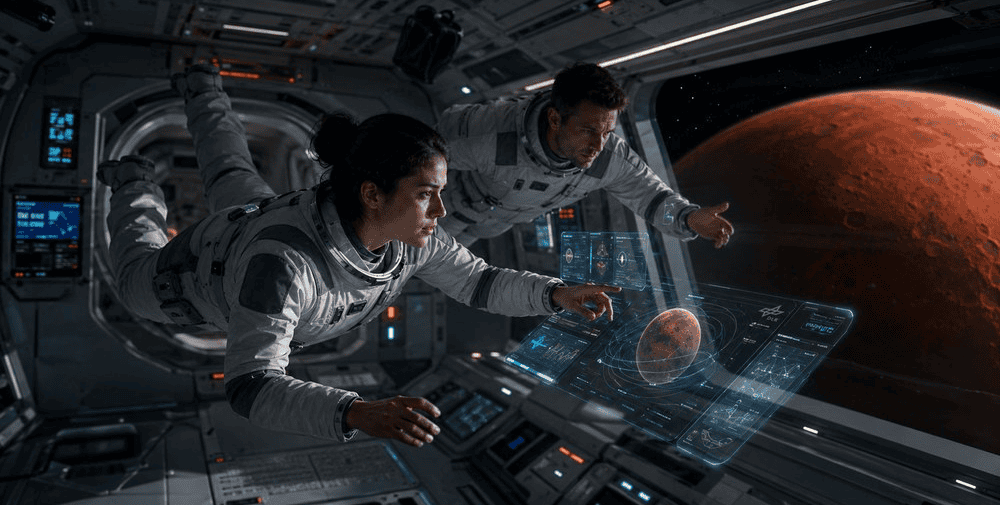
Through GSOC, for example, DLR supports—on behalf of the European Space Agency (ESA)—the operation of the Columbus module on the International Space Station (ISS), which is the European segment of the ISS. At the control center, telemetry data is received, systems are monitored, procedures are carried out, communication with the crew is maintained, their activities are planned, commands are prepared, maintenance routines are initiated, and anomalies on board are assessed. METIS is now set to take over this interplay of technology, experience, human interaction between space and the ground, control systems, and decision-making in the far reaches of space.
“METIS is a concept for an intelligent assistance system that we are developing at the Columbus Control Center in collaboration with our industry partner, System Vertrieb Alexander SVA GmbH,” says Carsten Hartmann, who heads the METIS project for the DLR’s Space Operations and Astronaut Training division. “The system is designed to learn how spaceflight operations are currently conducted from control centers—and to derive tools for operating future missions from that knowledge. In the future, METIS is intended to be deployed directly on board spacecraft to support the crews. What makes METIS special is its close connection to real-world practice. METIS is not based on abstract data sets, but on actual spaceflight operations, for which data, knowledge, and experience have been gathered at GSOC over many years.”
Relieving the burden on and supporting people in space when there is no real-time contact with Earth
This need arises from the next steps facing human spaceflight today. Since the beginning of crewed spaceflight, people have been working in near-Earth orbit on space stations or between Earth and the Moon. In all these missions, Earth is close enough to allow for rapid communication with control centers, as signal propagation times enable real-time dialogue or communication with slight delays of just a few seconds. For future missions beyond lunar orbit, this will no longer be the case. On Mars missions, for example, a radio signal can take up to 23 minutes to travel one way. A response may therefore not be received for up to 46 minutes. In critical situations, that is too late.
Complete Self-Sufficiency in Deep Space – A Paradigm Shift in Manned Spaceflight
The fact that future crews beyond the Moon will have to act independently is a first. This self-sufficiency on space missions is to be achieved through smart systems that analyze data, control routine operations, make suggestions, and prepare decisions. METIS is not a program that simply “takes over control.”
The basic idea is to design the system as a multi-agent system. The concept is based on human decision-making, the so-called OODA loop: observe, orient, decide, act. A monitoring agent monitors a vast number of parameters related to the spacecraft’s status. A reasoning agent evaluates anomalies and suggests actions to resolve them. A planning agent reviews and modifies procedures during ongoing operations. A commanding agent supports the preparation and execution of commands.
The Columbus module of the ISS serves as inspiration for METIS and provides, for example, operational logic, procedures, historical telemetry, and documented anomalies. Added to this is the experiential knowledge of the flight controllers. They not only evaluate individual measurement values but also understand what a value means in the context of an activity, a system configuration, or a previous deviation, and can react accordingly. All of this forms the vast database used to train METIS.
To gain the necessary situational awareness, the telemetry data archived over decades is particularly valuable. Accurately assessing a situation is highly complex, especially in the closed, high-tech environment of a spacecraft. This complexity is one of the greatest challenges for autonomous assistance systems. For example, a temperature reading might be unremarkable—or it could indicate a serious problem. A delay in the daily schedule might be harmless—or it could have implications for other activities aboard a spacecraft and for safety. An alarm may indicate a genuine anomaly—or be triggered by a routine functional test. In the future, METIS will identify such correlations more quickly and make them transparent to astronauts.
Transparency—the key to people’s trust in AI assistance
No matter how quickly an assistance system delivers results, Whether these results are assessed as reliable or as a strange “AI hallucination” in a specific case depends crucially on people’s prior experiences with their virtual assistants. Even before an—perhaps critical—incident occurs, the AI must prove that it is trustworthy and reliable. This requires a longer period of interaction beforehand, with maximum transparency regarding the “machine’s” output at all times. That is why its traceability is a central component of the METIS architecture. The assistance system must always be able to explain why it assesses a situation in a certain way. It must also know its limits and always allow for human intervention. After all, the goal is to avoid creating a “HAL 9000”—like the one in Kubrick’s film—that can ignore the crew’s instructions.
METIS is not yet an operational system for ongoing spaceflight operations, but rather consists of ground-based prototypes. So far, the system has been tested on the Columbus simulator on the ground. There, activities, telemetry, and anomalies can be examined without interfering with actual operations in Earth orbit. This fundamentally shapes the philosophy of space research: New systems must be tested, validated, and understood step by step before they can take on safety-critical tasks. The METIS team’s goal is to test the system on the International Space Station (ISS)—and thus in the real-world environment of an astronautical space mission—as soon as it has reached the appropriate level of technological maturity.
DLR Space Research at the German Space Operations Center (GSOC)
An assistance system like METIS demonstrates the potential of research activities at the German Space Operations Center (GSOC). There, the DLR bridges two worlds: Experience gained from operations on the ISS continually generates new ideas and knowledge for technologies and mission concepts that can significantly advance crewed spaceflight in the 2030s—from the Moon to Mars and beyond.
– – – – –
Further Links
👉 www.dlr.de
Photo: ChatGPT/OpenAI, edited by DLR