AI Accelerates, But Does Not Replace Understanding
The central question is not: Can AI build this? But rather: Can we justify the result from a professional and technical standpoint?
Unreflective use of AI tempts us to jump straight to the solution. A prompt, a plausible result, and then straight to the next step. This may feel productive at first. But assumptions often go unspoken, edge cases are identified too late, and important knowledge is confined to the chat histories of individual people.
This is particularly problematic in teams. Code must remain understandable, maintainable, and reviewable even later on. Developers continue to bear responsibility for architecture, quality, and the implications of a change.
What Is Spec-Driven Development?
Spec-Driven Development, or SDD for short, is neither a rigid template nor a new programming language. It’s a way of working: first, understand and document the problem, the target state, and the constraints. The implementation is then consistently aligned with these.
The specification is not a document that is written once and then filed away. It accompanies the entire process. It captures goals, technical guidelines, open questions, decisions, and test ideas.
This makes it a shared working foundation, both for the development team and for collaboration with AI. Instead of relying solely on a chat history as context, a traceable artifact is created that all stakeholders can refer to.
Understand First, Then Implement
A practical SDD workflow can be broken down into five steps:
- First, we analyze the ticket, the business context, the existing code, and the potential impacts of a change. AI can help here by structuring relationships and making unfamiliar code easier to understand.
- Next, we define the target state: What should change, what must not be changed, and which risks are we unwilling to accept?
- Open questions are deliberately collected and clarified. Otherwise, AI will tacitly answer unanswered questions with assumptions. Test ideas should already be included in this phase because they reveal misunderstandings early on.
- Only then is code written. The specification provides the context, boundaries, and clear test criteria for this. Implementation and review are deliberately carried out in small, traceable steps.
- Finally, we check the code against the specification again. Does it meet the goals? Does it stay within the boundaries? Have tests and edge cases been taken into account? And above all: Can we explain the solution to a colleague?
Celebrating together is part of it
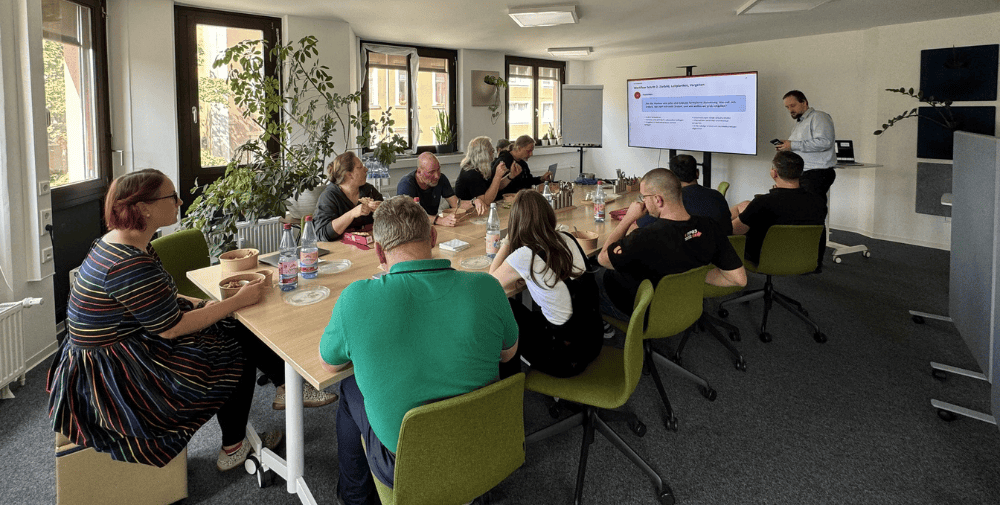
In addition to the technical exchange, there was also a special occasion: A team member celebrated their ten-year anniversary at Davitec. Of course, the Davitec muffins were a must—a lovely setting for shared conversations and a thank-you for their long-standing commitment.
Good AI code remains explainable
Spec-Driven Development doesn’t slow down development. It shifts the focus to where it belongs: before implementation and toward the deliberate verification of results.
AI is powerful when it comes to analysis, structuring, and acceleration. The specification ensures that this power can be harnessed and verified by the team. This way, a quick AI suggestion doesn’t become a magical black box, but rather a solution that can be justified both functionally and technically.
If you’d like to try out this approach, Spec Kit and OpenSpec provide the first tools for structured specification workflows. However, what matters most isn’t the tool, but the mindset behind it: understand first, then build.
– – – – –
Further Links
👉 www.davitec.de
Photo: Davitec