Gartner predicts that by 2027, more than half of the generative AI models used in enterprises will be developed for a specific industry or function rather than for general purposes—which benefits MES providers who actually understand manufacturing and not just AI.
But Gartner also makes it clear where the catch lies: Only about one-third of MES providers can currently demonstrate that AI is actually being used in a real production environment. Talking about AI is easy. Implementing it in manufacturing in a way that operators trust it and use it every day is the hard part.
That’s why I was pleased that Critical Manufacturing was once again named in this year’s Market Guide as one of the world’s most relevant MES providers and among the most advanced in the field of AI. But the recognition isn’t really the point. Put simply, it comes down to this: We’ve built the platform so that AI can work in a real manufacturing context—and not just as a chatbot sitting on a few dashboards.
AI in Manufacturing Needs a Strong MES Foundation
Manufacturing companies are interested in AI, and they’re right to be cautious about it. What they need is AI they can trust and actually use day in and day out—not just a demo. It must solve real problems for the people on the shop floor: operators, engineers, foremen, and production managers. If it doesn’t, it has no place there.
That’s the standard we’ve been working toward, and most of the work takes place beneath the AI, not within it. Our MES already handles truly complex production environments, tracks what’s happening on the shop floor down to the individual work step, detects deviations immediately as they occur, and works with live data rather than a snapshot from an hour ago.
The AI sits on top of that. And we’ve integrated it incrementally, rather than all at once: first machine learning and generative AI to help people understand their data, then more agent-based AI that can take on parts of a task on its own by thinking about what’s happening—not just retrieving data. That’s roughly the direction the market is heading, according to Gartner—which is reassuring, because that’s exactly the path we’ve been on for some time now.
True innovation lies in data access, not in AI
The most interesting change I’ve observed isn’t what AI can calculate. It’s about who is even allowed to ask the question. For years, retrieving an answer from the MES meant navigating a complex user interface, waiting for a dashboard that someone had created in advance, or asking a specialist to retrieve the data for you. The information was there. What was missing was access to it.
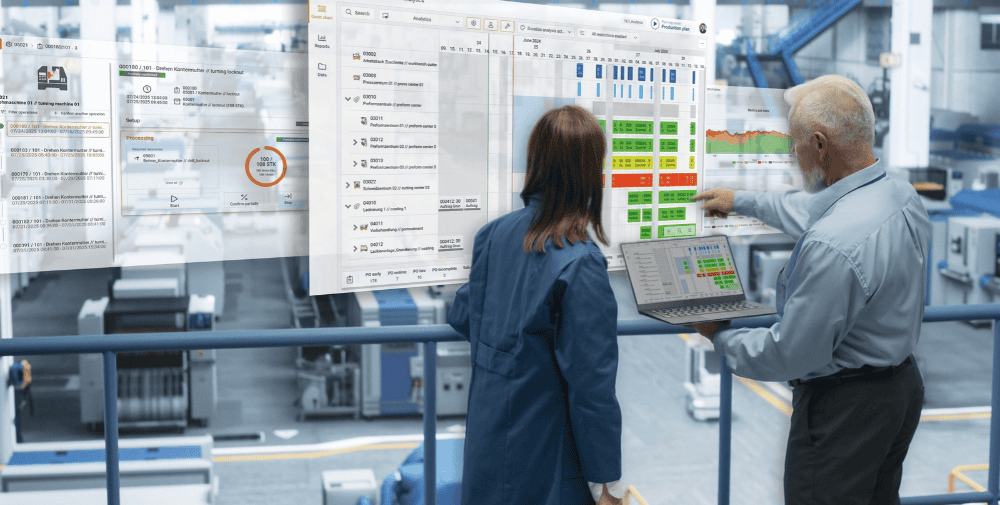
That’s exactly what AI copilots are for: not by simply attaching a chat window to the MES, but by enabling users to interact with the system in plain language. With the Analytics Copilot, users can query production data and create charts and dashboards themselves—without any special technical knowledge. A production manager can ask: “What were the main causes of downtime yesterday?” and receive a specific answer within seconds, instead of having to create a ticket and wait in a queue.
The MES Copilot does the same for operators directly within the MES they’re already using: It helps them find information, follow procedures, and complete their work independently—based on real, reliable data rather than guesswork. The added value doesn’t lie in the AI itself. It lies in what ceases to be a bottleneck once the AI is in place.
The true test comes after the AI is implemented
The toughest test for AI in manufacturing isn’t the proof of concept. The real test is whether it’s still being used three months later—during a regular shift, without anyone watching.
That’s the standard by which we measure our own use cases: summarizing documents, assisting with maintenance by sifting through manuals, creating shift handoff reports, consolidating performance data and logbook entries, automatically comparing document and bill of materials versions, and identifying scrap trends.
None of these tasks will win any awards for their ambition. But every single one saves real time for real people every day. When AI works this way, it doesn’t replace on-site expertise. Rather, it eliminates the associated friction
Nothing works without trust
None of this matters if manufacturers cannot trust the system, and Gartner rightly places transparency, governance, and observability at the center of the discussion. Manufacturers need to know how AI is being used, where their data is flowing, and whether a recommendation can be explained and verified—especially in high-risk, regulated environments.
For us, this is integrated into how the system works and isn’t just codified in a policy and left at that. Customer data is never used to train third-party models and is processed only at the exact moment an AI query is actually made. Manufacturers shouldn’t have to give up control in order to gain innovation. They should have both.
Where AI Is Headed in Manufacturing
Recognition from Gartner is a nice milestone, but not really the main point. The main point is that MES has outgrown its old job description. Execution, transparency, and control—all of these remain important, but they now form the foundation, not the ceiling. What is being built on this foundation is ultimately the same small shift we started with: from searching for an answer to simply asking the question, in order to ultimately reach the manufacturing level.
The benefit isn’t just a smarter system. It’s the operator, the engineer, and the production manager who receive the answer they would have previously waited days for—and who can thereby make a better decision, not just a faster one. That’s the change that matters. Not smarter software for its own sake, but more people on the shop floor who get the answers they need when they need them.
– – – – –
Related Links
👉 www.criticalmanufacturing.com
Photo: unsplash