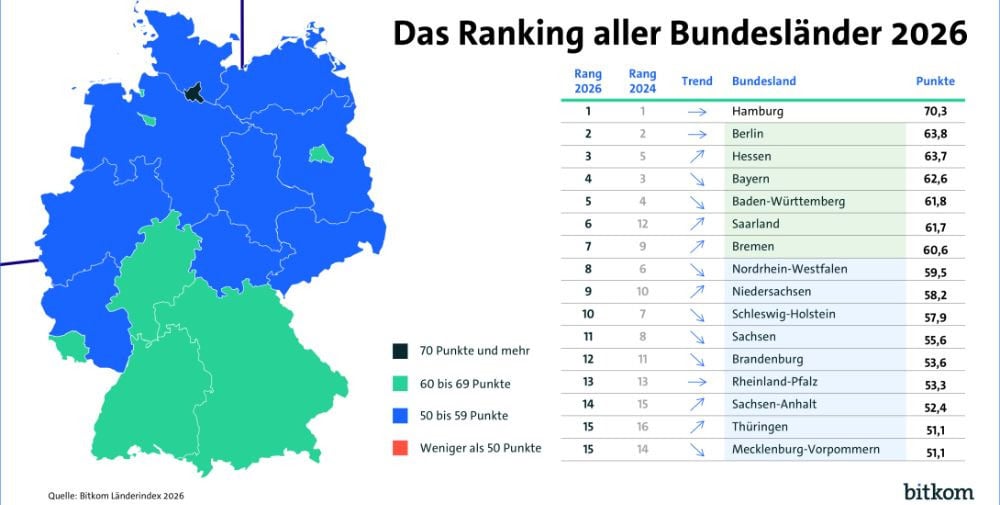
With 70.3 out of a possible 100 points, Hamburg is once again in first place by a clear margin, followed by Berlin with 63.8 points and Hesse with 63.7 points. Bavaria achieved 62.6 points, putting it in 4th place, followed by Baden-Württemberg in 5th place with 61.8 points. Saarland improved particularly strongly, moving up from 12th place in the 2024 state index to 6th place this year. At the bottom of the ranking are Saxony-Anhalt (52.4 points), Thuringia (51.1 points) and Mecklenburg-Western Pomerania (51.1 points), which share 15th place. “The Bitkom State Index shows how digitization can succeed in Germany’s regions. Some federal states benefit from strong economic and structural conditions, while others are catching up with smart political decisions and targeted investments,” says Bitkom President Dr. Ralf Wintergerst. “It is crucial that digitalization is strategically managed, vigorously implemented and anchored across the board – in administration, business, infrastructure and education.”
For the state index, Bitkom experts surveyed all 16 state governments and evaluated numerous official statistics and third-party studies. In addition, Bitkom Research conducted an empirical survey of more than 5,600 citizens, which provides representative results for all countries. The results are incorporated into a total of four categories with 30 indicators. Wintergerst: “The country index makes it clear where countries are making progress, where they have deficits and how differently their digital strengths are developed. This comparability is crucial in order to identify success stories, learn from each other and accelerate digitalization where the opportunities are greatest.”
Hamburg scores particularly well in economy and infrastructure
Leader Hamburg is not only in first place in the overall ranking, but also in the categories digital economy and digital infrastructure. Hamburg is ranked 3rd in Governance & Administration and 5th in Digital Society, with particularly strong scores for fiber optic and gigabit coverage as well as the proportion of IT companies and IT specialists. Berlin is in second place and scores particularly well with its digital economy. The high number of start-ups in the capital and the strong presence of IT companies are the main reasons for this. Hesse improved from 5th to 3rd place in the overall ranking and took first place nationwide for Governance & Administration and 2nd place for Digital Infrastructure. The outstandingly high data center performance in the Frankfurt/Main region has a particular impact here.
Saarland is the biggest climber
Saarland shows the most striking development in this year’s ranking. The state improved from 12th to 6th place in the overall ranking and even achieved 1st place in the Digital Society category. This is mainly due to strong scores in digital education: There are at least six compulsory hours of computer science in all types of schools, and 5 percent of teachers there teach computer science – the national average so far is only 3 percent. In terms of digital infrastructure, the smallest territorial state also has the highest level of gigabit coverage in schools. “Saarland is an example of how digital progress does not depend solely on size and budget. Those who make targeted investments in digital education and set political priorities can quickly move digitalization forward,” says Wintergerst.
Digital strengths are distributed very differently from region to region
The Länderindex 2026 also shows how differently strengths and weaknesses are distributed in the four major areas of digitalization. In the digital infrastructure category, the northern states – Hamburg, Bremen, Schleswig-Holstein and Lower Saxony – are in the lead. They are above average when it comes to fiber optic and gigabit networks. On the other hand, the south scores well in the digital economy and is only outperformed here by Hamburg and Berlin.
In turn, the eastern German states are successfully implementing measures for digital participation and education. In the Digital Society category, Mecklenburg-Western Pomerania is in second place, Saxony in third place and Thuringia in fourth place – although these states are significantly further down in the overall ranking. This is mainly due to digital education: In Mecklenburg-Western Pomerania, there are six compulsory hours of computer science at all types of schools, while in Saxony, 9 percent of teachers teach computer science. “With its activities in digital education, the East is laying the foundations for a stronger digital economy in the region in the future,” says Wintergerst.
What digital pioneers have in common
Digitally strong countries often have structural advantages such as a generally above-average economic performance, a high population density and a strong corporate and university landscape with high levels of investment in research and development. In addition, there are political and institutional factors such as an independent digital ministry, a digital cabinet, a digital check for new laws or a digital strategy with a public progress report. In order to move forward digitally, Bitkom recommends, among other things, introducing computer science as a compulsory subject from secondary school level I, expanding further training opportunities for teachers and creating offers to promote digital skills, for example in libraries or adult education centers. The administration needs an accelerated budget for digital measures and more speed in the implementation of the Online Access Act. Wintergerst: “In order for the administration in Germany to function better digitally, the federal and state governments must also work together more closely in terms of technology. Above all, the federal states should learn more from each other. If each state builds its own system, it will be complicated, expensive and slow.” The fact that the federal states have committed to the Deutschland-Stack could give digital administration a boost. “The Germany Stack has what it takes to put administration on a common, modern digital footing,” says Wintergerst.
At the same time, the federal states can already use existing scope to make digital progress. As part of the federal modernization agenda, the federal and state governments have agreed to reduce reporting obligations for companies, among other things. Wintergerst: “This will allow the federal states to get started straight away and directly relieve the local economy.” The same applies to the expansion of mobile communications: the federal government has already created the conditions for faster construction of new masts. Wintergerst: “The results of the state index show that Digitalization can be shaped. Where priorities are set, responsibilities are bundled and measures are consistently implemented, digital movement comes into the country. This is precisely where the opportunity lies for all federal states.”
– – – – – –
Further links
👉 www.bitkom.org
Graphic: Bitkom