At the same time, international competition is intensifying significantly: While Germany is expanding the capacity of its data centers to 5 gigawatts by 2030 and to just under 10 gigawatts by 2035, the United States is expected to reach 160 gigawatts and China 90 gigawatts. Europe as a whole is projected to reach 37 gigawatts by 2035. These are the findings of the latest Bitkom study, “Data Centers in Germany 2026: Figures, Trends, and Outlook in an International Comparison.” According to the study, the U.S. will already have approximately 47 gigawatts of data center capacity by 2025, and China will have 22 gigawatts. “The competition in AI is also a competition for computing power. Those who fall behind in infrastructure will quickly lose ground in AI as well. Germany is Europe’s largest data center hub, but the U.S. and China are expanding their capacities on an entirely different scale,” says Bitkom President Dr. Ralf Wintergerst. “We must therefore massively improve the investment conditions for data centers: with affordable electricity, suitable sites, and much faster planning and approval processes.”
According to a survey of data center operators and experts conducted as part of the study, a specific profile is emerging for Germany as an AI hub: 68 percent of respondents expect that primarily smaller AI models will be trained here, 54 percent view research institutions as an important driver of AI development, and 46 percent expect Germany to play a special role in new applications in the field of “Industrial AI.” This refers to the use of AI in machines, equipment, and industrial processes. The cloud is also fueling the German data center market. The capacity of cloud data centers is projected to rise from approximately 1,900 megawatts in 2026 to 3,258 megawatts in 2030 and 6,017 megawatts in 2035.
Data center capacity has doubled over the past 10 years
According to a Bitkom study, there are currently just over 2,000 data centers in Germany with a connected load of more than 100 kilowatts, including around 100 large data centers with a capacity of more than 5 megawatts. Total IT connected capacity in Germany will have risen by about 9 percent to 2,980 megawatts by 2025 and will reach 3,300 megawatts as early as 2026. This means that the computing power available in Germany has nearly doubled over the past ten years, up from 1,660 megawatts in 2015. Large data centers with more than 5 megawatts now account for 52 percent of the total IT connected load.
Investments at Record Levels
Investments in data centers will increase by 57 percent in 2026, reaching a record level of 23.5 billion euros. In 2025, total investments in data centers stood at just 15 billion euros, and in 2024 at 12.9 billion euros. Currently, approximately 5.5 billion euros are allocated to investments in buildings and building systems—up from 3 billion euros in 2025 and 2.9 billion euros in 2024. Investments in IT hardware, such as servers and storage, will reach approximately 18 billion euros in 2026, up from 12 billion euros the previous year and 10 billion euros in 2024. Wintergerst: “Every year, the business sector invests tens of billions of euros in Germany’s digital infrastructure,” says Wintergerst. “To ensure that Germany can keep pace with the competition and attract further investment, the business environment must be improved.”
Hesse Remains the Number One Data Center Location
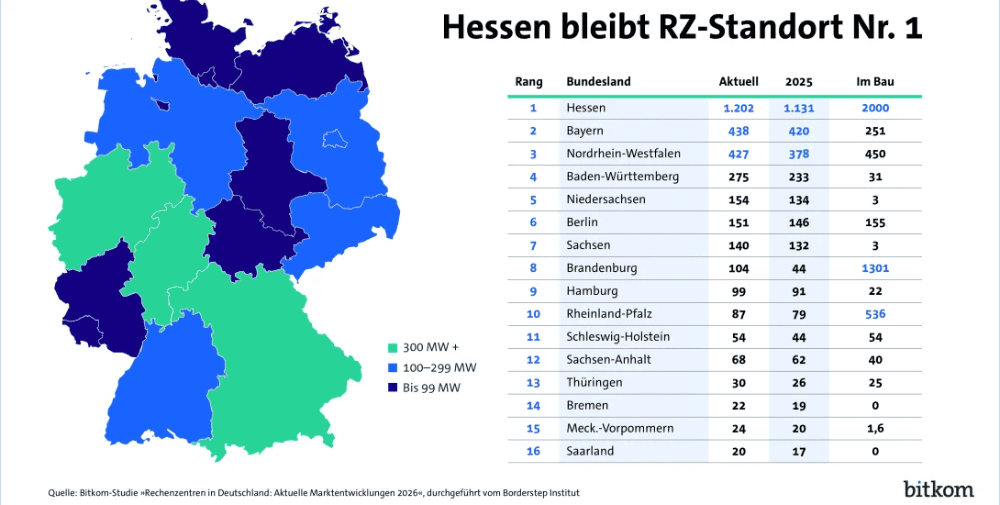
Hesse remains by far the largest data center location in Germany. Currently, the data centers there have an IT connected load of approximately 1,200 megawatts. Bavaria follows in second place with approximately 440 megawatts, and North Rhine-Westphalia in third with approximately 390 megawatts—both trailing by a significant margin. Hesse is also leading the way in further expansion: 2,000 megawatts of additional data center capacity is currently under construction in the state. The rising star is Brandenburg, with 1,301 megawatts of capacity under construction (currently: approx. 104 MW), followed at a considerable distance by North Rhine-Westphalia with 450 megawatts. “The Frankfurt-Rhine-Main region is the heart of Germany’s data center landscape, while at the same time new key regions are emerging in northern Germany. The high density of data centers makes Hesse an important location for digital business models and has attracted an entire ecosystem of companies, network operators, and cloud and IT service providers,” emphasizes Bitkom President Dr. Ralf Wintergerst. “For municipalities and regions, it can therefore be worthwhile to view data centers not only as energy consumers but also as the core of a digital industry.”
Germany Is Europe’s Largest Data Center Hub
By European standards, Germany continues to lead in data center capacity. By 2026, data centers in Germany will have approximately 3.3 gigawatts of IT connected load, followed by the United Kingdom with 2.9 gigawatts, France with 2.0 gigawatts, and Ireland with 1.7 gigawatts. By 2030, Germany is expected to reach approximately 5.5 gigawatts, while the United Kingdom is projected to reach 4.0 gigawatts.
Data centers are becoming more efficient, yet energy demand continues to rise
The growing demand for computing power is also reflected in energy consumption, albeit to a lesser extent. Data centers and smaller IT installations in Germany will require approximately 23 billion kilowatt-hours of electricity in 2026. Bitkom forecasts energy demand of 35 to 38 billion kilowatt-hours for 2030 and 56 to 70 billion kilowatt-hours for 2035. Energy efficiency has already improved significantly over the past decade and is expected to continue improving in the future. For example, the average PUE value of German data centers fell from 1.63 in 2020 to 1.42 in 2026. This metric describes the ratio of a data center’s total energy consumption to the energy consumption of its IT systems. As a result, the additional energy required for cooling and other infrastructure has decreased by about one-third relative to IT energy consumption. Significant progress has also been made in IT hardware: Modern servers are up to three times more energy-efficient than systems from 2021.
At the same time, progress has been made in water efficiency: According to the study, 65 percent of data centers in Germany have very low direct water consumption of no more than 0.1 liters per kilowatt-hour of connected load. The so-called WUE value (Water Usage Effectiveness)—the ratio of water consumption to energy consumption of IT equipment—has fallen from 0.55 in 2023 to 0.4 in 2025 for data centers in Germany listed in the EU register. “It is in the operators’ own interest to keep the resource consumption of their data centers as low as possible. Efficiency is therefore becoming increasingly important as power density rises and electricity demand grows,” says Wintergerst.
Expansion Falls Short of Political Goals
Despite dynamic growth, Germany could fall short of its own political goals when it comes to expanding its data centers. The current trend forecast for 2030 is 5,500 megawatts of connected capacity, while the federal government has set a goal of doubling capacity—an approximate expansion target of 6,000 megawatts. According to the forecast, this leaves a shortfall of approximately 500 megawatts—or about eight percent—to reach the political target. The data center industry’s assessment of the data center strategy is mixed: 66 percent view the strategy as positive for Germany as a business location. However, only 33 percent consider the expansion targets sufficiently ambitious, and just 20 percent expect rapid implementation.
Bitkom Calls for Better Framework Conditions
For Germany to meet the growing demand for computing power and maintain its position as Europe’s leading data center location, it needs better framework conditions for investment and further expansion. These include a reliable power supply at competitive prices, accelerated expansion of the power grids, and more efficient allocation of existing grid connection capacities. In addition, suitable sites for data centers must be specifically designated, and planning and permitting procedures must be simplified, digitized, and accelerated. At the same time, expansion must be designed to be sustainable. This requires ambitious yet practical and European-harmonized standards for energy efficiency and waste heat utilization. In particular, the Energy Efficiency Act must take into account the actual scope of influence that data center operators have. To strengthen waste heat utilization, it must be better integrated into municipal heat planning and made more economically attractive to potential consumers. A holistic approach is also needed for water consumption, one that supports water-saving cooling technologies and takes into account the interplay between water and energy consumption. . Bitkom President Dr. Ralf Wintergerst: “Data centers form the infrastructural foundation for a digital Germany. They enable not only digital business models, industrial transformation, the cloud, and AI, but also work, communication, streaming, and many public and private services. Data centers are of paramount importance for a digitally capable, sovereign, and secure Germany. Policy makers at the federal, state, and local levels must recognize the importance of data centers even more strongly—in their economic policy, but also in energy policy and urban planning.”
– – – – –
Further Links
👉 www.bitkom.org
Graphic: Bitkom