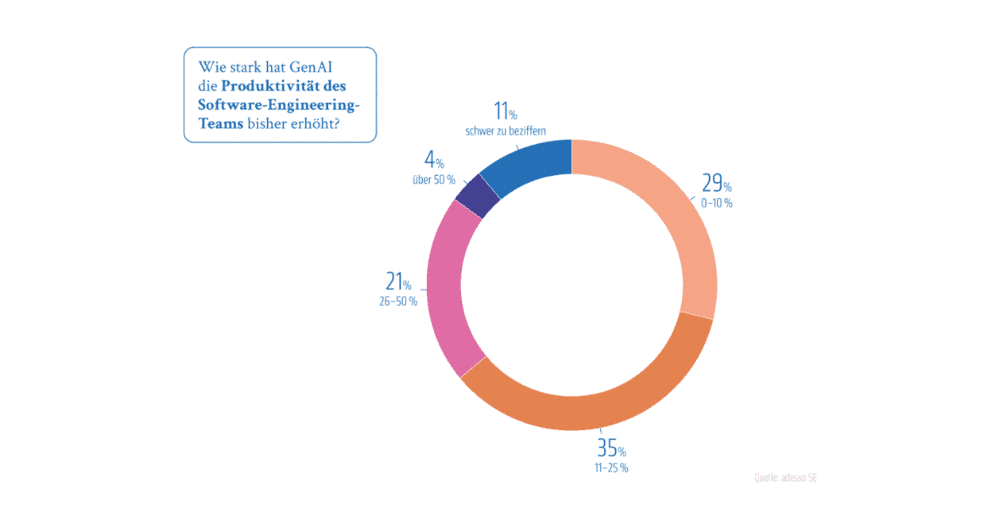
59 percent of the companies surveyed are already using agent-based systems that independently generate, test, and optimize code. On average, they report a 21 percent increase in productivity. However, this average masks considerable variation: As the overarching GenAI Impact Report Germany 2026 shows, organizational maturity determines who benefits and who does not. One-third of companies with a low level of AI maturity see no measurable return. Those that adopt AI in a structured manner and launch initial initiatives with clear processes achieve tangible results 93 percent of the time. The difference lies not in the tools, but in the organization.
“The question is no longer whether AI is used in software development, but whether companies are creating the conditions to benefit from it,” says Benedikt Bonnmann, member of the Executive Board of adesso SE. “What we see in our projects—and what the study confirms—is that companies that incorporate governance, clear processes, and the right guidelines achieve measurably better results. This creates the foundation for truly scaling agent-based development. Those who ignore this are not investing sustainably.”
Governance as an Enabler, Not a Hindrance
The findings on governance are particularly revealing: 49 percent of companies have no or only a few guidelines for the use of AI in software development. Companies without clear rules are three times less likely to conduct pilot projects than companies with guidelines. Governance is often viewed as a bureaucratic hurdle, but in practice it proves to be a prerequisite for speed.
The biggest obstacles cited by companies confirm this pattern: At 38 percent, compliance and security rank first, followed by a lack of skills (34 percent) and insufficient acceptance (25 percent). Technical factors such as toolchain complexity or legacy architectures, on the other hand, play a minor role. The technology is ready, but the organization often lags behind.
The Blind Spot: Young Talent and Job Profiles
The study also highlights a long-term consequence that has hardly been discussed so far. Nearly one in three companies is hiring fewer junior developers than they did two to three years ago. Generative AI is taking over routine tasks—the very tasks through which new professionals have traditionally acquired their basic skills. With fewer young professionals, the pool of experienced specialists will also shrink in the long term. At the same time, requirements are shifting: 48 percent of companies see their developers’ role increasingly focused on architecture and code review, while 38 percent cite prompt engineering as a new core competency. Taken together, these trends raise questions for training programs that currently have no answers.
The full special report on software development from the GenAI Impact Report 2026 is now available for download.
– – – – –
Related Links
👉 www.adesso.de
👉 Software Development Special Report
Graphic: adesso SE