The Cyber Resilience Act at a Glance: An Overview of Reporting Requirements and Deadlines
The Cyber Resilience Act (CRA) has been in effect since December 10, 2024. As of September 11, 2026, the reporting requirements for actively exploited vulnerabilities and serious security incidents under Article 14 also apply to products already on the market: Early warning within 24 hours, a more detailed report within 72 hours, in each case via ENISA’s central reporting platform; a final report follows. As of December 11, 2027, all other requirements—including conformity assessment and CE marking—will apply to products newly placed on the market; for products already on the market, they will apply only in the event of a significant change. Violations may result in fines of up to 15 million euros or 2.5 percent of global annual revenue, whichever is higher.
Our article “Cyber Resilience Act: A Strategic Opportunity Rather Than a Regulatory Burden” describes who is affected and what areas of action arise. This leads to the next question: How can manufacturers maintain CRA compliance documentation across an entire product portfolio without the documentation becoming an end in itself? After all, the real value lies in more resilient products that better fend off attacks, limit disruptions, and respond quickly to new vulnerabilities.
Why the Product Portfolio Becomes the Real Challenge in CRA Compliance
For a single product, the CRA status can still be recorded manually. But with hundreds of products, dozens of configurations, and numerous versions, this process becomes slow, error-prone, and difficult to replicate—even though vulnerability management must cover the entire support lifecycle.
Furthermore, the data is fragmented. It is scattered across software composition analysis (SCA), static code analysis, CI/CD, ticket systems, and penetration tests. For hardware-software products, there is an additional technical hurdle: For Java, a Software Bill of Materials (SBOM) can be generated largely automatically via Maven or Gradle. For hardware-related C or C++ code, this approach is often unavailable because libraries are embedded directly in the source code or in supplied binary components. Build analyses and binary scans then provide results in different formats and with varying levels of insight. The data is often available, but it is neither comparable nor consolidated. There is a lack of a unified product view that maps findings to a specific version and links them to CRA requirements.
From Tool Signal to CRA Compliance Evidence
A technical signal does not become evidence simply because it is stored centrally. A tool signal is initially just a finding. Only the context provided by the finding, risk assessment, mitigation measure, and test result makes it usable for assurance—that is, for the substantiated and verifiable statement that a requirement has been met. This also applies to the SBOM: The CRA requires it to be machine-readable, at least for top-level dependencies. What is crucial for vulnerability management, however, is what happens to the vulnerabilities that it reveals.
As long as harmonized standards are not fully available, IEC 62443-4-1 and BSI TR-03183 provide good guidance for control objectives. As an example, the mapping looks like this:
Which requirements are relevant in each individual case is determined by the risk assessment of the respective product.
The CRA Readiness and Assurance Platform as an Integration Layer
To avoid having to create this mapping manually for each product, a central readiness and assurance platform is recommended. This does not refer to yet another scanning tool, but rather to an integration layer built on top of the existing toolchain. It takes the results from existing tools, assigns them to products, and evaluates them against the control objectives. Architecturally, it can be divided into six levels:
1. Data sources such as Dependency-Track, SonarQube, CI/CD, or ticket systems provide the findings.
2. Adapters convert them into a common data model and assign timestamps and origins.
3. The product and version model assigns them to a product, release, variant, and component.
4. The assessment and control level links them to the control objectives via rules and quality gates; where rules are insufficient, a technical assessment is incorporated.
5. The evidence repository stores evidence and decisions in a versioned and traceable manner.
6. The user and workflow layer displays the status in dashboards, CI/CD, tickets, and notifications.
It is not the volume of collected data that provides assurance, but rather its unambiguous assignment, timeliness, and evaluation. For product teams, this means: A data source is connected once—for example, by assigning a Dependency Track project to a product and a version. After that, the platform automatically imports new results, checks them for timeliness and completeness, and displays the status right where the teams are already working.
Practical example: CRA Reporting Requirements in Practice: A Critical Vulnerability, 300 Product Variants, 24 Hours
A simplified, fictional scenario: A manufacturer of automation components manages around 300 product variants. One morning, it becomes known that a vulnerability in a widely used open-source library is being actively exploited. Without a shared product view, the search begins via email and spreadsheets, and it can easily take days to obtain a reliable overview of the situation.
With the platform, the SBOMs for all releases are already available, and a query shows within minutes that the affected version is present in 12 variants across four releases. An assessment process is automatically initiated for each variant. The experts determine that the vulnerable function is not accessible in five variants and document this with justification, for example, as a VEX status (Vulnerability Exploitability eXchange). For the remaining seven, corrective actions are initiated. Thus, within a few hours, the basis for deciding whether—and for which products—an early warning under Article 14 is necessary is in place. The manufacturer makes the decision itself, but based on a complete and documented assessment of the situation rather than an estimate.
What Can Be Automated—and Where Expertise Remains Necessary
This example illustrates a sensible division of labor. The platform does not automate the compliance decision, but rather data collection, assignment, consistency checks, and repeatable rules.
Easily automatable: Is there a current SBOM available for the release? Are there critical vulnerabilities that have not been addressed in a timely manner? Has every known vulnerability been assessed? Have the defined security tests been successful? Is the required information and evidence available in the expected version?
To be assessed technically: Does the product fall within the scope, and which product category applies? Is a vulnerability exploitable in the product context? Are the risk scenarios complete, the measures appropriate, and the residual risks acceptable? Which conformity assessment procedure should be applied?
The platform provides up-to-date, structured data and highlights discrepancies. Decisions are made by qualified personnel, and responsibility remains with the manufacturer.
Step-by-Step from Pilot to Full-Scale Operation
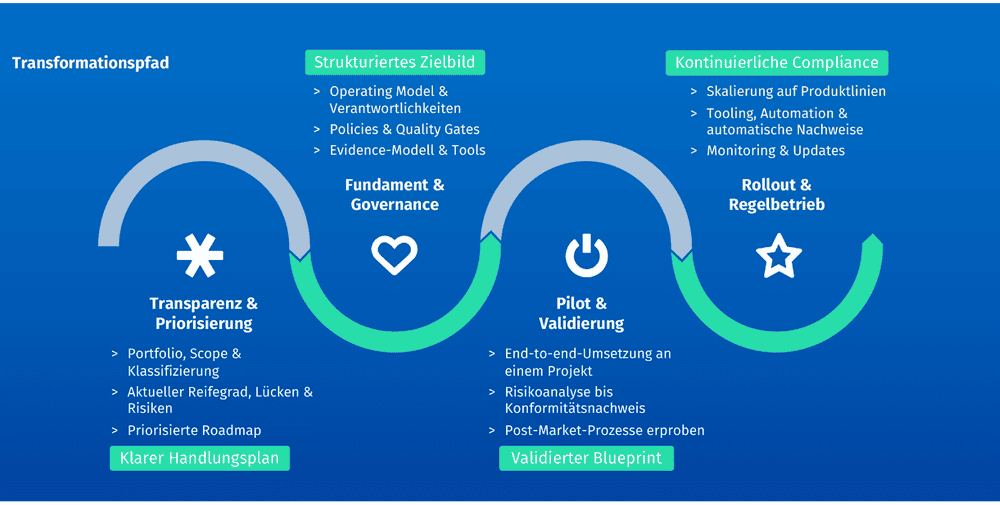
Such a platform is best developed in four phases. Transparency and portfolio prioritization are followed by the foundation of roles, evaluation criteria, and quality gates. A representative product then undergoes the entire process as a pilot—from risk analysis to proof of conformity, including vulnerability handling and reporting—before the validated approach is applied to other product lines.
In this way, a pilot project evolves into a common framework for the entire portfolio. Each product retains its individual risk assessment, while reusable adapters, control objectives, and verification structures reduce the burden on the teams.
Conclusion: Distributed data leads to control capability
Much of the information required for CRA evidence is already generated during development. When consolidated by product and continuously evaluated, it provides more than just compliance transparency: It helps manufacturers identify risks earlier, prioritize measures more effectively, and make informed decisions within the reporting deadlines of the Cyber Resilience Act in the event of an emergency.
How much of your CRA readiness is already built into your development tools? Contact us: In a joint assessment, we’ll show you where you stand and which steps will have the greatest impact.
– – – – –
Related Links
👉 www.adesso.de
Graphic: adesso