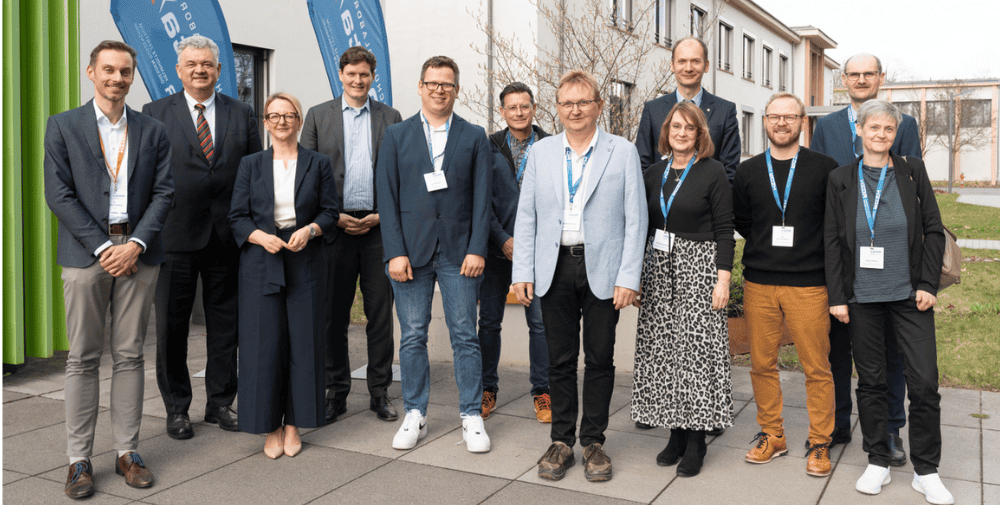
Dresden, March 9, 2026: The ForLab network has published a competence atlas for microelectronics research at German universities. The platform aims to better connect research institutions, companies and young scientists.
Categories

Dresden, March 9, 2026: The ForLab network has published a competence atlas for microelectronics research at German universities. The platform aims to better connect research institutions, companies and young scientists.

Categories
Tags
Contact info
Silicon Saxony
Marketing, Kommunikation und Öffentlichkeitsarbeit
Manfred-von-Ardenne-Ring 20 F
Fax: +49 351 8925 889
Contact person:
The “Research Laboratories Microelectronics Germany” (ForLab), to which the Technische Universität Dresden (TUD) also belongs, have published the ForLab Competence Atlas. The platform makes high-tech infrastructures and specific expertise in the field of microelectronics research at German universities visible and accessible. With the launch of the online database, the project has reached a milestone in strengthening the specialist and young talent base for the electronics of the future. Prof. Thomas Mikolajick, Professor of Nanoelectronics at the TUD, is behind the project. ForLab is funded by the Federal Ministry of Research, Technology and Space (BMFTR). The go-ahead for the rollout was given at the symposium “Microelectronics Research in Germany: From Fundamentals to Applications” (FTME), which took place in Bochum from March 4 to 6, 2026.
Prof. Thomas Mikolajick, coordinator of the ForLab project, explains: “With the Competence Atlas, we are creating Germany-wide visibility of research infrastructures and skills in the field of microelectronics at universities for the first time. In this way, we are enabling better cooperation between university, non-university and private sector research and development in a targeted manner. The ForLab Competence Atlas is more than just a directory – it is a strategic tool for all those who want to promote microelectronics in Germany. It is therefore a core element of the ForLab strategy, which aims to leverage synergies, promote talent and bring innovations into application more quickly.”
Prof. Jens Müller, head of the sub-project and Vice President for International Relations and Transfer at TU Ilmenau, emphasizes: “The platform is aimed at research institutions and companies – especially small and medium-sized enterprises (SMEs) that are specifically looking for expertise, equipment infrastructure, technological solutions and cooperation partners. It is therefore an important tool for transferring knowledge to industry.”
However, the development is not complete with the launch of the website: Members can use a login area to update their respective information and add new features. Further content and features are also planned for the future. Prof. Mikolajick gives an outlook: “I am very pleased that we have succeeded in releasing the Competence Atlas by the date of FTME 2026. It was presented to an ideally suited specialist audience at the conference and thus received appropriate attention at its launch. Now it is up to all users to contribute with their experience in using the tool and their feedback to us to further develop the tool and gradually improve it to such an extent that it optimally covers the various needs.”
The ForLab-NataliE project has set itself the task of establishing an association of German universities with a research focus on microelectronics. This initiative, funded by the Federal Ministry of Research, Technology and Space (BMFTR), is thus creating a collaborative network that combines research and practical applications. By developing cross-university partnerships and expanding training opportunities, ForLab-NataliE aims to strengthen the next generation of skilled workers in Germany and thus accelerate progress in semiconductor and microelectronics technology. With a focus on increasing the visibility of microelectronics research at universities, ForLab strives to facilitate the transition of innovative technologies into real-world applications and to foster the next generation of researchers beyond traditional academic boundaries.
You need to load content from reCAPTCHA to submit the form. Please note that doing so will share data with third-party providers.
More InformationYou are currently viewing a placeholder content from Turnstile. To access the actual content, click the button below. Please note that doing so will share data with third-party providers.
More InformationYou are currently viewing a placeholder content from Facebook. To access the actual content, click the button below. Please note that doing so will share data with third-party providers.
More InformationYou are currently viewing a placeholder content from Google Maps. To access the actual content, click the button below. Please note that doing so will share data with third-party providers.
More InformationYou are currently viewing a placeholder content from OpenStreetMap. To access the actual content, click the button below. Please note that doing so will share data with third-party providers.
More InformationYou are currently viewing a placeholder content from Instagram. To access the actual content, click the button below. Please note that doing so will share data with third-party providers.
More InformationYou are currently viewing a placeholder content from X. To access the actual content, click the button below. Please note that doing so will share data with third-party providers.
More Information