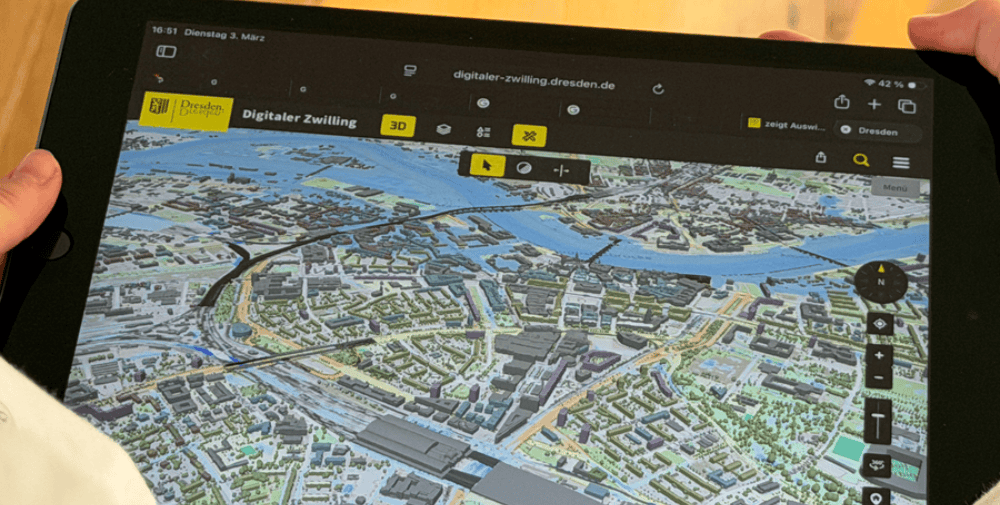
The digital twin of Dresden is a real model of the city. It simulates the consequences of heavy rainfall of around 30 to 50 liters per square meter per hour and shows possible damage to residential buildings in the city area. In addition, measurement data on precipitation, water levels in bodies of water and air temperature can be called up. The calculated scenarios illustrate correlations and provide valuable input for urban planning.
The digital heavy rain twin is being developed at the Institute of Hydraulic Engineering and Technical Hydromechanics at TUD: “Combining complex urban data in one platform and making it usable for heavy rainfall prevention is an exciting challenge,” explains developer Lars Backhaus. “We are integrating previously abstract information into a powerful tool that offers administration and citizens clear guidance.” Such a sophisticated system requires further specialist expertise: “We are very happy that several Dresden partner institutions from administration and science are working together on this project,” says project manager Dr Katja Maerker from the environmental office of the state capital Dresden.
A team from the Dresden University of Applied Sciences (HTWD) is developing tools for 3D visualization and damage calculation of residential buildings. Data is provided by the Office for Geodata and Cadastre and Dresden’s urban drainage system, among others. In future, the model is to be expanded to include an early warning system and sensor technology for detecting flooding in railroad underpasses.
The online application is now publicly accessible at digitaler-zwilling.dresden.de. Users are invited to share their impressions and experiences of trying out the heavy rain twin with the project team. An online survey has been set up for this purpose at digitaler-zwilling.dresden.de/survey.
Digital twins for the optimization of water cycle management worldwide
The potential of such digital twins with regard to the global challenges posed by climate change and cross-border cooperation was recently presented in India by Prof. Jürgen Stamm, Professor of Hydraulic Engineering. At a conference of the Indo-German Science and Technology Centre (IGSTC) in New Delhi, he showed how such simulations can be used to carry out stress tests for critical infrastructures or optimize the circular economy in the water sector.
Against this background, Stamm said, technological innovations offer new opportunities to expand the partnership with India, for example at the transCampus with IIT Madras through long-term institutional integration, joint doctoral training and bilateral research platforms.
About the Smart City Dresden model project
The Smart City Dresden model project is a cooperative funding project of the state capital Dresden and TUD, which aims to promote strategic digitalization and sustainable, integrated urban development. The aim is to test innovative digital solutions, citizen participation formats and technological approaches in order to improve the quality of life, participation and sustainability in the city. The project is part of the German government’s nationwide Smart Cities Model Projects funding program and is financed by the Federal Ministry of Housing, Urban Development and Building (BMWSB) via the Kreditanstalt für Wiederaufbau (KfW).
– – – – – –
Further links
👉 https://tu-dresden.de
Photo: Benjamin Griebe