“The fat years are over. Jobs are no longer on the street. Because an employee market has now become an employer market again”. A cacophony of empty phrases that sounds devastating for job seekers and those looking to change jobs. After years of abundance, growth and the eternal mantra of a shortage of skilled workers, the wind has changed, as statistics and the constantly falling number of job applications show. The number of unfilled jobs has halved across all sectors and compared to the height of the skills shortage in 2022. Moreover, fewer new jobs are being reported than ever before. Backfilling is still an issue, but unfortunately there are hardly any new hires at the moment. In Saxony and in the Silicon Saxony industries – the microelectronics and ICT sector – the statistics of the past two years also underline this trend. After sustained growth of around 5,000 new jobs per year (since the crisis year 2009), stagnation has returned. Since 2024, the number of employees subject to social security contributions in Saxony’s high-tech sector has remained constant at 81,000. Retirements and other departures are being compensated for. New hires have only been made sporadically. However, this could soon change – at least in the Silicon Saxony region. But more on that later.
Reappointments are mandatory, but unfortunately new appointments are not
The first forecasts predict a significant and general recovery in the labor market as early as 2026. For the first time, fewer people will be entering the labor market than leaving it. Other analyses see a continued redistribution or reorientation on the labor market for the time being. With the increasing migration of individual industrial sectors, e.g. the automotive sector, jobs are being lost. However, with the growth of other industrial sectors, e.g. the defense sector, new demand is being created in similar areas. In the service sector, such as care, workers are urgently needed. On the other hand, areas such as marketing or HR are increasingly being cut from companies’ lists. It is a wild mix with many ifs and buts. The situation in the Silicon Saxony sectors also seems confusing at times. Large waves of redundancies, e.g. at software companies, are followed by hiring cycles at the same companies – albeit with a different technological profile. Artificial intelligence is the determining disruptive factor here. Staff without the necessary AI expertise must make way for staff with helpful AI know-how. Due to the limited availability of this group of people, a shortage of skilled workers is quickly reported in this area.
The Silicon Saxony industries are becoming an important stabilizer of the job market
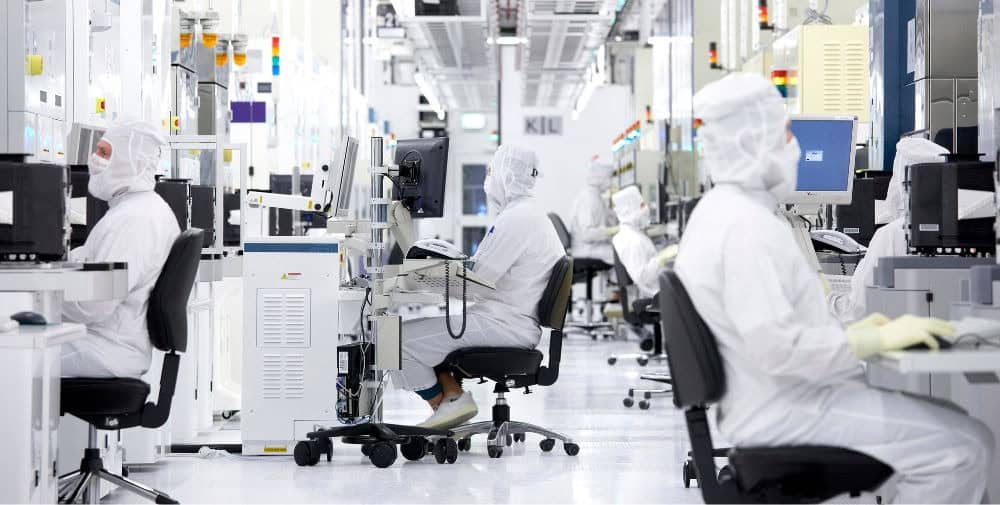
It remains confusing, that much is certain. The good news in this context is that AI will definitely not replace people. However, knowledge about it will become a key criterion for recruitment or continued employment, you have to be honest. But even apart from such restructuring, there are currently opportunities and needs to start a new or different career. An impression that was reinforced last weekend at KarriereStart – Saxony’s education, job and start-up fair. The halls of Messe Dresden were packed this year. Companies and institutions from numerous sectors showed that the market for workers is alive and well. However, it has changed considerably. Silicon Saxony was also on site with its own joint stand in Hall 1, surrounded by numerous small, medium-sized and large member companies of our network. Because the recovery of the labor market mentioned above is becoming apparent in Saxony and the local high-tech industry. Companies such as GlobalFoundries, Infineon and ESMC – i.e. semiconductor manufacturers in the region – are currently expanding their presence in the region, in some cases massively, or are setting up completely new operations here. The demand for skilled workers is correspondingly high, especially in the area of production. There are attractive positions with excellent remuneration for experts, but also for lateral entrants. In addition, the ICT sector is in an excellent position and is likely to remain a stabilizer of the labour market in 2026.
In 2026, the ICT sector will further expand its position as the industry sector with the highest employment
According to a Bitkom forecast, the ICT sector is expected to generate sales of €245 billion this year. That would be 4.4% more than in 2025. 11,000 new jobs are also expected to be created in this sector across Germany, further strengthening the ICT sector’s position as the largest industrial employer (ahead of the automotive and mechanical engineering sectors). It is therefore hardly surprising that there is huge interest in the jobs offered by Silicon Saxony members and the industry at both the KarriereStart (January 25 – 27) and at events such as the “Branchentreff Mikro- und Optoelektronik an der TU Dresden” (January 22). Future-proof, varied and with the best benefits, the microelectronics and ICT sector has been an extremely sought-after field of work, and not just since yesterday. This makes it all the more important to finally find a viable solution for the long-discussed training center for the Saxon semiconductor industry and to clarify both the location and the conditions for potential sponsors, and in general – and not only in Saxony – to position and expand training opportunities for the ICT sector even more strongly. In addition, bureaucracy must also be reduced in this area, new incentives must be created for those looking for training, studies and jobs, and the course must be set for this rock in the labor market. An exchange between the sectors at a federal level can only be helpful in this regard, such as at the Microtec Academy Forum in Dortmund in March, which will also focus on the reorganization of the training regulations for microtechnology and the cooperative use of clean rooms, among other things.
As good and important as the promotion of the microelectronics sector is for Germany and Europe, the associated issue of recruiting and securing skilled workers is just as important. Not everything can be compensated for by employing lateral entrants and the associated in-house training programs. The expansion of training and study opportunities is also becoming a success factor in this key European industry. A fact that must be reflected even more strongly in the efforts of all partners involved. Long-announced projects such as the Saxon Microelectronics Training Center need to be tackled accordingly and not overslept any further.
– – – – – –
Further links
👉 SPARK project of the LJBW
👉 Silicon Saxony joint stand at the job, training and start-up fair KarriereStart
👉 Branchentreff Mikro- und Optoelektronik an der TU Dresden
👉 Microtec Academy Forum
Photo: GlobalFoundries