From hesitation to action: Why cooperation is crucial
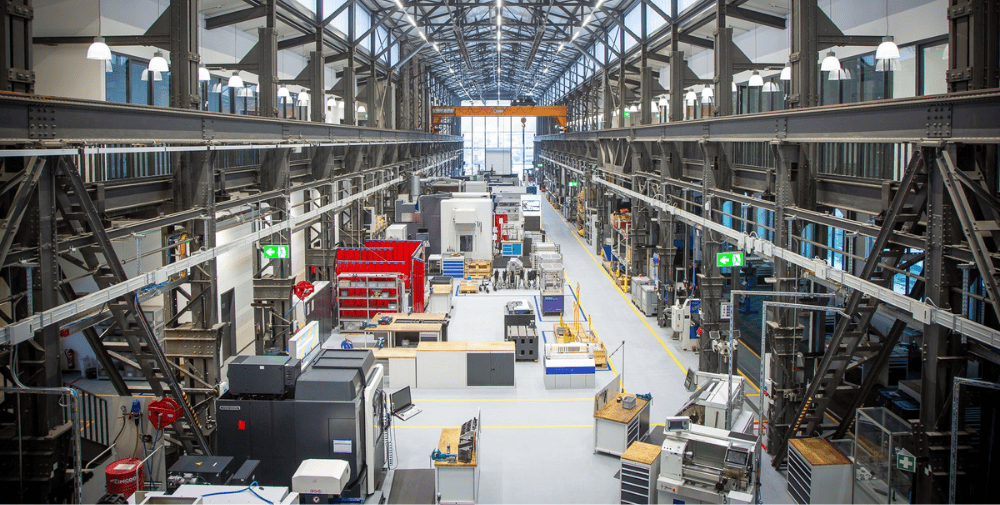
“Germany has learned to minimize risks – but has often lost speed over it. International competitors test new technologies while they are still being developed. This is where we in Germany need to regain speed and a willingness to take risks,” says Dr. Axel Barten, shareholder of the long-established Siegerland company Achenbach Buschhütten and one of the main initiators of Campus Buschhütten. Almost 100 companies, including medium-sized global market leaders from the traditional mechanical engineering region, have joined forces here. Participants share knowledge and insights. The competition is not in the neighborhood, but in Asia or North America. “Everything here is 100 percent real,” says Prof. Dr.-Ing. Peter Burggräf from the University of Siegen and initiator of the SDFS. “No mock-ups, no gimmicks, we develop and produce products up to market maturity and use artificial intelligence where it actually provides benefits.”
Siemens as a partner: technology meets industrial reality
With the recent entry of Siemens AG, the Campus Buschhütten ecosystem has gained a strong technology partner. Siemens has been present in Siegen for 125 years and is now contributing its expertise in a targeted manner where local industry is successful: in highly specialized machines, systems and production processes.
“Campus Buschhütten impressively demonstrates how industry has to work today: fast, networked and application-oriented,” says Christoph Venohr, Head of the Siemens Siegen branch. Siemens technologies are used directly – from the store floor to energy-efficient building concepts.
From data collector to value creator
Technically, many companies are already well positioned today: Machines are networked, data is collected. But this is precisely where the next challenge lies. “Productivity is stagnating – we are no longer making progress,” says Burggräf. The bottleneck no longer lies in collecting data, but in generating decision-relevant added value for productivity and sustainability from existing data. “We need to move from being collectors to hunters,” says Burggräf. AI marks this transition.
At Heinrich Georg Maschinenfabrik, one of the many “hidden champions” from the region, so-called “machine and deep learning processes” are used to make systems more robust and create prospects for autonomous machines. “Once you have found the right approach, other use cases quickly emerge,” says Marco Tannert, Chief Digital Officer at Heinrich Georg. “Data drives optimization – from detecting the smallest deviations to self-regulating systems. All in all, this can represent a decisive competitive advantage for us time and time again.”
AI in practice: efficiency where it counts
AI will also become part of the core business at Pipe Bending Systems from Lennestadt in the Sauerland region in the future. The company is already using digital twins to efficiently produce individual items and small batches. Old pipes are scanned, digitally mapped and transferred directly to production. “This would not be possible without digitalization,” says Managing Director Dr Christian Gerlach. “Open interfaces are essential for SMEs like us: we connect to CAD, E CAD and PLM systems – partnerships instead of isolated solutions, that’s the key.” In addition, generative AI drastically reduces processing times in indirect areas: “What used to take half a day, we now do in minutes.”
Investing in digitalization – speed is the competitive factor
For Dr Axel Barten, Partner at Achenbach Buschhütten, one thing is clear: “Investments need to be rethought. We invested in buildings and machines for a long time. Today, we have to invest part of our capital specifically in digital infrastructure in order to become faster. Speed is one, if not the decisive competitive factor. We build things and test them at the same time – that’s how we dramatically shorten development times.” The owner family of the Achenbach Buschhütten company, who played a key role in initiating and building the campus on their company premises, is particularly important is the mindset that is cultivated there: Away from compartmentalization, towards ‘open source’. “Because knowledge grows when you share it. Collaboration in creative alliances under one roof, the production hall as a creative space,” says Barten.
People at the center: training & acceptance
All those involved emphasize: AI is not replacing people – but it is changing work. Routine activities are being automated, freeing up skilled workers for more demanding tasks. This requires training and acceptance. Dr. Sebastian Dreßen, responsible for research collaborations at Siemens AG, calls for the consistent dismantling of silos in companies and education: “We need interdisciplinary, holistic thinking – a digital ‘flat rate’ in teaching and proximity to real use cases. The campus offers ideal conditions and a neutral environment for this: pre-competitive testing, making data usable and making added value visible.”
Classification & Outlook
The current mood in the German economy is characterized by urgency: The old export model is under scrutiny, energy prices and regulation are a burden, and innovation has long been emerging outside of Europe. The message: the direction is right – the pace is not. AI waves dramatically shorten cycles; productivity must therefore be consistently increased. Germany’s opportunity lies in the industrial application of AI – where real added value is created. This requires data alliances in the SME sector and faster decisions.
The discussion marks a paradigm shift: AI is an application topic in the SME mechanical engineering sector, not a dream of the future. Success factors lie in integrated process chains, clean data, fast iterations – and a culture that puts collaboration before competition. The smart demonstration factory on the Buschhütten campus shows how AI can become a productivity lever – not in the abstract, but where value is created. “At a time when speed and relevance are decisive for competitiveness, this is precisely the way forward,” summarizes Dr. Axel Barten, traditional entrepreneur and co-initiator of the Campus.
About Siemens
Siemens AG is a leading technology company with a focus on the fields of industry, infrastructure, mobility and healthcare. The company’s mission is to develop technology that improves everyday life for everyone. By connecting the real world with the digital world, it enables customers to accelerate their digital and sustainable transformation. This makes factories more efficient, cities more liveable and transportation more sustainable. As a leader in industrial artificial intelligence, Siemens uses its extensive expertise to apply AI – including generative AI – to real-world applications and develops AI solutions for customers across all industries that deliver real value. Siemens is the majority owner of the listed company Siemens Healthineers, a global leader in medical technology pioneering healthcare. For every person. Everywhere. Sustainably. In fiscal year 2025, which ended on September 30, 2025, the Siemens Group generated revenue of €78.9 billion and profit after tax of €10.4 billion. As of September 30, 2025, the company employed around 318,000 people worldwide on a continuing basis.
– – – – –
Further links
👉 www.siemens.com
Photo: Siemens AG / Photographer: Ulrich Wirrwa