How does it feel to immerse yourself in the world of microelectronics together with students from all over Europe, learn about new technologies and make valuable contacts for the future at the same time? Anyone who has ever been part of the ECS Summer School, which will take place for the third time in Bologna, Italy, from August 23 to 28, 2026, will know.
In a varied program, professional input from industry and research will be combined with international exchange, practical insights and an inspiring environment.
Patrick Mersiowsky, a student of electrical engineering at the Saxony Cooperative State University and practice partner of X-Fab Dresden GmbH & Co KG, took part in the Summer School in summer 2025. In this interview, he talks about what motivated him to apply, what experiences he particularly remembers and why he would definitely recommend other students to take part.
We conducted the interview in writing.
Dear Patrick, what motivated you to take part in the ECS Summer School and how did you find out about the program in the first place?
Patrick Mersiowsky: I became aware of the ECS Summer School when I was forwarded an email by my practical company as part of my dual study program. I was particularly impressed by the opportunity to get to know students from all over Europe and to network internationally. I also found the previous year’s program very interesting, as it included many topics that I found exciting. Last but not least, the location of Budapest also played a role, which was an additional incentive for me.
How did the application process go?
Patrick Mersiowsky: Students from STEM subjects who have completed at least two years of their studies and are still studying for at least one more year are eligible to take part. Participants must also be enrolled at a university in the EU or an associated country and have a good command of English, as the entire program is held in English. 40 participants are then selected from all the applications. The application process itself was straightforward: I wrote a letter of application and a short CV and submitted these via the website. A letter of recommendation from the employer or another job can have a positive effect, but is not necessary. Even if not all the criteria are met: it’s still worth a try.
What expectations did you have beforehand?
Patrick Mersiowsky: My expectations were deliberately not too high. Above all, I wanted to explore new topics in a relaxed atmosphere and at the same time take the opportunity to see something of Budapest. I was also looking forward to meeting students from all over Europe.
Have you had any previous contact with microelectronics or semiconductors?
Patrick Mersiowsky: Through my dual study program, I already had insights into the semiconductor industry, especially through my practical company, X-Fab in Dresden. There I was able to get to know the production of integrated circuits, so the subject area was not completely new territory for me. However, no special prior training is necessary for participation. A few links to basic videos are provided on the Summer School website.
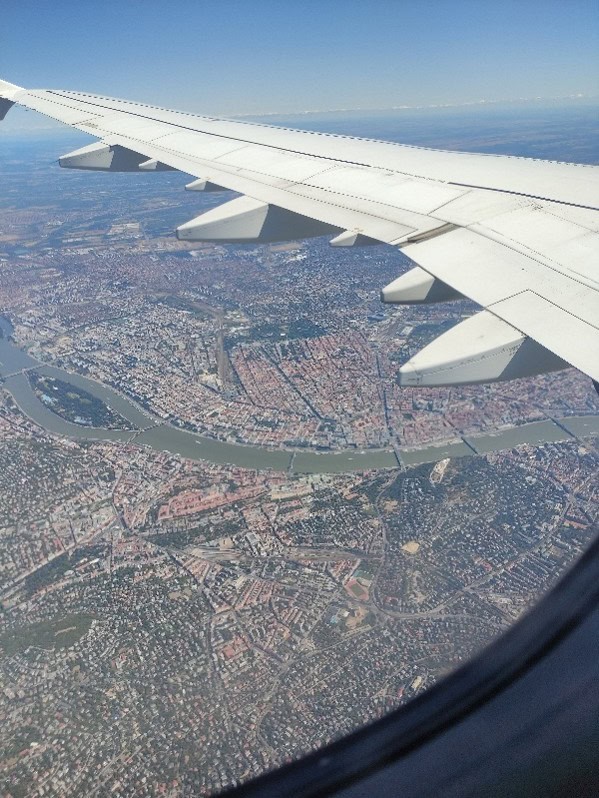
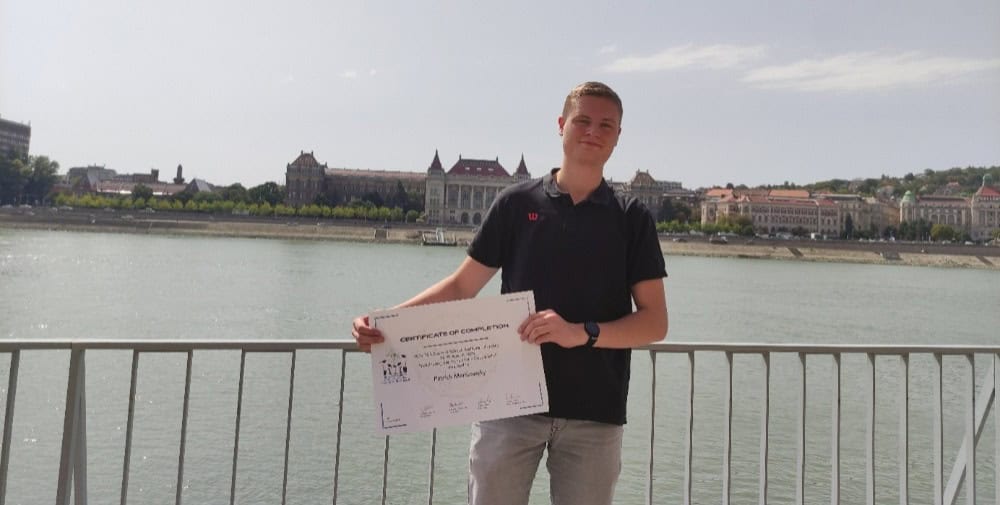
Picture: Patrick Mersiowsky_Approach to Budapest
Let’s talk a bit about your time at the Summer School. What did you particularly remember?
Patrick Mersiowsky: Oh, a lot of things really stuck with me, especially in terms of content, although I wouldn’t have expected that in advance. But other aspects should not be neglected either. On the one hand, the technical aspects have stuck with me, delivered in a relaxed atmosphere and by no means dry. I particularly remember Patrick Cogez as the moderator, who guided us through the day every day. But the other speakers, some of them from management positions, were also very approachable. Everyone involved was perfectly suited to imparting knowledge without being too reminiscent of a university lecture. On the other hand, the free time spent exploring the city of the host university, Budapest, will remain in our memories. Together with the other participants, this was a great experience. There was something new to do every day and every night.
Which parts of the program did you find the most exciting?
Patrick Mersiowsky: I particularly liked the structure of the program – from chip production, technologies and packaging to systems and end applications. The content on semiconductor production itself was less new to me, as I was already familiar with it from my work. However, I was able to gain new insights here too. I found all the other items on the program very interesting. The tour of a PCB assembly facility, the visit to a university clean room and the insights into the production of metrology tools at Semilab were particularly exciting.
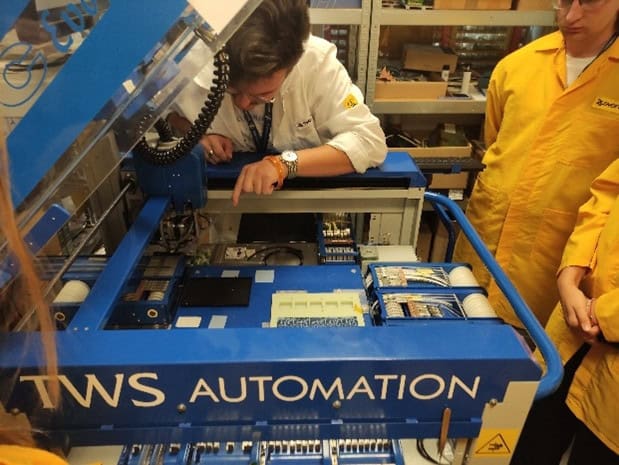
Picture: Patrick Mersiowsky_PCB_Bestueckung_Uni_Budapest
And which topics were particularly valuable to you for your further studies – and why?
Patrick Mersiowsky: Microelectronics has been dealt with less intensively in my studies so far. That’s why the summer school was a very good addition for me and expanded my knowledge in this area. the technology topics in particular were very valuable for me, as I gained deeper insights here than I knew from my day-to-day work. I think that the knowledge I gained will help me in the future. All the lecture slides are also available online and can be viewed again later. If the field of semiconductor technology is dealt with more intensively in my (further) studies, I feel I am well prepared.
How practical or theoretical was the program?
Patrick Mersiowsky: Overall, the program was rather theoretical, but never boring. Hands-on sessions and various tours made what we had learned even more tangible. Some speakers brought along illustrative material to support the presentations.
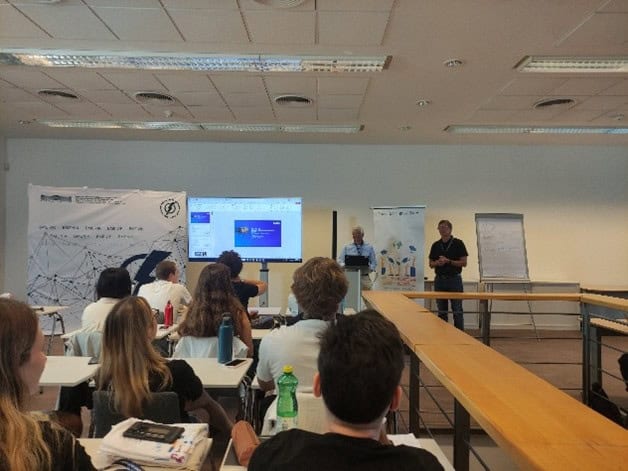
Picture: Patrick Mersiowsky_Lecture on the second day
How did you experience the exchange with other students and the industry?
Patrick Mersiowsky: Very relaxed, almost informal. Communication with other students was possible at any time and I found the participants to be very open and pleasant. It was also possible to talk to representatives from industry and academia in a relaxed atmosphere, especially after presentations.
Did this result in lasting contacts?
Patrick Mersiowsky: Yes, I am still in contact with a number of students from various countries, including Italy, Poland and Turkey. I am also active as a Student Embassador. We are a group of many young people who have the goal of bringing the interest in semiconductor technology closer to other pupils and students. Within this framework, there are regular opportunities to exchange ideas and discuss them, as well as opportunities for further training.
How has the Summer School changed your view of career paths?
Patrick Mersiowsky: Participation has confirmed my choice of company and the path I have taken so far. The microelectronics sector is the industry that still appeals to me the most.
Why would you recommend students to apply to the ECS Summer School?
Patrick Mersiowsky: The application itself involves relatively little effort, but it is definitely worth it. Above all, the opportunity to meet students from all over Europe and build a strong network is unique. At the same time, new content can be learned in a relaxed environment and the exchange about different study programs from other countries is very enriching.
All in all, it is an unforgettable time and there are hardly any costs involved. Travel costs are reimbursed and hotel and meals are provided, so that participation is financially inexpensive, but the contacts and knowledge you gain during this time are priceless. The organization is great, there is always a contact person you can get in touch with.
Were there any concerns beforehand that turned out to be unfounded?
Patrick Mersiowsky: I was initially worried that networking with other students would be difficult. In fact, the opposite was the case: contacts were made quickly as everyone was very relaxed. I also realized that perfect English is not required.
_ _ _ _ _ _
Apply now for the Summer School 2026
The ECS Summer School 2026 will take place from August 23 to 28, 2026 at the University Residential Centre of the University of Bologna in Bertinoro, Italy. Bachelor students from STEM subjects (mathematics, computer science, natural sciences and technology) from the EU and associated countries can apply.
👉 To the Summer School
👉Go directly to the application
_ _ _ _ _
About our interview partner
Patrick Mersiowsky is 21 years old and comes from Bautzen. After graduating from high school in 2022, he began a dual study program in electrical engineering at the Saxony Cooperative State University in Bautzen. His practice partner is X-Fab Dresden GmbH & Co KG. He completed his bachelor’s degree last year. He is now studying for a Master’s degree at HTW Dresden.
_ _ _ _ _ _
The European Chips Skills Academy (ECSA)
The European Chips Skills Academy (ECSA) is a project funded by the European Union (EU) under the coordination of SEMI Europe and in collaboration with industry partners AENEAS, EPoSS and INSIDE. The alliance is organizing the Summer School for the third time in summer 2026. It also operates a learning platform with numerous online courses in the semiconductor sector.
The initiative is a response to current industry challenges. The aim is to strengthen innovation and resilience in the microelectronics industry and bridge the gap between general education and industry in order to address the acute shortage of skilled workers and talent in Europe.
👉 To ECSA