Ahead of burglars by exceeding the standard
“We always want to be way ahead of burglars,” explains Uwe Schmeißner, Managing Director of SCHMEISSNER GmbH in Hermsdorf, Thuringia. The demand for ever better and at the same time cost-effective solutions for security technology is very high, especially in view of recent events. “We have already developed retrofittable glass breakage sensors and established them on the market. Some of these already meet the VdS criteria. That is the benchmark.” The VdS Schadenverhütung GmbH test is stricter than the DIN in terms of material quality, installation and protection against tampering and is required in areas with an increased or very high risk of burglary. However, Schmeißner went on to say that the company does not want to rest on its laurels. “In the project, we want to apply two levers for better sensors – more sensitive detection, also with regard to potential new intrusion methods, and greater robustness against false alarms.” Repeated unwanted alarms in particular can lead to security staff becoming jaded and ultimately to the sensors being deactivated by the operator.
The challenge of glass breakage sensors
Glass breakage sensors evaluate ultrasonic signals that are generated by vibrations in the glass. These change when the glass is exposed to external influences. Typical signals caused by normal environmental influences such as temperature fluctuations, rain, hail or stones thrown up by passing vehicles must be detected, as must signals that are generated when the pane is broken by force, when pieces are cut out or simply when a stress crack occurs due to large temperature differences. Differentiating between these scenarios places high demands on the sensor’s evaluation algorithms. In addition, new types of break-in methods may not only require more sensitive evaluation, but also influence the ultrasonic signals in such a way that immunity to false alarms will become even more difficult in the future.
More sensitive and robust glass breakage sensors targeted
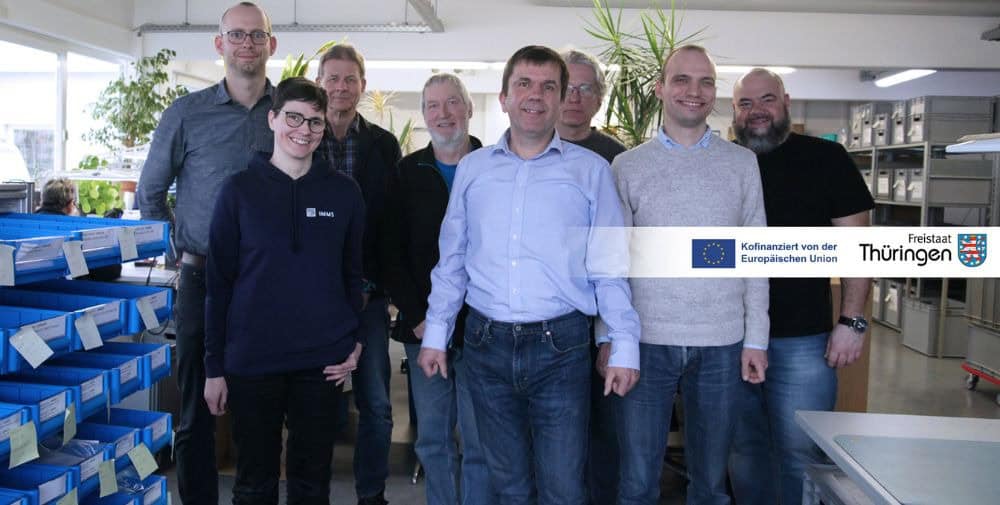
The new glass breakage sensors, which are particularly sensitive and at the same time robust against false positive alarms, are to be achieved firstly through a powerful and interference-resistant hardware design. “In addition to the new hardware, the pivotal point will be the use of innovative analysis and evaluation methods,” explains Dr. Ludwig Herzog, Head of Mechatronics and RGBS Project Manager at IMMS. The aim is to use complex algorithms to clearly separate breakage detection from permissible effects.” IMMS is coordinating the project and will be responsible in particular for developing the methodology and developing the more sensitive and robust breakage detection. SCHMEISSNER GmbH will primarily develop the hardware and constructively protect it against interference, carry out validation measurements and perform further preparatory steps for subsequent product development, such as EMC simulation and tests as well as software development for the user interface.
As a result, an innovative and at the same time inexpensive retrofit solution is being sought that meets the growing demands of customers and users of glass breakage sensors by contributing to securing objects at the highest level and strengthening the competitiveness of Thuringian companies in this field of application.
– – – – – –
Further links
👉 www.imms.de
Photo: IMMS