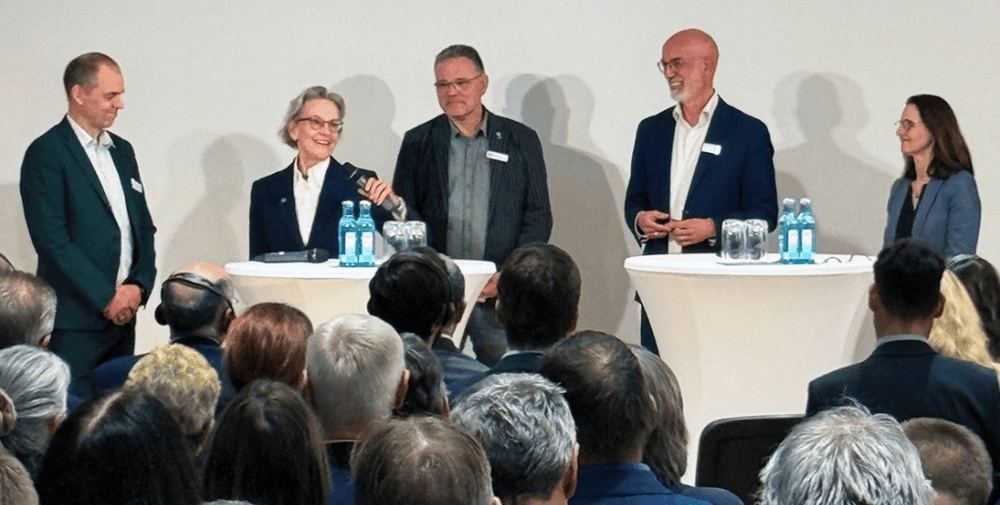
The Scientific Director of the HZDR, Prof. Sebastian M. Schmidt, emphasizes the expertise of the HZDR in the field of quantum technologies: “This is an extraordinary success for the HZDR and shows once again that our scientists always have possible applications of their research in mind. With these now funded projects, the HZDR can contribute to creating a network for the sustainable anchoring of expertise in the development and application of quantum technologies across all research areas. We therefore also see ourselves as an important player in the German government’s High-Tech Agenda.”
The three selected projects are aimed at the use of quantum technologies for real applications in the fields of earth and environment, energy and health. All projects will run for three years and start on 1 January 2026.
The projects in detail:
QuBiposy – Quantum Biopsy for Cancer Visualization on Macro and Micro Scales
Dr. Georgy Astakhov, Prof. Larysa Baraban, Prof. Anna Dubrovska, 1.5 million euros, Coordinator: HZDR
Conventional imaging and biopsy methods have so far been insufficiently successful in detecting rare tumor cells and micrometastases in cancer diagnostics. QuBiposy aims to improve this diagnosis even in complex tissue environments. To this end, QuBiopsy integrates three complementary quantum imaging methods. The first relies on nitrogen defects in diamond to visualize magnetic fields on a microscopic level. It offers a very high spatial resolution. The second method uses vapor cell magnetometry. This allows even very weak magnetic signals to be measured extremely sensitively in larger sample areas. The third method uses entangled photons to visualize primary tumors and micrometastases with high contrast and high resolution – both with and without fluorescent markers. The image data from quantum magnetometry and photon imaging will be combined to create a comprehensive, multimodal diagnostic platform. The aim is to exceed the detection limits of current techniques for tissue and liquid biopsy. In addition, a stochastic process model inspired by quantum theory will be developed. By linking quantum physics and biomedicine, QuBiopsy will enable early cancer detection for initial diagnosis as well as for the detection of metastases and recurrences, thus offering great potential for personalized cancer diagnostics.
qFLOW – Quantum-Accelerated Solutions for Fluid Dynamics and Environmental Systems
Dr. Werner Dobrautz, 1.3 million euros / Coordinator: HZDR
Quantum computing should enable advances in the simulation of complex flow processes and thus overcome challenges in the areas of climate adaptation, clean energy and water security. Such simulations are central to hydrology, environmental sciences and energy technologies, but exceed the capacities of today’s high-performance computers in many application scenarios. qFLOW is all about accelerated solutions for fluid dynamics and environmental systems. The project is doing pioneering work in the development of quantum-assisted solutions for coupled transport processes in fluids. The focus is on groundwater flows and reservoir-based hydrological models on the one hand and on multiphase flows, including bubble flows and bubble oscillations at interfaces, on the other. The open-source quantum software suite developed in qFLOW will enable broad use and serve as a blueprint for the integration of quantum-based methods into the Helmholtz research fields of Earth and Environment and Energy. qFLOW thus lays the foundation for quantum-assisted digital twins of complex fluid dynamics and environmental systems.
QT-Batt – Quantum Technologies for Batteries
Dr. Werner Dobrautz, 350,000 euros / Coordinator: Forschungszentrum Jülich
QT-Batt aims to develop quantum algorithms tailored to battery-related simulations, focusing on energy materials and charge transfer processes. In addition, quantum sensor platforms that can be embedded in battery architectures for real-time diagnostics will be developed simultaneously. This dual approach will improve the predictive accuracy of material models and provide high-resolution insights into degradation and failure mechanisms. There is a growing global demand for high-performance batteries that are safer, have longer lifetimes and enable fast charging and high performance conditions. Conventional computational methods and sensor technologies are reaching their limits in modeling complex electrochemical systems and detecting minute fluctuations in battery performance. Quantum computing has the potential to simulate molecular and quantum mechanical interactions at exponential speed. It thus offers a transformative and cross-scale approach for the development of next-generation batteries, including solid electrolytes and advanced electrode interfaces. At the same time, quantum sensing enables highly sensitive detection of local temperature changes and electromagnetic fields in batteries during operation, opening up ways to improve the reversibility of redox processes in batteries.
Contact
Dr. Werner Dobrautz I Center for Advanced Systems Understanding (CASUS) at HZDR
Tel.: +49 3581 37523 59 I E-Mail: w.dobrautz@hzdr.de
Dr. Georgy Astakhov I Institute for Ion Beam Physics and Materials Research at the HZDR
Tel.: +49 351 260 3894 I E-Mail: g.astakhov@hzdr.de
– – – – – –
Further links
👉 www.hzdr.de
Photo: Blaurock