The more data is to be transmitted simultaneously, the higher the carrier frequency used must be. As a result, research is now penetrating into the terahertz range. This frequency spectrum lies beyond the microwave range currently used in mobile communications and has been difficult to access technologically to date. “Increasing frequencies up to the terahertz range and then working with them is currently very inefficient,” explains Dr. Georgy Astakhov, Head of the Quantum Technologies Department at the Institute of Ion Beam Physics and Materials Research at the HZDR. The reason for this is that the signals have to be amplified and stabilized for high frequencies, which has so far required a lot of energy and complex amplifier circuits. “Our approach shows that it can be much simpler.”
Weak signals, strong effect
For the experiment, the team used a wafer-thin film of mercury telluride. This material belongs to the class of Dirac materials. In these special substances, electrons move as if they had hardly any mass. As a result, they react extremely quickly to electromagnetic fields. This makes them particularly suitable for accelerating or mixing signals.
Interestingly, the material used is not one that has only recently been discovered. Mercury telluride has been used for decades in infrared detectors, for example. What is new, however, is the precise control of precisely those electronic properties that make the substance a Dirac material. This opens up possibilities that were previously unthinkable. “The decisive moment in our work was when we clearly saw the signal at room temperature,” says Tatiana Aureliia Uaman Svetikova, PhD student at the HZDR and first author of the study. “This is particularly challenging because the signal easily disappears in the background noise.” This is why comparable experiments previously always had to be extremely cooled.
Also astonishing was the conversion efficiency with which the team was able to set a new milestone. It was over two percent. This is an exceptionally high value for the terahertz range. In previous approaches, the efficiency of such frequency conversions was often in the range of 0.01 to 0.1 percent.
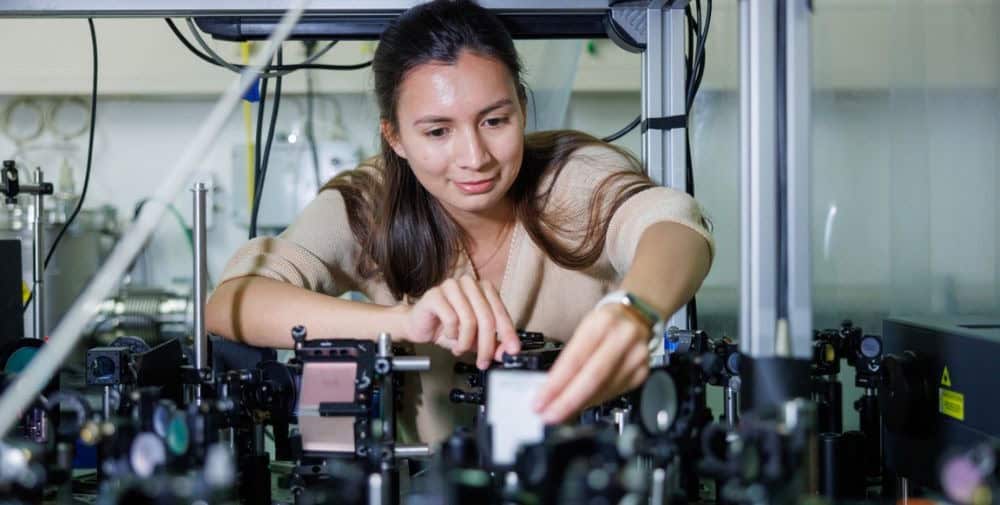
In order to detect the signal in the omnipresent background noise, the team used the ELBE Center for High Power Radiation Sources at the HZDR for its measurements. This is because the terahertz source TELBE and the free-electron laser FELBE provide high-precision experimental conditions there. For their experiment, the researchers had to precisely combine two terahertz signals at the right angle, with the right intensity and at the right moment. “That was a major challenge,” describes Uaman Svetikova. “We had to tune the sources very precisely in order to clearly work out the interaction.” Only this controlled superposition made the significant transformation measurable at all.
The results show that Dirac materials could play a central role in future high-frequency technologies. “Dirac materials can efficiently convert weak radio signals into higher terahertz ranges,” explains Astakhov. “This opens up prospects for wireless communication far beyond today’s mobile communications standards, up to future 6G and 7G systems, as well as for high-resolution radar and sensor technology.”
However, development work is still required before the materials can be used in components. As a next step, the team plans to further refine the structures and transfer them to different material systems. Only then will it be possible to test how well such terahertz mixers can be integrated into real circuits. “We are clearly in the area of basic research here,” summarizes Astakhov. “But it is a building block that points the way towards compact high-frequency technologies.”
Publication
T. A. Uaman Svetikova, I. Ilyakov, A. Ponomaryov, T. V. A. G. de Oliveira, C. Berger, L. Fürst, F. Bayer, J.-C. Deinert, G. L. Prajapati, A. Arshad, E. G. Novik, A. Pashkin, M. Helm, S. Winnerl, H. Buhmann, L. W. Molenkamp, T. Kiessling, S. Kovalev, G. V. Astakhov, Highly efficient broadband THz mixing and upconversion with Dirac materials, in Communications Physics, 2025. (DOI: 10.1038/s42005-025-02273-0 )
Contact
Dr. Georgy Astakhov | Head of Quantum Technologies
Institute for Ion Beam Physics and Materials Research at the HZDR
Tel.: +49 351 260 3894 | E-Mail: g.astakhov@hzdr.de
– – – – – –
Further links
👉 www.hzdr.de
Photo: Oliver Killig/HZDR