The hub was initiated by the Industrial Digital Twin Association (IDTA), the Chair of Information Management at the Dresden University of Applied Sciences (HTWD) and the Process-to-Order Group at Dresden University of Technology.
“With the IDTA Research Hub, we are combining academic expertise and industrial practice and creating a central point of contact for all questions relating to the Industrial Digital Twin in the semiconductor industry,” emphasizes Prof. Dr. Dirk Reichelt, HTW Dresden. “Our aim is not just to explain AAS, but to make it directly tangible in real production and supply chain scenarios.”
“The IDTA thrives on a strong ecosystem. With the Research Hub, we are specifically strengthening the close links between standardization, research and the industrial application of AAS. Such partnerships are crucial in order to further develop the standard and integrate industry-specific requirements in a structured manner. We greatly appreciate this close cooperation because it drives technological innovation and strengthens the connection between the semiconductor industry and its user industries in the long term,” explains Dr. Matthias Bölke, CEO of IDTA.
Core objectives of the IDTA Research Hub
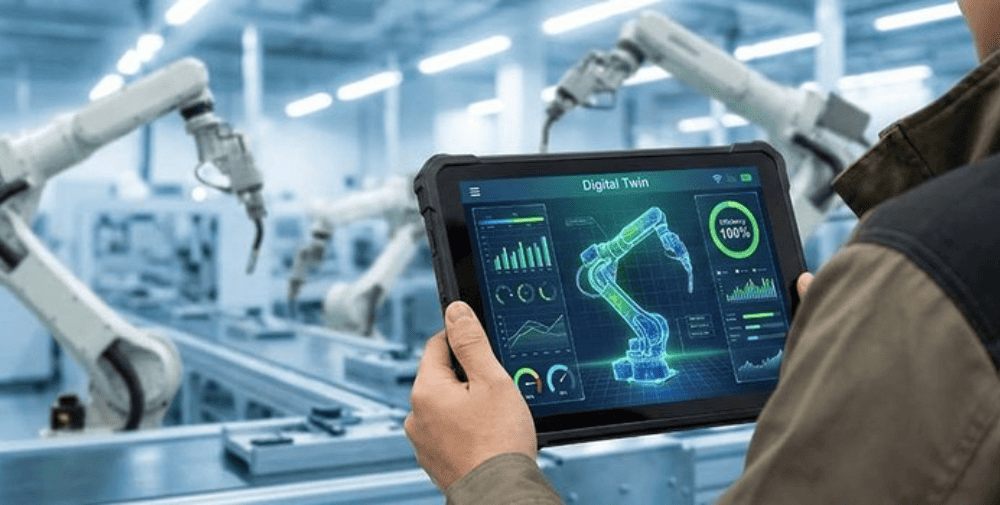
The focus is on the AAS as the technical backbone of the Industrial Digital Twin. The AAS is the standardized digital twin of a physical object, which provides all relevant information in a structured way to map data on machines, systems and companies in a standardized way and make it available across manufacturer and system boundaries.
While data was previously often distributed in different IT systems, the AAS bundles this information in a standardized structure. This means that systems from different manufacturers and companies can “talk” to each other without having to program individual special solutions. It is precisely this interoperability that is a prerequisite for scalable Industry 4.0 applications.
The hub aims to establish the AAS across domains in both discrete and process-oriented manufacturing environments in the semiconductor industry and demonstrate its applicability in real production and supply chains. Research, teaching and practical demonstrators are intended to make the digital twin tangible and scalable for companies.
Opening up the Dresden Learning Factories as a research platform for applied AAS solutions is a core concern. In addition, cross-domain supply chain scenarios based on the digital product passport are to be implemented and a long-term research network with industrial partners along the value chains of the semiconductor industry and downstream industries, such as the chemical, automotive and mechanical engineering industries, is to be established. The hub sees itself as a contribution to initiatives such as Manufacturing-X and aims to support small and medium-sized companies in particular with the introduction of AAS-based solutions.
Concrete steps and initial demonstrators
In a first step, a physically tangible AAS showcase for semiconductor applications for the automotive industry is being created. The focus is on use cases relating to fine and specialty chemicals, which play a key role in the industry. The demonstrator is complemented by modular “AAS Experience Labs”, which provide interactive insights from modeling to integration into production and supply chain processes. A dedicated website, regular specialist events and access to information materials and learning factories are also planned.
“The Asset Administration Shell will become a central building block of digital value creation, from chemistry to wafer to vehicle assembly,” explains Prof. Dr. Leon Urbas, TU Dresden. “With the IDTA Research Hub, we are creating a place where success stories and lessons learned can be shared openly.”
The hub will therefore not only bundle research, but also serve as a platform for exchanging experiences, transparency and cross-industry learning. Particular attention will be paid to anchoring the AAS in research and education in order to familiarize future specialists and managers with the Industrial Digital Twin at an early stage.
Call for participation
At the same time, the hub is making a clear call for participation from industry, research institutions and technology providers. Joint projects, shared demonstrators and open knowledge exchange are intended to accelerate the practical introduction of AAS and translate interoperability and data sovereignty into measurable added value for companies and European industry.
Contact:
Prof. Dr. rer. pol. Dirk Reichelt
+49 351 462 2614
dirk.reichelt@htw-dresden.de
_ _ _ _ _
👉 Press release