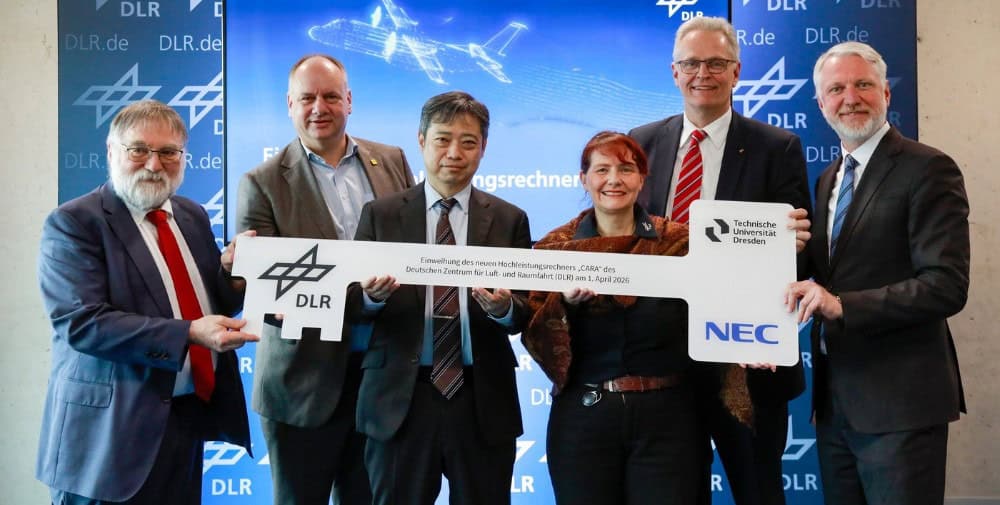
With the renewal of the CARA (Computing for Advanced Research in Aerospace) supercomputer in Dresden, the German Aerospace Center (DLR) is investing in the future and putting its new high-performance computer into operation. In doing so, DLR is meeting the increasing demand for computing power for research and development in key fields of innovation such as aeronautics, space, energy, transportation, quantum technologies and artificial intelligence. The modernized CARA supercomputer was officially handed over on 1 April 2026.
“CARA is more than just an IT infrastructure. CARA represents the next stage of digitalization in aerospace and transport. Simulation, data analysis and artificial intelligence are no longer just supporting tools, but key drivers of innovation. The system enables state-of-the-art applications such as AI-supported analyses, quantum simulations and data-intensive projects – precisely where conventional IT systems reach their limits. CARA shows what is possible when research institutions successfully work together with the federal and state governments,” explains Prof. Dr.-Ing. Anke Kaysser-Pyzalla, Chairwoman of the DLR Executive Board.
Saxony’s Minister of Economic Affairs Dirk Panter praises the partnership that has grown between DLR, TU Dresden with its Center for Information Services and High Performance Computing (ZIH), strong industrial partners and an innovation-oriented Free State. It is precisely this interplay between science, companies, infrastructure and the public sector that makes the location competitive and future-proof.
“Modern aerospace is not just created on the factory floor. It is created much earlier: in models, in simulations, in digital twins, in data-driven development processes. Those who calculate flows more precisely, understand materials better, optimize systems faster and integrate AI effectively gain time and increase their productivity. But they also gain innovative strength and, not least, a degree of technological and political sovereignty. This is why infrastructures such as CARA are important investments in the future. They help to keep know-how in the country, facilitate new collaborations and open up new value chains. I would like to say thank you for the associated financial commitment of the federal government and DLR,” says Dirk Panter.
CARA: Innovation through high-performance computing in technology and research
As a large-scale research facility, CARA is designed to handle highly complex numerical simulations. Exceptionally high computing power is required in particular when technical issues – such as in design or optimization – are translated into extensive mathematical equation systems. In addition to classic numerical simulations, the high-performance computer is used in many other areas. These include the analysis of stalls and wake vortices in aircraft, the reduction of air resistance in cars and trains, the optimal positioning of wind turbines and the reduction of pollutants and increased efficiency of combustion processes. In addition, the system enables AI-supported applications, atmospheric simulations, quantum simulations and extensive data analyses.
Part of a powerful HPC infrastructure
CARA, along with its sister system CARO in Göttingen, is a central component of DLR’s HPC infrastructure (HPC stands for High Performance Computing). Both systems are available to all DLR institutes and are used whenever conventional PCs or servers are not sufficient due to limited computing power or storage capacity. The bundling of resources in a few powerful HPC clusters enables particularly efficient and effective use.
With its HPC strategy, DLR is pursuing the independent operation of high-performance computing systems as a key technology to support research and development. CARO, which is operated at the Gesellschaft für wissenschaftliche Datenverarbeitung mbH Göttingen (GWDG), complements CARA as a second location within this infrastructure.
Operating at two locations not only ensures high capacity utilization, but also significantly increases reliability. At the same time, this structure allows systems to be replaced or modernized alternately, while the other facility remains available without restriction.
Technological renewal
In 2025, DLR commissioned the Japanese technology group NEC Deutschland GmbH to renew CARA. This is crucial in order to meet the increasing demands of modern research. Increasingly complex issues and growing volumes of data require ever greater computing power, while new technologies offer greater efficiency and performance. Thanks to the modernization, CARA remains a reliable and future-proof tool and continues to enable the use of innovative applications – from artificial intelligence to highly complex simulations. As part of the upgrade, the storage capacity will be increased to around 30 petabytes – almost double. The computing power will also significantly exceed the previous 3.2 quadrillion operations per second.
DLR is providing around 14 million euros for the entire project.
Combined expertise at the Dresden site
CARA will be operated in close cooperation with the Technische Universität Dresden, in particular with the Center for Information Services and High Performance Computing (ZIH). The necessary infrastructure – including power supply, cooling and building technology – is provided by the Free State of Saxony, represented by the Staatsbetrieb Sächsisches Immobilien- und Baumanagement.
The data center meets the highest standards of energy efficiency. A particularly low Power Usage Effectiveness (PUE) is achieved through innovative water cooling at an elevated temperature level. Another milestone is the use of waste heat: it is used as local heat to heat the office building of the DLR Institute of Software Methods for Product Virtualization and is fed into the district heating network of the city of Dresden as district heating.
_ _ _ _
Further links
👉 DLR Institute for Software Methods for Product Virtualization
👉 Website for the HPC cluster at DLR