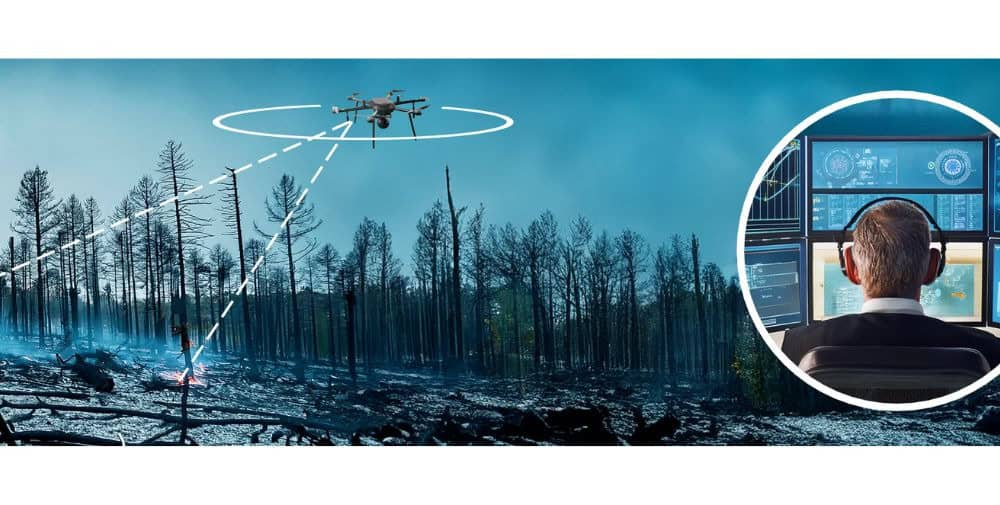
Forest fires are now one of the biggest challenges for fire departments and civil protection in Central Europe too. The search for and extinguishing pockets of embers in the undergrowth is critical. Conventional drones quickly reach their limits here: They are too large and too heavy to fly through dense vegetation. Thermal imaging cameras are often not sensitive enough and therefore do not provide reliable data on hidden sources of fire. Currently, firefighters often have to use a spade to manually detect pockets of embers that are up to 1.5 meters deep.
The German consortium in the PROACTIF project is developing a new solution for this: a multi-sensor module that combines radar and infrared sensor technology for the first time in an ultra-light and compact unit weighing less than 3 kilograms. Heimann Sensor GmbH is supplying the infrared sensors, while researchers at the Fraunhofer Institute for Reliability and Microintegration IZM are working with InnoSenT GmbH to develop the innovative radar sensor technology and integrate the infrared sensor into the system. By combining short- and long-range radar with a range of 80 and 200 meters respectively, the newly developed drone can detect obstacles in the immediate vicinity with a fully automated 360-degree view as well as survey larger forest areas and, for the first time, fly under the tree canopy at 30 km/h while the infrared sensor detects embers.
Three packaging technologies for the best possible implementation
The unique expertise at Fraunhofer IZM enables a combination of three key technologies from packaging technology:
- LTCC technology (Low-Temperature Co-fired Ceramic) enables powerful high-frequency antennas and stable signal processing even at high temperatures.
- Moulding technology allows the three-dimensional shaping of antenna structures and minimizes signal losses, which is crucial for long-range radar.
- Embedding technology integrates the short-range sensor technology into flexible materials to save space and reduce weight and size.
Project manager and scientist at Fraunhofer IZM Dr.- Ing.Christian Tschoban summarizes: “Only through the interaction of LTCC, molding and embedding technologies is it possible to combine short- and long-range radar together with infrared sensors in an ultra-compact module. The result is what is known as multi-sensor packaging, a lightweight sensor unit that combines high resolution, robustness and energy efficiency.”
Practical demonstration in German forests
The multi-sensor module will soon be tested in a practical scenario in Germany. In close consultation with the forestry office and fire department, the researchers are testing the use of the drones in Münsterland and near Wiesenburg. During the simulated fire, particular attention is being paid to ensuring that it takes place outside the dry season, as well as to bird protection. The drones will fly independently through the forest area and detect obstacles and pockets of embers in real time. In the long term, the drones will fly autonomously when a forest fire is reported and create a precise picture of the situation before the emergency services arrive, providing information on how many helpers are actually needed.
In addition, the technology opens up possibilities for search and rescue operations or the monitoring of critical infrastructure. With around 25 percent of the entire consortium in the PROACTIF project, the German consortium is making a decisive contribution to making autonomous systems in Europe more efficient and safer.
The PROACTIF project runs from 01.06.2025 – 30.04.2028 and is funded as part of the Chips Joint Undertaking (HORIZON-JU-Chips-2024-1-IA-T1) with a total of €41.8 million, including €2.02 million from the Federal Ministry of Research, Technology and Space (BMFTR), €320,000 from the Free State of Saxony and €90,000 from the Free State of Thuringia. The project, in which 42 European institutions, including five from Germany, are participating, is part of the German strategy to secure technological sovereignty in the field of quantum research. The overarching goal is to significantly increase European competitiveness in the field of technology for personless missions and to increase the cost efficiency and effectiveness of autonomous monitoring of critical infrastructures.
(Text: Lotta Jahnke)
PROACTIF project partners
Nokia Solutions and Networks Oy, Asya AI, Riga Technical University, HUN-REN Számítástechnikai és Automatizálási Kutatóintézet, Sieć Badawcza Łukasiewicz – Instytut Mikroelektroniki i Fotoniki, Heimann Sensor GmbH, Captain AI B.V., ViNotion B.V., InnoSenT GmbH, Silicon Austria Labs GmbH, Acorde Technologies, S.A., Eindhoven University of Technology, VIA electronic GmbH, TST-Sistemas, Universidad de Granada, Skyability, Research Studios Austria Forschungsgesellschaft mbH, Fraunhofer IZM, Würth Electronic, Safran Electronics & Defense/ SED SPAIN S.L., DEMCON Unmanned Systems BV, Mellanox Technologies Ltd, Van Oord Ship Management B.V., Avular Innovations B.V., CISC Semiconductor GmbH, SSH Communications Security Oyj, Centre Suisse d’Electronique et de Microtechnique SA, Citymesh Integrator N.V., Saab Finland Oy, League Geophysics B.V., VTT Technical Research Centre of Finland Ltd, Ascento AG, YellowScan, FixPosition AG, Leonardo S.p.A, Innovation River, Gdansk University of Technology, Luna Geber Engineering SRL, AITEK SPA, Università degli Studi di Perugia, Dimetor GmbH, Stichting IMEC Nederland.
– – – – – –
Further links
👉 www.izm.fraunhofer.de
Photo: Fraunhofer IZM