The EU and the Free State of Saxony are supporting the start-up phase of the network until the end of 2027 with three million euros in ERDF funding. This will create a permanent structure that creates national and international visibility and enables close links to European pilot lines.
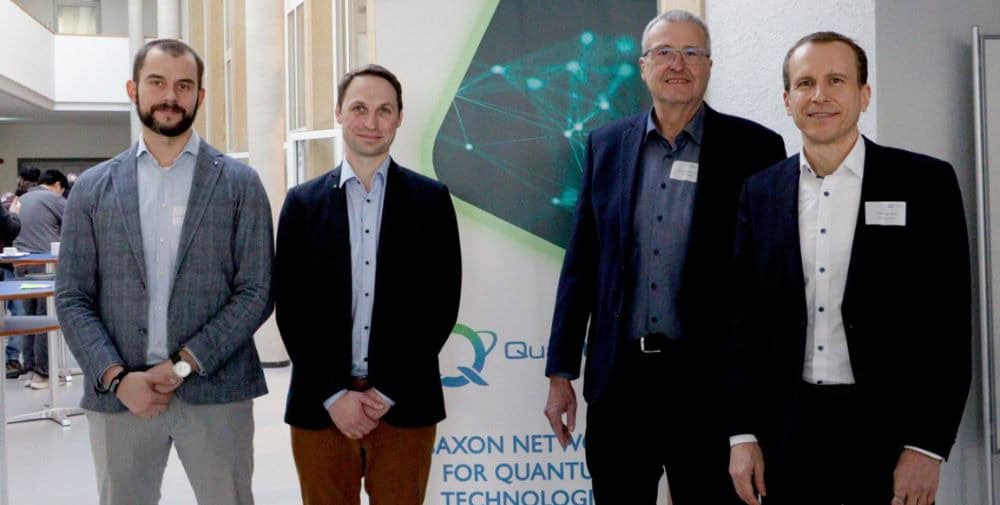
At the launch of the network on 17 December 2025, Science Minister Sebastian Gemkow emphasized: “Quantum technologies are being researched in the publicly funded scientific institutions of the Free State of Saxony as a subject area of particular strategic importance. In Germany’s High-Tech Agenda, they are identified as key technologies and are thus moving more than ever into the scientific and, above all, economic focus. Quantum Saxony establishes a network of the Saxon quantum technology community that is at the center of national, European and global developments and strategy processes.”
To jointly expand Saxony’s position in the quantum field
Quantum Saxony networks expertise from universities and non-university research institutions and involves associations, start-ups and industry partners. The aim is to develop quantum technologies in all areas and bring them into industrial application.
The network sees itself as an open platform that continuously integrates additional partners and intensifies the exchange between research, industry and politics. Saxony’s interdisciplinarity – from materials science to micro- and nanoelectronics to software development – is thus specifically promoted in the direction of commercial use.
A central concern is also the development of qualified specialists: targeted education and training programs are intended to train young talent and quantum experts for research and industry.
The Fraunhofer IPMS in the network
The Fraunhofer IPMS assumes a central coordination role within Quantum Saxony. As an interface between microelectronics, semiconductor technology and quantum technologies, the IPMS contributes its many years of experience in application-oriented research, industrial cooperation and technology transfer. The expertise of the IPMS enables the fast path “from lab to fab”, i.e. from the research laboratory to industrial production. This translates scientific findings directly into market-ready solutions, making Fraunhofer IPMS a key driver of the network.
“Our industrial-grade clean room enables us to test new quantum materials and components under real production conditions and transfer them to pilot production,” says Dr. Benjamin Lilienthal-Uhlig, Head of the Next Generation Computing business unit at Fraunhofer IPMS. “This is a unique selling point that significantly strengthens Saxony’s innovative power. Start-ups and small to medium-sized companies in particular benefit from the fact that we can offer them pilot production at wafer level.”
In the network, Fraunhofer IPMS combines its expertise with partners from science and industry, including Infineon, GlobalFoundries, RWTH Aachen University, imec, CEA-LETI, VTT and Forschungszentrum Jülich. This creates synergies along the entire innovation chain – from basic research to technology development and industrial application.
– – – – – –
Further links
👉 www.ipms.fraunhofer.de
Photo: Fraunhofer IPMS