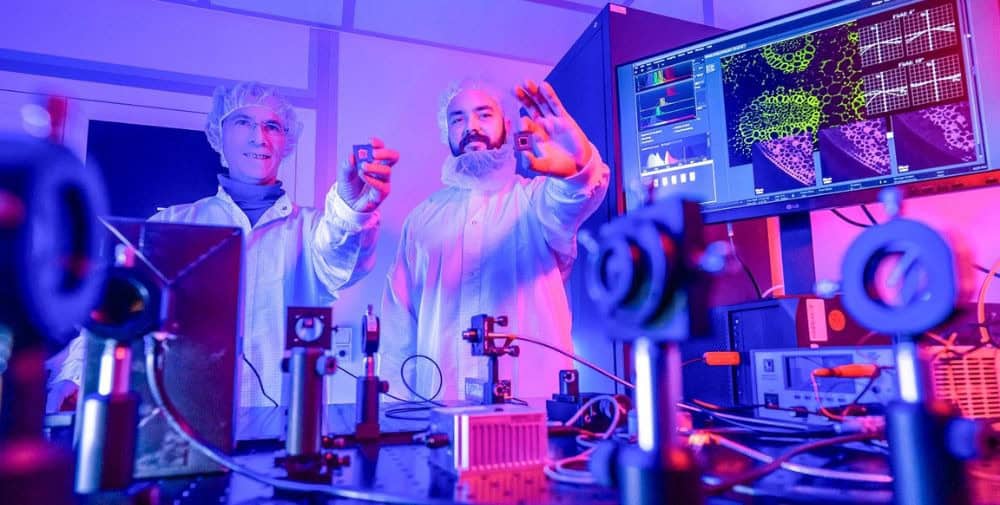
Fraunhofer IPMS is a central research partner in the OASYS project. The aim of the collaboration is to develop compact, energy-efficient and highly integrated optoelectronic sensor components for the life sciences and intelligent manufacturing. The project focuses on two main areas of research: Firstly, MEMS-based hyperspectral imaging for industrial and agricultural technology applications, and secondly, high-resolution optical processes for the life sciences, in particular for imaging in scattering media. The basis for this are state-of-the-art microelectromechanical components, photonic technologies and adaptive optical concepts, from which novel processes and systems are developed.
Lead project B1 – MEMS-based imaging in scattering media
The lead project B1, in which Fraunhofer IPMS plays a key role, develops imaging systems for highly scattering media, such as biological tissue. In such environments, light scattering, absorption and reflection (e.g. by various molecules, pigments or cells) lead to wavefront distortions (phase), resulting in a significantly limited imaging depth and image quality.
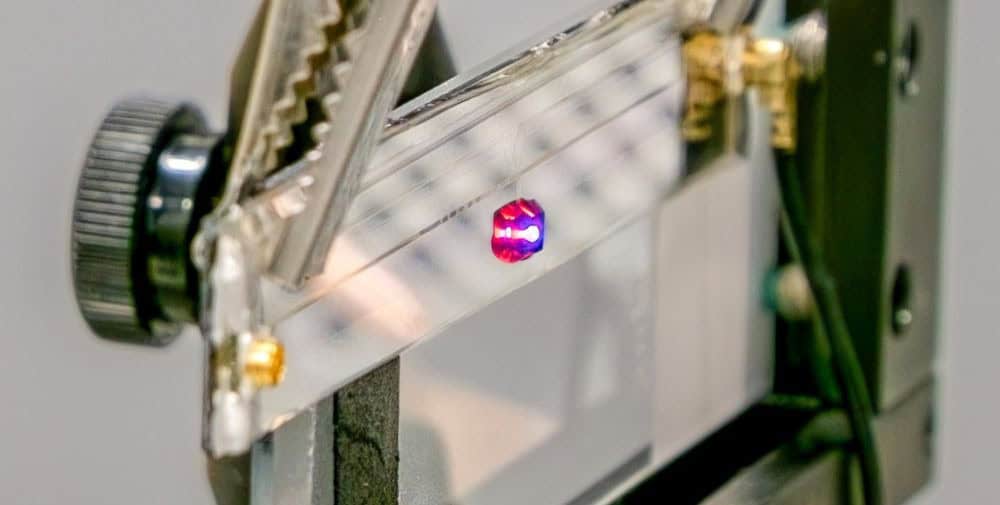
For this purpose, specific spatial light modulators (SLMs) were developed at Fraunhofer IPMS. These consist of thousands to millions of individual micromirrors that can be moved independently of each other at high speed (kHz range) in order to adjust the wavefront of the light. Optical distortions can thus be corrected in a targeted manner, enabling high-resolution imaging even in deep and highly scattering tissue layers, for example in microscopy and endoscopy for deep tissue imaging. The aim is to improve non-invasive diagnostic options (e.g. cancer), treatment monitoring and biomedical research.
“The challenges in optical imaging are diverse and complex. With this project, we not only want to develop technical solutions, but also explore the limits of what is possible,” explains Prof. Dr. Harald Schenk, Managing Director of Fraunhofer IPMS and Professor of Micro- and Nanosystems at BTU Cottbus. “Only the high speed and precision of the microscopically small and movable micromirrors allow decisive image corrections and thus increases in resolution, which have the potential for extended diagnostic possibilities in medicine. This makes it possible to examine deep tissue layers for changes that were previously inaccessible to optical methods.”
In addition, the area light modulators developed as part of OASYS sub-project B1 open up numerous other potential applications, including microscopy for high-resolution analyses in the sub-micrometer range, use for geo-space satellites for improved earth observation and exoplanet research, as well as applications in quantum technologies for quantum computing, secure quantum communication, quantum cryptography and holography.
The OASYS joint project will run for five years (September 1, 2023 to August 31, 2028) and is funded by the Federal Ministry of Research, Technology and Space (BMFTR) with around 12.5 million euros. The project is being coordinated by the Brandenburg University of Technology Cottbus-Senftenberg (BTU). In addition to the Fraunhofer IPMS, the Ferdinand-Braun-Institut FBH and the IHP – Leibniz Institute for Innovative Microelectronics are also part of the network. OASYS and Project B1 in particular exemplify the innovative strength of Fraunhofer IPMS in the field of optical systems. “In line with our guiding principle of making novel research results usable for innovative applications in a targeted manner, the developments are geared towards use in specific applications together with partners in practice,” Schenk emphasizes in conclusion.
– – – – – –
Further links
👉 www.ipms.fraunhofer.de
👉 Information about the OASYS project and the partners
Photo: Fraunhofer IPMS