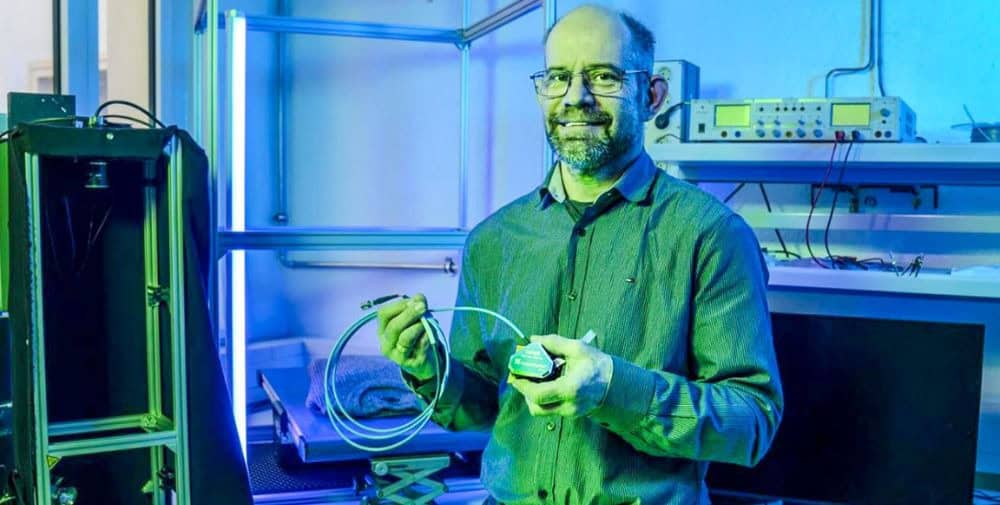
The innovative hyperspectral camera opens up numerous fields of application along industrial and agricultural value chains. The camera works according to an innovative principle: a conventional 2D camera first captures a high-resolution image of the object. Artificial intelligence analyzes this image in real time and automatically identifies the areas of interest, the so-called regions of interest. The integrated spectrometer only carries out a spectral analysis at these selected positions and determines the chemical composition. This intelligent approach makes hyperspectral measurements significantly more efficient: Instead of laboriously capturing the entire image hyperspectrally, only the relevant measuring points are analyzed. This significantly reduces data volumes, energy consumption and computing time.
The resulting information supports the reliable sorting of textiles and plastics, for example, and increases security when identifying counterfeits. In addition, they improve quality control in food processing by detecting bruises and defects, and enable an accurate assessment of plant condition and nutrient requirements in agriculture. Automated evaluation means that decisions can be made much more quickly and reliably. At the same time, processes are made more sustainable and economic resources are used more efficiently.
“With the compact hyperspectral camera from OASYS A1, we are creating a technology that brings analytical processes to where they are needed: directly into production lines, sorting systems or in the field,” explains Heinrich Engelke, project manager at the Fraunhofer Institute for Photonic Microsystems IPMS. “The combination of miniaturization, energy efficiency and artificial intelligence opens up completely new application possibilities and at the same time makes an important contribution to resource conservation and process reliability.”
The components developed in the project form the basis for future sensory systems that can achieve significant improvements in industry and recycling as well as in the agricultural and food sectors.
About the project
The OASYS research program covers a period of five years from September 2023 to August 2028 and is funded by the Federal Ministry of Research, Technology and Space (BMFTR) with around 12.5 million euros. The Brandenburg University of Technology Cottbus-Senftenberg (BTU) is coordinating the project. In addition to the Fraunhofer IPMS, the Ferdinand-Braun-Institut FBH and the IHP – Leibniz Institute for Innovative Microelectronics are also involved in the network. The joint involvement in OASYS and in particular the work in project A1 underline the leading role of Fraunhofer IPMS in the development of innovative optical system technologies.
Further information about the OASYS project and the partners can be found on the website https://oasys-cottbus.com
About Fraunhofer IPMS
Fraunhofer IPMS is a leading international research and development service provider for electronic and photonic microsystems in the application fields of intelligent industrial solutions, medical technology and health, mobility as well as green and sustainable microelectronics. Research focuses on customer-specific miniaturized sensors and actuators, MEMS systems, microdisplays and integrated circuits as well as wireless and wired data communication. The services offered range from consulting and design to process development and pilot series production
– – – – – –
Further links
👉 www.ipms.fraunhofer.de
Photo: BTU / Fraunhofer IPMS