Intelligent sensor technology can extend the service life of bridges or other engineering structures, plan renovations in a more targeted manner and increase safety – efficiently and sustainably. The testing and monitoring of engineering structures in Germany – especially bridges – is governed by the DIN 1076 standard. Although this provides for regular structural inspections, it does not currently include constant structural monitoring, which can create a solid data basis for assessing the need for refurbishment or remaining service life. Fraunhofer IIS is a member of DeGeBaM, the Society for Structural Health Monitoring, which is committed to making sensor technology an integral part of the standard. One problem: the market for specific structural health monitoring sensors is small, so the technology is expensive.
Saving costs by reusing established technology
In its search for a cost-effective solution, Fraunhofer IIS in Dresden came across an established technology with similar requirements. “High precision, long service life, permanent load and temperature tolerance from minus 40 to plus 120 degrees Celsius? The answer was quite clear: automotive sensor technology,” explains Dr. Christoph Sohrmann, group manager at Fraunhofer IIS. “For example, so-called MEMS sensors, previously only installed in vehicles or cell phones, which can ‘hear’ a break in the prestressing wires of prestressed concrete bridges, are conceivable. We will soon be testing this principle on a real bridge with the company MKP GmbH. Above all, however, we use radar sensors, originally developed for autonomous driving.” The costs of commercially available special sensor technology for infrastructural monitoring are 10 or even 100 times higher than those of a corresponding new use of vehicle sensor technology, because many aspects such as the hardware, production standards, cybersecurity aspects and self-monitoring of the sensors can be adopted from automotive use.
Necessary: Technical adaptations and interlinking of trades
The radar sensor technology from the automotive sector cannot be used one-to-one for so-called “structural health monitoring” (SHM), which aims to detect various damage processes on structures. Frequency-based processing from the automotive sector offers too low a resolution for detecting the smallest changes in structures. In the real laboratory at TU Dresden in Bautzen, the Fraunhofer researchers tested tactile sensor technology in conjunction with non-contact measurement using radar on the 45-metre-long test bridge. The reference data collected in this way is used to develop and validate suitable sensor and monitoring concepts for infrastructural monitoring. “Our radar sensors make it very easy to measure vibrations on structures as part of condition monitoring and SHM campaigns,” says Sohrmann. “Our solution uses a phase-based interferometric evaluation of the data, which also makes it possible to measure static displacements in the millimetre or even sub-millimetre range as well as vibrations with frequencies of up to over 1000 Hz.”
The measurement campaigns are commissioned and evaluated by the building authorities responsible for the road safety of the structures and associated civil engineering offices. According to Sohrmann, an intensive exchange between the trades is therefore essential for success. “What data needs to be collected and with what accuracy and frequency? Are the results easy enough to read? These kinds of questions need to be clarified for a tailor-made development,” says Sohrmann. Prof. Steffen Marx, Professor of Concrete Structures at TU Dresden, has therefore supported the project from the very beginning with valuable input from the civil engineering side.
Further development in follow-up project RICARES
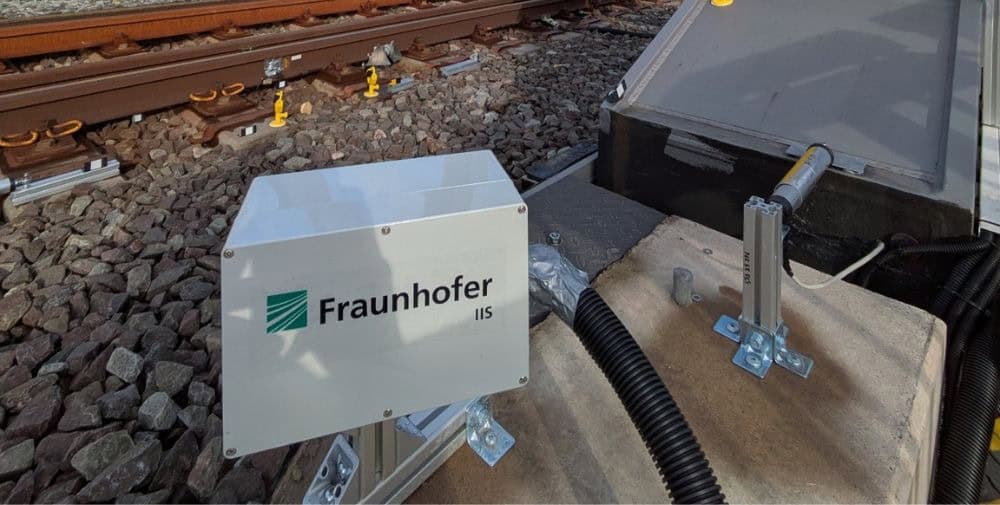
For the measurements, the sensors – so-called ground-based radar inferometers – are placed on or under a bridge, for example. Dynamic measurement campaigns can be carried out in just a few days or weeks, while data is collected over several years for long-term monitoring. “How many sensors we can synchronize and which sensors we can best optimize with suitable lenses or antennas or even reflectors on the bridges is one of the topics of our follow-up project RICARES,” explains Sohrmann. The project, which will start in January 2026, is supported by the Sächsische Aufbaubank SAB and focuses on monitoring the stability of railroad bridges, but the technology can also be used for road bridges.
Affordable sensor technology enables comprehensive monitoring
“Affordable sensor technology enables construction authorities to establish infrastructure monitoring not only in suspected cases, but across the board,” says Sohrmann. “They should seize this opportunity, because historical data on the load on structures in particular is a great help in analyzing incipient damage.” In addition to RICARES, the scientist is now aiming for meaningful further funding and partnerships with appropriate industrial partners.
– – – – – –
Further links
👉 www.eas.iis.fraunhofer.de
Photo: Fraunhofer IIS