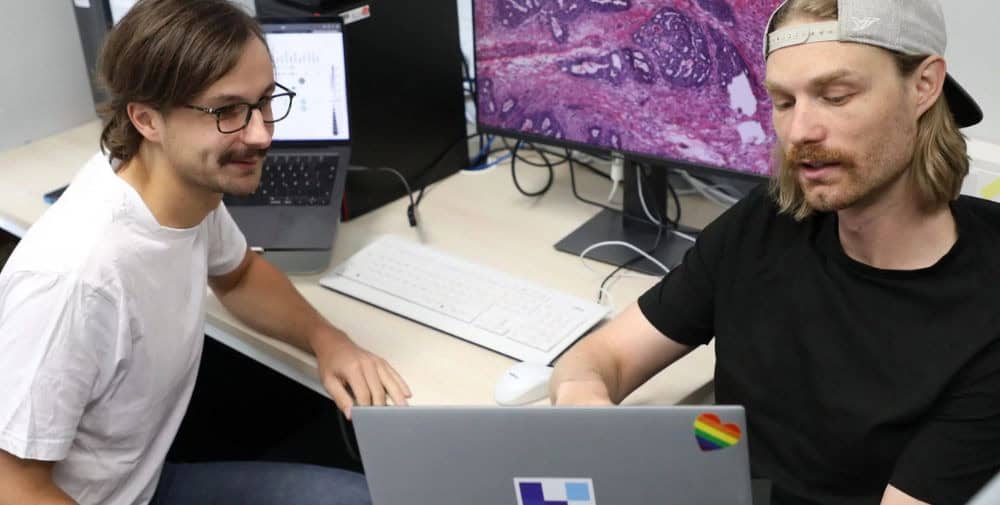
The multicentre study analyzed almost 2,000 digitized tissue sections from patients with colorectal cancer from seven independent cohorts in Europe and the USA. The samples included cross-sectional images of tissue samples as well as clinical, demographic and lifestyle data. The researchers developed a novel “multi-target transformer model” that can predict a variety of genetic alterations directly from standard histologically stained tissue sections of colorectal cancer samples. Previous studies were mostly limited to predicting only one genetic alteration at a time – simultaneously occurring mutations and the associated changes in the tissue were largely ignored.
“Previous deep learning models and the analysis of the underlying tissue changes usually refer to only one mutation at a time. Our new model can identify many biomarkers at the same time, including those not previously considered clinically. We were able to demonstrate this in several independent cohorts. We found that many mutations occur more frequently in microsatellite unstable (MSI) tumors,” explains Marco Gustav, first author of the study and scientist at the EKFZ for Digital Health at TUD. Certain types of colorectal cancer can be classified on the basis of microsatellite instability (MSI). Microsatellites are short, repetitive DNA sequences that are distributed throughout the genome. In cancer, MSI can occur when these sequences become unstable due to a defect in the DNA repair system. MSI serves as an important biomarker to identify patients who could benefit from immunotherapy. “This suggests that different mutations together contribute to the altered appearance of the tissue. So the model recognizes common visual patterns – rather than identifying genetic changes independently,” he adds.
The researchers showed that their model performed as well as established models in predicting numerous biomarkers such as BRAF or RNF43 mutations and MSI directly from pathological specimens – and even outperformed some of them. The pathological expertise for the assessment of tissue changes based on histological sections was provided by experienced physicians. Dr. Nic Reitsam from Augsburg University Hospital played a key role in the study.
On the significance of the study, Jakob N. Kather, Professor of Clinical Artificial Intelligence at the EKFZ for Digital Health at TUD and senior oncologist at the NCT/UCC of the University Hospital Carl Gustav Carus Dresden, says: “Our research shows that AI models can significantly accelerate diagnostic procedures. At the same time, we are using these methods to gain new insights into the relationship between molecular and morphological changes in colorectal cancer. In the future, this technology could be used as an effective pre-screening tool – and help doctors to select patients for further molecular tests and make individualized treatment decisions.”
The research team is currently planning to transfer this approach to other types of cancer.
The study was the result of an interdisciplinary collaboration between numerous scientists at leading research institutions in Europe and the USA. In addition to the TUD and the Dresden University Hospital, the Faculty of Medicine at the University of Augsburg, the National Center for Tumor Diseases (NCT) in Heidelberg, the Fred Hutchinson Cancer Center in Seattle (USA), the Medical University of Vienna (Austria) and the Mayo Clinic (USA) were also involved.
Publication
Marco Gustav, Marko van Treeck, Nic G. Reitsam, Zunamys I. Carrero, Chiara M. L. Loeffler, Asier Rabasco Meneghetti, Bruno Märkl, Lisa A. Boardman, Amy J. French, Ellen L. Goode, Andrea Gsur, Stefanie Brezina, Marc J. Gunter, Neil Murphy, Pia Hönscheid, Christian Sperling, Sebastian Foersch, Robert Steinfelder, Tabitha Harrison, Ulrike Peters, Amanda Phipps, Jakob Nikolas Kather: Assessing Genotype-Phenotype Correlations with Deep Learning in Colorectal Cancer: A Multi-Centric Study; The Lancet Digital Health, 2025.
To the study: https://www.thelancet.com/journals/landig/article/PIIS2589-7500(25)00073-1/fulltext
Else Kröner Fresenius Center (EKFZ) for Digital Health
The EKFZ for Digital Health at the TU Dresden and the University Hospital Carl Gustav Carus Dresden was founded in September 2019. It is funded by the Else Kröner-Fresenius Foundation with a total of 40 million euros for a period of ten years. The center focuses its research activities on innovative, medical and digital technologies at the direct interface to patients. The aim is to fully exploit the potential of digitalization in medicine in order to significantly and sustainably improve healthcare, medical research and clinical practice.
Contact
EKFZ for Digital Health
Anja Stübner and Dr. Viktoria Bosak
Press and Public Relations
Tel.: +49 351 – 458 11379
– – – – – –
Further links
👉 https://digitalhealth.tu-dresden.de
👉 https://tu-dresden.de
Photo: Anja Stübner / EKFZ