“Many robots are not optimally utilized – this is not due to their performance, but to how they are programmed. If the system comes to a standstill during programming, this costs valuable production time,” explains Ralf Dohndorf, Vice President Factory Simulation at DUALIS.
Online programming of robots – directly at the production cell
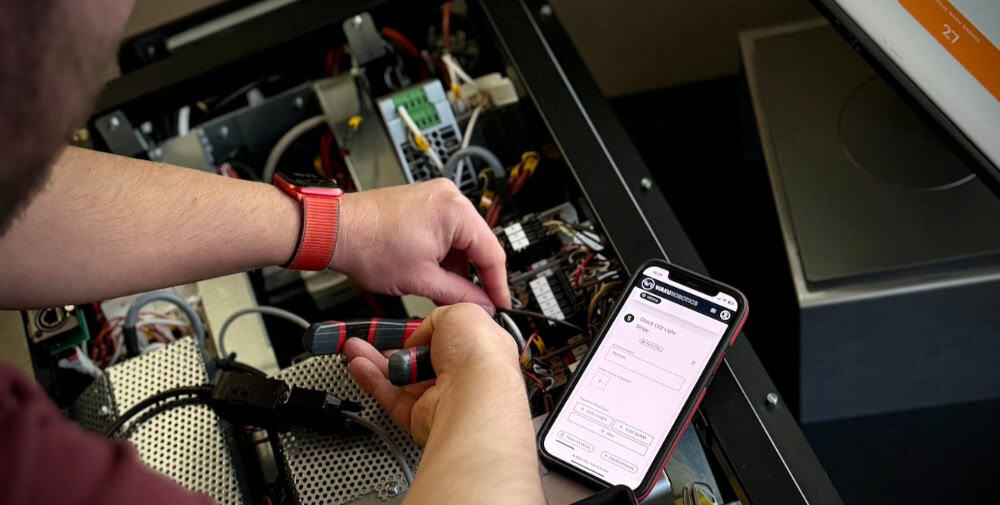
In the past, it was standard practice to program industrial robots directly at the production cell – using the so-called teach-in method. Depending on the complexity, this time-consuming process can take hours or even days. Changes to component geometry or fixtures often require complete reprogramming. Typical disadvantages include production downtime during programming and the time required for complex motion sequences. In addition, no collision check or simulation is possible, meaning that errors only become visible during real operation.
“Online programming can quickly become a bottleneck, especially with complex or variant-rich processes. This reduces system utilization and valuable production time is lost,” says Dohndorf.
Planning in parallel and staying productive with offline programming
In contrast, offline programming takes place on the computer, independently of the physical robot. Production can therefore continue. Modern OLP uses the digital twin: movements, processes and entire production scenarios are simulated. A major advantage is that there are no interruptions to production. By simulating collisions, reach and cycle time, errors and inefficiencies can be eliminated before commissioning. Programs for different robot makes and high reusability for similar processes significantly simplify workflows.
Ralf Dohndorf says: “Offline programming is often faster and more reliable than other methods, despite the initial additional work involved. It delivers precise, consistent results right from the start of the design process. Companies report up to 80 percent shorter programming times.”
DUALIS, as a distributor of Visual Components, supports its customers in integrating OLP solutions quickly and practically – with workshops, add-ons and user-friendly interfaces. The Visual Components OLP Suite enables the direct import of 3D CAD models, covers all common robot makes and offers over 18 integrated post-processors, 1-click programming and advanced calibration tools. This allows robot cells to be set up more quickly and fixtures, tools and processes to be tested and optimized virtually – without any risk to real production. Saved programs can be reused at any time or modified for comparable cells.
Vision-based programming as a supplement
In addition to online and offline programming, image processing-supported, so-called vision-based programming has become established. This method uses cameras to record the exact position and orientation of workpieces. The robot automatically derives its movements from this and can therefore react flexibly to varying component arrangements.
The process enables a high degree of flexibility as it does not require fixed fixtures. It is particularly suitable for parts with random positions or tolerances. However, stable lighting and visibility conditions are required.
Ralf Dohndorf says: “Vision-based programming is not a replacement, but a supplement. It is primarily recommended for simple, repeatable tasks – but not for precise processes with complex geometries.”
Intelligent combination is the future
In the future, DUALIS expects different programming methods to coexist. OLP is becoming increasingly important thanks to AI-supported optimization, cross-manufacturer standards and intuitive no-code interfaces. At the same time, the classic teach-in method for simple or spontaneous adjustments will remain.
“Only those who intelligently combine digital planning, simulation and advanced programming will be able to exploit the full potential of their automation. The future lies in flexibility – and that starts at the base,” explains Dohndorf.
About DUALIS GmbH IT Solution
Founded in 1990, DUALIS GmbH IT Solution – a subsidiary of iTAC Software AG and part of the Dürr Group – specializes in the development of software and services for simulation, process optimization and production planning. The product range includes the APS system GANTTPLAN, the 3D simulation platform Visual Components and the hall planning tool AREAPLAN. DUALIS products are integrated in numerous well-known applications in large-scale industry and in medium-sized companies in the production and service sectors. Consulting and services for strategic and operational planning round off the DUALIS range of services.
The Dürr Group is a leading global mechanical and plant engineering company with particular expertise in the technology fields of automation, digitalization and energy efficiency. Its products, systems and services enable highly efficient and sustainable manufacturing processes – especially in the automotive industry, for manufacturers of furniture and wooden houses as well as in the assembly of medical and electrical products and in battery production. The Dürr Group achieved sales of € 4.7 billion in 2024 and currently has around 18,000 employees and 130 locations in 32 countries.
– – – – – –
Further links
👉 www.dualis-it.de
Photo: Visual Components/DUALIS