March 4, 2026: Funding is intended to bring together Europe’s distributed excellence and ensure greater visibility in global competition
Categories

March 4, 2026: Funding is intended to bring together Europe’s distributed excellence and ensure greater visibility in global competition
Categories
Tags

Contact info
Silicon Saxony
Marketing, Kommunikation und Öffentlichkeitsarbeit
Manfred-von-Ardenne-Ring 20 F
Fax: +49 351 8925 889
Contact person:
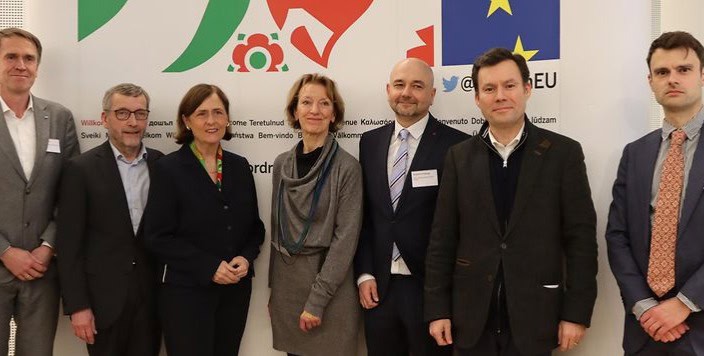
How can European science be strengthened in global competition? The German Research Foundation (DFG), the German Rectors’ Conference (HRK) and the German Council of Science and Humanities (WR) presented a discussion paper on this question entitled “Nexus – Networking excellence – Enabling participation – Transforming European Science” in Brussels on March 3. In it, they propose strengthening the networking of cutting-edge research within the European Research Area. Nexus is intended to strengthen institutionalized cooperation between the best universities and research institutions in Europe – in addition to existing funding instruments. The starting point for these considerations is the Draghi Report by the former President of the European Central Bank on European competitiveness, which outlined an “ERC for Institutions” as a highly competitive program for particularly strong research institutions in 2024, based on the European Research Council (ERC).
DFG, HRK and WR propose using the Nexus funding instrument to establish networks of excellence in future, consisting of at least three universities or research institutions from different countries. The networks should conduct research on a common topic of strategic importance to the participating institutions. The guiding principles should be a science-led selection process, a focus on excellence, openness to all disciplines and topics and embedding in strategic processes at the universities or research institutions. In the view of the DFG, HRK and WR, the ERC would be the ideal place to implement these principles. Regardless of the location of the concept within the new European Research Framework Program, the aforementioned principles must be maintained.
Nexus funding would finance a network with 20 million euros per year over a period of seven years. If located in the ERC, 20 networks could be funded in a pilot phase. The prerequisite would be that funds are made available in the new EU Research Framework Program FP10 in addition to the planned ERC budget (2028-2034: 2.8 billion euros). After the pilot phase, the implementation and impact of Nexus should be evaluated in order to decide on its continuation.
“Our concept aims to link Europe’s distributed excellence more systematically and content-oriented than before and to use synergies at Europe’s universities and research institutions for this purpose. In this way, Europe’s cutting-edge research should achieve the critical mass required for future scientific breakthroughs. Nexus can thus not only overcome the fragmentation within the European Research Area, but also support the resilience of the European research and innovation landscape and further increase Europe’s international visibility as a globally competitive region for science and innovation,” said DFG President Professor Dr. Katja Becker at the presentation of the concept in Brussels.
HRK President Professor Dr. Walter Rosenthal explained the joint proposal: “Nexus would increase the international visibility of cutting-edge European research with thematically focused networks that connect and strategically support top players from universities and research institutions. The prerequisites for this are lean application processes, thematic openness and the full range of European cutting-edge research – from basic to applied research. In this way, Nexus could strengthen scientific performance in Europe in a targeted manner and provide positive impetus for European society.”
The Chairman of the Science Council, Professor Dr. Wolfgang Wick, added: “Europe should set new priorities in the short term, as competition for ideas, talent and resources is increasing rapidly. In addition to the existing programs with content-related guidelines, more open competition is needed. The Excellence Strategy in Germany shows that a lot can be achieved if there are no content-related guidelines and instead a lot of emphasis is placed on creativity and bottom-up driven cooperation in science. Nexus is intended to help universities and research institutions to network cutting-edge research that is competitive in the long term.”
The joint idea of a Nexus funding instrument is based on the experience of the DFG, HRK and WR with the German Excellence Initiative and Excellence Strategy, which have shown that initiatives to promote cooperative excellence can significantly strengthen the international competitiveness and visibility of universities and other research institutions. Nevertheless, Nexus does not simply transfer the German model to the EU level, but tailors the proposed networks of excellence precisely to European needs.
You need to load content from reCAPTCHA to submit the form. Please note that doing so will share data with third-party providers.
More InformationYou are currently viewing a placeholder content from Turnstile. To access the actual content, click the button below. Please note that doing so will share data with third-party providers.
More InformationYou are currently viewing a placeholder content from Facebook. To access the actual content, click the button below. Please note that doing so will share data with third-party providers.
More InformationYou are currently viewing a placeholder content from Google Maps. To access the actual content, click the button below. Please note that doing so will share data with third-party providers.
More InformationYou are currently viewing a placeholder content from OpenStreetMap. To access the actual content, click the button below. Please note that doing so will share data with third-party providers.
More InformationYou are currently viewing a placeholder content from Instagram. To access the actual content, click the button below. Please note that doing so will share data with third-party providers.
More InformationYou are currently viewing a placeholder content from X. To access the actual content, click the button below. Please note that doing so will share data with third-party providers.
More Information