March 11, 2026 Decision in the evaluation procedure of the Universities of Excellence funding line of the Excellence Strategy
Categories

March 11, 2026 Decision in the evaluation procedure of the Universities of Excellence funding line of the Excellence Strategy
Categories
Tags

Contact info
Silicon Saxony
Marketing, Kommunikation und Öffentlichkeitsarbeit
Manfred-von-Ardenne-Ring 20 F
Fax: +49 351 8925 889
Contact person:
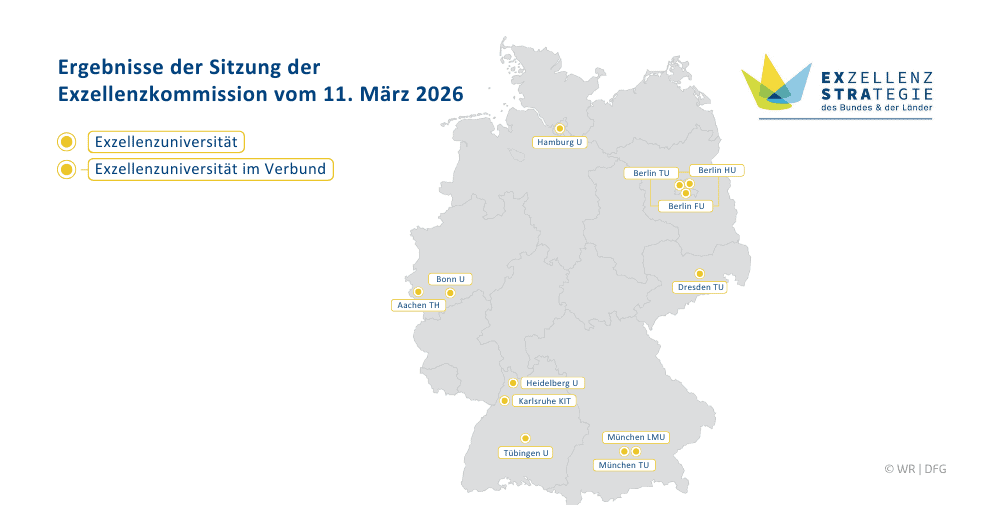
Green light for Germany’s Universities of Excellence: Ten of the eleven institutions currently funded under the Excellence Strategy of the federal and state governments were evaluated as part of their permanent funding and all received a positive assessment. From January 1, 2027, the following institutions will receive funding for a further seven years: RWTH Aachen University, the University of Bonn, the Berlin University Alliance (an alliance of FU, HU and TU Berlin), TU Dresden, Universität Hamburg, Universität Heidelberg, KIT Karlsruhe, LMU Munich, TU Munich and the University of Tübingen. The University of Konstanz had not reached the minimum number of Clusters of Excellence required for continued funding.
Frank Bösenberg, Managing Director of Silicon Saxony, Europe’s largest trade association for the microelectronics industry, comments:
“We warmly congratulate TU Dresden on retaining its status of excellence. As an indispensable partner in Saxony’s microelectronics and software ecosystem, TU Dresden ranks among Germany’s very top universities. It trains skilled professionals, drives key technologies forward and strengthens our international competitiveness. At Silicon Saxony, we look forward to continuing our close collaboration in research, technology transfer and talent retention.”
The decision was made today based on the evaluation of the Committee of Experts, which is made up of international scientists, and was unanimously confirmed by the Excellence Commission of the Excellence Strategy. This is made up of the Committee of Experts and the federal and state science ministers.
The decisions were announced following the meeting via livestream by the Chairman of the Science Council, Wolfgang Wick, the President of the German Research Foundation, Katja Becker, the Federal Minister of Research, Technology and Space, Dorothee Bär, and Falko Mohrs, the Deputy Chairman of the Joint Science Conference of the Federal Government and the Länder (GWK) and Lower Saxony’s Minister of Science and Culture. They praised the commitment of the universities, which had impressively achieved the goals set as part of the funding and successfully developed their institutions strategically. They also emphasized the quality of the scientific assessment and the evaluation by the Committee of Experts as the basis for the joint science-led decision by science and politics in the Excellence Commission, as well as the outstanding importance of the Excellence Strategy for Germany as a science location.
The Committee of Experts acknowledged the successes achieved through the funding, which the Excellence locations had documented in detail in their self-reports. These had also become visible during the on-site visits, which were also used by the locations of excellence as an impetus for quality assurance and further development.
The overall university excellence funding was used by the funded institutions as a lever for institutional change and strategic prioritization. Energy and resources have been used very effectively, the goals set have been achieved and in some cases even exceeded. Overall, greater international visibility, a successful selection of the best from the global talent pool, an increase in prestigious international grants and strong national and international partnerships were achieved, according to the conclusion of the international Committee of Experts.
The increase in scientific performance and enhanced reputation would not only benefit the locations of excellence, but also the entire German science system, which could learn from these experiences. The locations of excellence are a good example of how institutional development can succeed and what conditions are necessary for this. The increasingly interdisciplinary organization of research and the involvement of young researchers, who take on responsibility at an early stage, contribute new ideas and thus strengthen the institutions’ capacity for renewal, were praised as exemplary. This is accompanied by participative and adaptable governance structures, so that the strategies are implemented on a broad basis.
Another effect of the funding is the high priority given to issues of equal opportunities and diversity. Transfer is also being consistently driven forward. It has also become clear that the Universities of Excellence contribute to solving challenges facing society as a whole. This is demonstrated by the efforts to increase knowledge and expertise on issues such as research security and responsible innovation in the interests of society as a whole.
Among the recommendations that the committee has made to the Excellence locations are A closer link between monitoring and strategy formation in order to guarantee the success of measures as well as data-based further development. In addition, the institutions should focus even more specifically on the needs of different groups of people when it comes to diversity and equal opportunities, further consolidate research-oriented as well as practice-oriented teaching and, particularly in technology-related areas, more consistently teach ethical skills.
The Committee of Experts is convinced that the research-intensive locations will also use the future funding to consistently pursue their strategic goals and constructively implement the recommendations of the international experts. The Universities of Excellence funding line, in conjunction with regular evaluations, creates a reliable and at the same time quality-assured framework. This long-term approach gives the Universities of Excellence the planning security they need to develop sustainable structures and remain internationally competitive and capable of renewal at an institutional level.
In order to make the review process transparent and provide impetus for a learning science system, the statements of the Committee of Experts on the individual Universities of Excellence will be published on the website of the German Council of Science and Humanities on March 16.
In the first round of the competition in 2019, ten individual universities and one university alliance were recommended for permanent funding in the Universities of Excellence funding line. The prerequisite for the continuation of permanent funding is the successful acquisition of at least two or, in the case of a University of Excellence alliance, three Clusters of Excellence, as well as a positive evaluation of the funded Universities of Excellence, which is carried out every seven years.
After the Excellence Commission of the Excellence Strategy selected 70 Clusters of Excellence in May 2025 for (continued) funding from January 1, 2026, it was clear that ten of the eleven Excellence locations continued to meet the requirements for funding in the Universities of Excellence funding line. One university no longer met the required minimum number of clusters of excellence
At the beginning of the first evaluations carried out in summer 2025, the funded Universities of Excellence submitted self-reports on the extent to which the goals set during the first funding phase had been achieved and what effects had been achieved beyond this.
From September to December of the same year, site visits with international expert groups took place at all locations. The locations were measured against the goals they had defined themselves and their individual strategic development.
For the 2027-2033 funding period, up to five additional Universities of Excellence or Universities of Excellence alliances can be funded in addition to the ten positively evaluated locations if the science-led process is successful. The total funding amount of the funding line in the first funding phase amounted to 148 million euros per year for eleven funding cases.
In future, up to an additional 60 million euros will be available for a maximum of 15 funding cases. Depending on the application, the individual funding amounts are between 10 and 15 million euros per year for individual universities and between 15 and 28 million euros for university alliances. The exact funding amounts for the coming funding phase will be determined after the decision on the up to five additional Universities of Excellence has been made next October.
In accordance with the administrative agreement between the federal and state governments on the Excellence Strategy, the Universities of Excellence funding line is implemented by the German Council of Science and Humanities. The DFG carries out the Clusters of Excellence funding line.
As in the first round of calls, a single university is eligible to apply if it has at least two clusters of excellence. A joint application as a consortium of two or three universities requires the funding of at least three clusters of excellence at these universities. Each of the universities participating in the consortium must either have at least one Cluster of Excellence or be involved in a joint Cluster of Excellence as an applicant.
The Science Council received eleven applications(Download) for the Universities of Excellence funding line of the Excellence Strategy by the deadline of November 12, 2025. Seven applications were submitted by individual universities and four by consortia of two or three universities.
In a next step, site visits by international expert groups will take place from April to June 2026. On October 2, 2026, the Excellence Commission will decide on the new Universities of Excellence or Excellence Alliances to be selected. Funding for all Excellence locations will begin on January 1, 2027.
You need to load content from reCAPTCHA to submit the form. Please note that doing so will share data with third-party providers.
More InformationYou are currently viewing a placeholder content from Turnstile. To access the actual content, click the button below. Please note that doing so will share data with third-party providers.
More InformationYou are currently viewing a placeholder content from Facebook. To access the actual content, click the button below. Please note that doing so will share data with third-party providers.
More InformationYou are currently viewing a placeholder content from Google Maps. To access the actual content, click the button below. Please note that doing so will share data with third-party providers.
More InformationYou are currently viewing a placeholder content from OpenStreetMap. To access the actual content, click the button below. Please note that doing so will share data with third-party providers.
More InformationYou are currently viewing a placeholder content from Instagram. To access the actual content, click the button below. Please note that doing so will share data with third-party providers.
More InformationYou are currently viewing a placeholder content from X. To access the actual content, click the button below. Please note that doing so will share data with third-party providers.
More Information