Over 400 participants, top international speakers and a new AI survey on the state of artificial intelligence in software engineering
Categories

Over 400 participants, top international speakers and a new AI survey on the state of artificial intelligence in software engineering
Categories
Tags

Contact info
Silicon Saxony
Marketing, Kommunikation und Öffentlichkeitsarbeit
Manfred-von-Ardenne-Ring 20 F
Fax: +49 351 8925 889
Contact person:

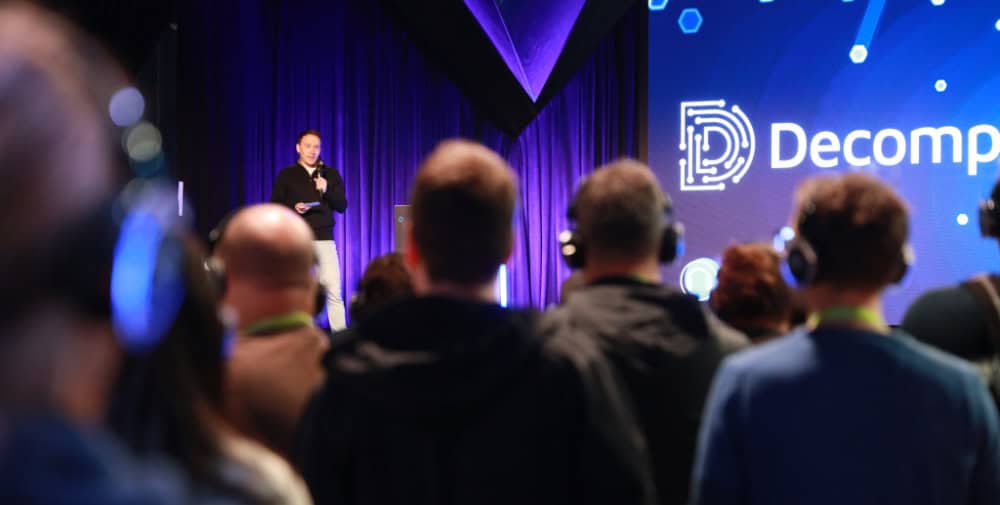
Dresden, March 12, 2026. The OSTRA-DOME in Dresden will once again be the meeting place for the international software community. The DecompileD 2026 will be attended by over 400 developers, product managers and tech decision-makers from all over the world. The focus will be on the questions of how artificial intelligence can be integrated into development processes, how modern cloud architectures can be scaled and how product teams can remain capable of acting under increasing complexity.
International perspective with global players
With speakers from GitHub, AWS, Uber, SAP, Grafana Labs, Blue Yonder, LinearB, Communardo and ParshipMeet, among others, DecompileD brings international perspectives directly to Dresden. Guests are traveling from Brazil, Japan, France, Belgium and the Czech Republic, among others. This gives regional development teams access to expertise that would otherwise require international conferences. For tech events of this size in Germany, such a high level of international participation is by no means a matter of course. “DecompileD 2026 will once again make Dresden and Saxony a central hotspot for software development in Germany. The conference focuses on the use of AI in code development and provides first-hand international insights. After the thesis “Software is eating the world”, the question now arises as to whether “AI is eating software” will apply in the future and to what extent the widespread “AI fear” is actually justified,” says Prof. Dr. Frank Schönefeld, Chairman of the Silicon Saxony Presidium and Deutsche Telekom MMS.
New study: AI in software development – widespread, hardly thought through
A recent interview study by the consulting firm DevBoost among 80 tech leads from the DACH region, with CTOs, VP Engineering and development managers mainly from medium-sized software companies, paints a sobering picture: AI has arrived on a broad scale, but is hardly strategically underpinned.
The key findings:
The core message of the DevBoost AI Report is clear: the crucial strategic question is not “Which tool?”, but “Which use case first?” and it is precisely this step that most companies are currently skipping. The results of the study can be downloaded from March 12 here.
Focus on productive AI in everyday engineering
The conference focuses on the topics that are currently fundamentally changing software development. The focus is on the productive use of Generative Artificial Intelligence. It is not the vision that will be discussed, but the application in everyday life: How can AI-supported code assistants be meaningfully integrated into existing development processes? What impact do large language models have on architecture decisions, testing strategies and release cycles? And how does the role of developers change when AI goes from being a field of experimentation to an operational tool? The keynote will be held by Pierre Tempel, Director of Product Management at GitHub. Under the title “Ship Faster, Break Less: Practical AI for Builders”, he will show how AI-supported tools can change development cycles and measurably increase productivity.
Cloud, product development and engineering culture
Another focus will be on modern cloud engineering. The focus is on topics such as scalable infrastructures, observability, security, resilience and platform strategies. Particularly against the backdrop of growing regulatory requirements and complex, distributed systems, companies will report first-hand on how they reconcile innovation speed and stability. Web and mobile development will also be strategically examined. Performance optimization, user centricity, modern front-end architectures and the integration of intelligent services show how closely product management and engineering are interlinked today. Experience reports from international companies will also illustrate how team structures, quality processes and collaboration are changing under the influence of AI and automation. The program comprises four parallel tracks on Generative AI, Cloud Engineering, Web and Mobile Development as well as Product Development and Engineering Stories. It will be complemented by two masterclasses, a lightning talk format for compact impulses and a live recording of the programmier.bar podcast.
Strengthening the tech location Dresden
DecompileD is supported by an organizational team from the regional tech scene, including representatives from DevBoost, WAKU Robotics and Alarm Dispatcher. The aim is to offer the community a place for professional exchange, benchmarking and international networking. At the same time, the conference sends a clear signal beyond the region. Silicon Saxony is traditionally perceived as a leading microelectronics location. However, the cluster is also increasingly establishing itself as a software location with international appeal. The fact that experts from different continents are specifically traveling to Dresden to share their knowledge and exchange ideas with the local scene underlines this development. DecompileD thus shows that Dresden as a technology location not only bundles industrial excellence, but also modern software and AI expertise and makes it internationally visible. “The regional developer scene is already very well networked. DecompileD creates an additional platform: both for a very informal exchange within the community and for further networking with new companies and technologies. The presentations are given by experts and are very informative. They once again demonstrate the innovation potential and digital clout of the region,” says Linda Splitt, Senior Business Development Manager Cloud&Heat Technologies GmbH.
Who is behind DecompileD?
A collective of colleagues and friends from very different areas of the tech industry came up with the idea of organizing a major software event in 2018. Since 2019, Silicon Saxony has taken over the organization of the event with the firm conviction that Dresden has a lot of potential in the tech sector as a location for education, innovation and business and needs an international tech conference like DecompileD to make current topics and key players visible. This wish is the result of many discussions with experts, start-up founders and students. The growing interest of science and business in the areas of cloud, mobile development and machine learning is also a strong argument in favor of this.
Establishing a tech hub
The DecompileD partners are contributing to the vision of establishing a tech hub in eastern Germany and thus bringing the most exciting topics in the industry back home. DecompileD offers companies an attractive platform to present themselves to the local developer scene.
Image material for download at:
https://www.flickr.com/photos/siliconsaxony/albums/72177720323726530/
For media use free of charge.
Image credit: © Silicon Saxony
For media inquiries:
WeichertMehner, Phone: 0351 50 14 02 00
Email: info@weichertmehner.com
About Silicon Saxony: With over 650 members, Silicon Saxony is Saxony’s largest high-tech network and one of the largest microelectronics and IT clusters in Germany and Europe. As a self-financed association, Silicon Saxony has been connecting manufacturers, suppliers, service providers, colleges/universities, research institutes, public institutions and industry-relevant start-ups in Saxony and beyond since its foundation in 2000. The overarching goals of the network’s work include expanding and strengthening Europe’s leading microelectronics location and driving forward the parallel development of Saxony as a software state.
You need to load content from reCAPTCHA to submit the form. Please note that doing so will share data with third-party providers.
More InformationYou are currently viewing a placeholder content from Turnstile. To access the actual content, click the button below. Please note that doing so will share data with third-party providers.
More InformationYou are currently viewing a placeholder content from Facebook. To access the actual content, click the button below. Please note that doing so will share data with third-party providers.
More InformationYou are currently viewing a placeholder content from Google Maps. To access the actual content, click the button below. Please note that doing so will share data with third-party providers.
More InformationYou are currently viewing a placeholder content from OpenStreetMap. To access the actual content, click the button below. Please note that doing so will share data with third-party providers.
More InformationYou are currently viewing a placeholder content from Instagram. To access the actual content, click the button below. Please note that doing so will share data with third-party providers.
More InformationYou are currently viewing a placeholder content from X. To access the actual content, click the button below. Please note that doing so will share data with third-party providers.
More Information