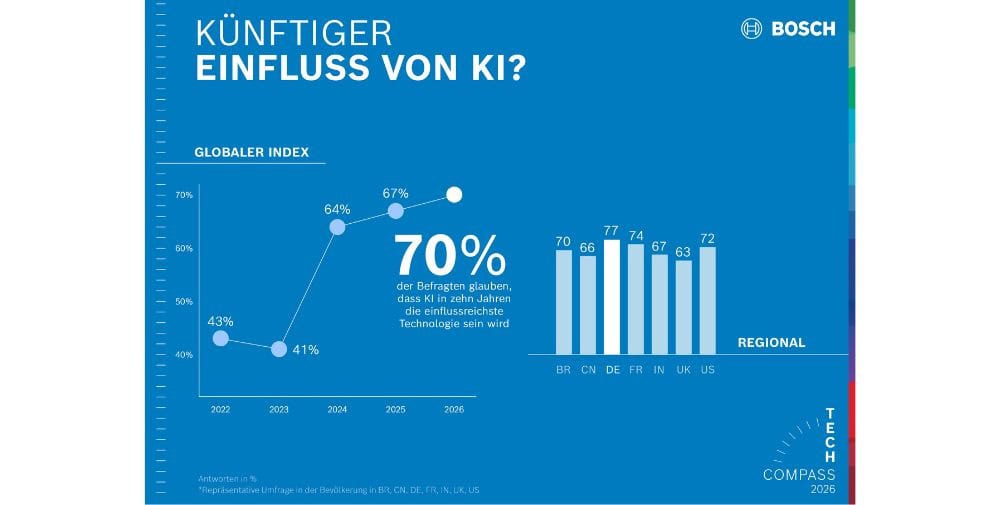
Germans have the highest expectations of AI
The expectations associated with AI are particularly high in Germany: 77% of respondents in this country see AI as the most influential technology of the next ten years. However, as in previous years, skepticism towards technological progress is also relatively high among respondents in Germany. Only 59% believe that technology will make the world a better place – only in France (53%) are people even more skeptical. Worldwide, however, 71% are technology optimists. In Germany, only 40 percent currently feel prepared for the age of AI – the lowest figure of all countries and at the same level as last year.
Two further results could provide an answer as to where the technology scepticism in Germany comes from: Only 30 percent of respondents in Germany say that the education system has encouraged innovative thinking in them and only 23 percent think that regulation in the country successfully promotes innovation – putting Germany at the bottom of the league on both counts.
“The results of the Bosch Tech Compass indicate that we need to increase social acceptance of innovation in Germany,” says Stefan Hartung, Chairman of the Board of Management of Robert Bosch GmbH.
“However, in order to get innovation from research to the streets, the innovation policy framework must also be right: This includes measures such as tax relief for investments in innovative technologies, more agility and less bureaucracy. Overall, I would like us as a society to have more courage to take risks. And if something doesn’t work, we shouldn’t see it as a failure, but as part of the learning process,” says Stefan Hartung, Chairman of the Board of Management of Robert Bosch GmbH.
Tanja Rückert, Member of the Board of Management and CDO of Robert Bosch GmbH, comments on the results: “We are seeing a rapidly growing number of innovative AI solutions worldwide, the likes of which we could not have imagined just a few years ago. It is therefore not surprising that the number of people worldwide who see AI as the most influential technology of our future has skyrocketed from 41 percent to 70 percent in just three years.”
59 percent would encourage their child to found a start-up
The positive attitude towards innovation and risk is also a cultural issue: 59 percent of respondents worldwide would encourage their child to skip college and found a start-up if they had a ground-breaking idea. Only 52 percent of German respondents share this courage to take risks. Yet it is only through this courage that the solutions of tomorrow are created. When asked about the areas on which technological innovation should be focused, climate change (37%), access to healthcare (31%) and cyber security (28%) were mentioned most frequently worldwide.
AI with the greatest positive and greatest negative impact
According to the respondents, AI will not only be the most influential technology of the next ten years, but also the one with the greatest positive impact on society. This is predicted by 43 percent worldwide. Biotechnology and climate engineering follow at a clear distance behind, with 36% and 32% respectively believing they will have a particularly positive impact.
However, the respondents see a downside: AI also ranks above all other technologies in terms of negative impact on society, being named by 34%. Humanoid robots and self-driving vehicles follow behind.
“For us at Bosch, this is a clear mandate: innovation must go hand in hand with responsibility. When it comes to AI in particular, it is therefore important that we introduce rules for trustworthy AI worldwide. At the same time, we must avoid curtailing the development and use of AI through overregulation,” says Tanja Rückert, member of the board of management and CDO of Robert Bosch GmbH.
The study
For the Bosch Tech Compass, the Gesellschaft für Innovative Marktforschung mbH (GIM) surveyed more than 11,000 people over the age of 18 in seven countries in the fall of 2025. In Germany, France and the United Kingdom, 1,000 people each took part; in Brazil, China, India and the USA, 2,000 people each took part. Bosch was not named as a client at any point in the survey.
– – – – – –
Further links
👉 www.bosch.de
Photo: Bosch