“Stereotypical role models are still anchored in too many companies,” says Bitkom President Dr. Ralf Wintergerst. “If IT professions put women off or are too little known to them, this is not a law of nature. It is a clear mandate for companies, education and politics to break down barriers and make IT professions visible and attractive for women.”
Equality as a competitive factor for companies
German companies predominantly rate equality positively – and also see it as a factor for greater competitiveness. More than three quarters (78 percent) of companies say that without women, the economy is gambling away its future. 65 percent are of the opinion that the economy cannot solve the IT skills problem without women. At the same time, companies appreciate the benefits of teams. 9 out of 10 companies (91 percent) believe that teams of women and men improve the working atmosphere and have a positive effect on the corporate culture. 8 out of 10 (80 percent) are convinced that mixed teams increase productivity and creativity in the company. Accordingly, equality is also anchored organizationally in many companies: more than a third (37%) have an equal opportunities or women’s representative, and almost a third (32%) have a diversity officer. Overall, 42 percent have at least one of these two positions in place, 27 percent even have both.
Women continue to be underrepresented in IT and digital professions
In professional practice, however, women remain underrepresented. In 58% of German companies, less than half of employees are female – in 2025, the figure was 64%. A quarter of companies (25%) report an almost balanced ratio of women and men (2025: 19%). 13% employ more women than men, compared to 15% in the previous year.
The imbalance is significantly greater in IT and digital specialist areas. In these activities, such as IT administration, software development, but also in departments for digital transformation or artificial intelligence, none of the representative companies surveyed (0 percent) employ more women than men – as was the case in the previous year. In 89% of companies, less than half of the positions in IT and digital departments are held by women. In the previous year, this proportion was slightly higher at 94%. Only 9% report an almost balanced gender ratio here (2025: just under 4%). The international assessment is correspondingly critical: 67% of companies believe that the German economy is lagging behind when it comes to gender equality in IT and digital professions, and 17% even believe that the German economy has missed the boat. “If you want to successfully shape digital transformation and AI, you can’t afford to miss out on half of the talent,” says Wintergerst. “Mixed teams work more productively and creatively. Companies that promote diversity therefore not only improve their culture, but also strengthen their economic performance.”
What slows down women in IT and digital professions
From a business perspective, the reasons for the low proportion of women in IT and digital professions are manifold – and often lie with the companies themselves. Half of the companies (50 percent) see barriers to re-entry, such as a lack of further training during parental leave, as a key factor. 48 percent cite insufficient awareness among managers with personnel responsibility. Stereotypes within companies also play a role: 47% see male role models as an obstacle. 39 percent speak of a “glass ceiling”, i.e. structural discrimination against women with the same qualifications and performance. 35 percent state that the promotion of women is perceived as unfair by parts of the male workforce.
Political factors are also cited as a cause. More than half of the companies (55 percent) see barriers to lateral entry, 48 percent deficits in the childcare infrastructure and 40 percent clichéd career guidance as reasons for the low proportion of women. “It is crucial that more girls and young women come into contact with IT at an early age – through better career guidance, practical offers and targeted training,” says Wintergerst. “But new ways of recruiting female specialists and making it easier for women to join the industry can also help companies to attract women to IT professions.”
Women’s share: 4 out of 10 companies set themselves targets
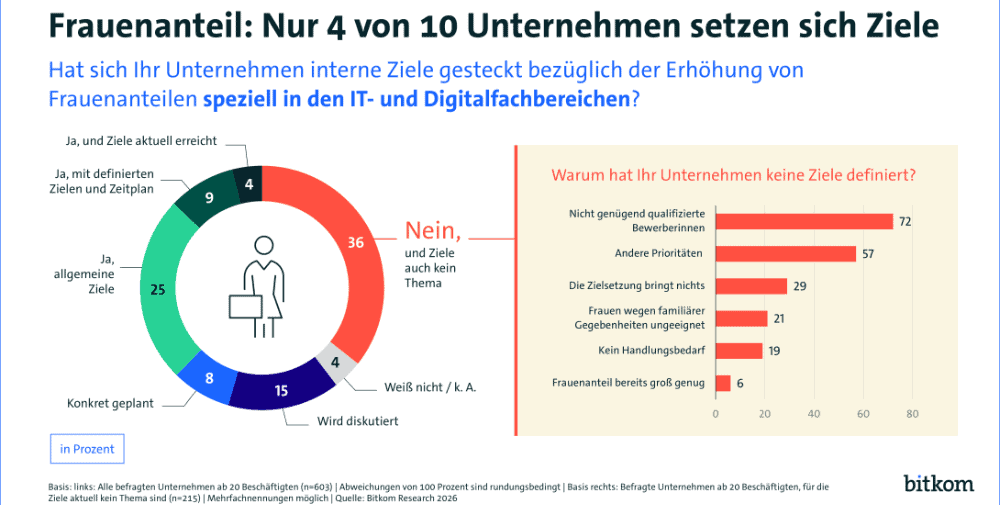
In principle, the German economy would like to see a higher proportion of women in IT and digital specialist areas. 4 percent of companies state that they have set internal targets in this regard and have already achieved them. Almost one in ten companies (9 percent) have defined targets with a timetable. A quarter of companies have set themselves general targets. 8 percent of companies are planning targets and 15 percent are discussing them. However, more than a third of companies (36%) state that they have no targets and that these are not an issue. According to these companies, they do not have enough qualified female applicants (72 percent) or they simply have other priorities (57 percent).
Majority use measures to recruit women
In order to actually attract more women specifically to IT and digital professions, a majority of 79 percent of companies use at least one measure for the targeted recruitment of women. Cooperation with universities and schools, which 29% of companies already use to attract women to IT and digital professions, is the most widespread. 25 percent offer special entry programs such as traineeships. 24 percent use advertising or social media campaigns tailored to women, while 23 percent are active at women-specific career events or fairs.
Women’s advancement in business in general: not everyone is on board
Above and beyond the IT sector, some companies continue to have reservations about women’s advancement – partly in principle, partly with regard to implementation. For example, 20 percent of respondents agree with the statement that the advancement of women is an unnecessary burden on companies, while 23 percent say it is not worthwhile. More than a quarter (28%) even believe that the advancement of women is no longer necessary. In general, there is widespread skepticism about the advancement of women: 34 percent of companies believe that the advancement of women is unfair to men, while 35 percent see it as a distraction from more important issues. Doubts about the credibility of many initiatives are also significant: 38 percent believe that the advancement of women is often only a pretext – in fact, many companies do not want to change anything in practice.
Despite these reservations, the advancement of women remains a relevant topic for many companies – and the corresponding measures are being further expanded. Companies are actively using measures to improve the work-life balance and provide support on the job. They most frequently rely on mobile working: Currently, 86 percent state that they are implementing or planning to implement corresponding offers, compared to 80 percent in 2025. Family-friendly working conditions are also on the rise, increasing from 66% to 78%. In terms of direct career development, further training remains at a high level at 72%. Mentoring grew particularly strongly from 36% to 51%. “The advancement of women must not fail because of prejudices or symbolic politics – it has to work in everyday life,” says Wintergerst. “The figures show this: Many companies are taking action, for example with flexible working models and mentoring offers. It is now crucial to implement measures consistently and to tighten them up, especially in areas where structures are still holding women back.”
Companies see themselves as responsible – but politicians must also act
More than two thirds of companies (68%) agree with the statement that companies themselves are responsible for increasing the proportion of women in IT and digital professions. At the same time, politicians also have a duty from the company’s point of view: none of the companies surveyed said that no further measures were needed from politicians; in 2025, 5% still shared this opinion. There is currently a particularly high demand for more investment in childcare infrastructure (71%) and measures along the education chain – such as promoting interest in IT among girls and young women (59%). 57% of companies also see public campaigns and role model programs as measures that the federal government should address.
“Promoting women is not only good for the women being promoted, it is at least as good for the companies promoting them,” says Wintergerst. “Companies must consistently implement diversity themselves – with clear responsibilities for equality, with job advertisements that specifically address women, with better lateral entry paths and visible role models. At the same time, this is a mandate for politicians: the fact that not a single company wants to forego further political measures is a clear signal. Priority must be given to expanding the childcare infrastructure as well as more support along the education chain – from compulsory IT lessons to targeted qualification programs for women.”
In order to inspire women to pursue careers in the digital economy and to support politicians and companies in promoting female specialists and managers, Bitkom is involved in the #SheTransformsIT initiative. The interdisciplinary alliance of business, science, politics and civil society is committed to empowering girls and women in the digital world.
“Many girls and women don’t decide against IT because they can’t do it – but because they don’t see themselves there,” says Susanne Dehmel, member of the steering committee of #SheTransformsIT and the Bitkom management board. “This is exactly where we come in: with visible role models, practical career orientation and networks that strengthen women on their career path.”
More figures on women in digitalization:
- 18 percent of women among IT specialists (source: Federal Employment Agency 2025)
- 17 percent of women studying computer science (proportion in interdisciplinary courses is significantly higher, e.g. 45 percent in medical computer science or 44 percent in computer science). 45 percent in medical informatics or 44 percent in bioinformatics) (source: calculation based on GENESIS Online, Federal Statistical Office 2026)
- 12 percent share of women in IT training (source: training market statistics, Federal Employment Agency 2024)
– – – – – –
Further links
👉 www.bitkom.org
Graphic: Bitkom