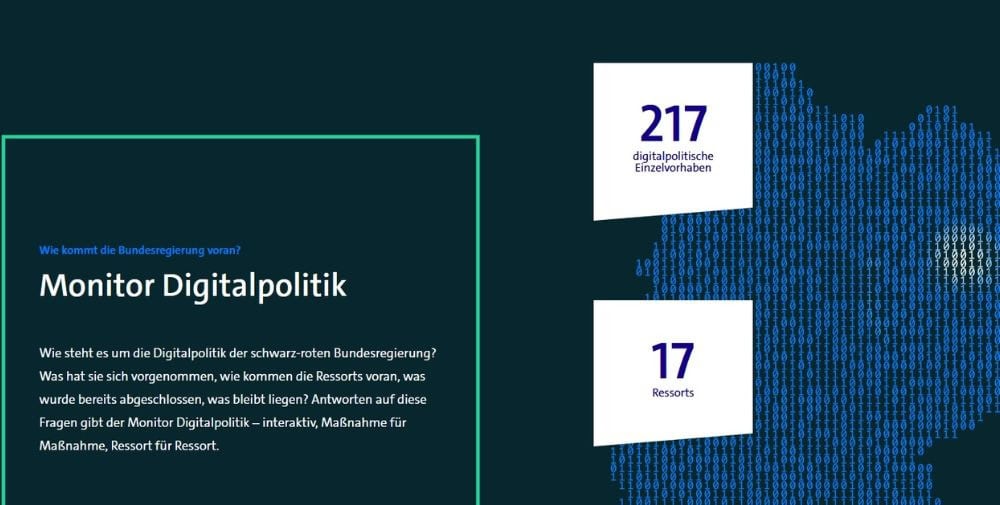
The monitor was relaunched in fall 2025 and maps the status, progress and gaps in the federal government’s digital policy across all departments. The latest version maps the situation as of January 1, 2026. The monitor can be accessed here.
According to the report, the influence of the Ministry of Digital Affairs is particularly noticeable: of its 62 projects, it has completed 7 (11%) and started 30 others (48%). “In its first few months, the federal government has brought important digital projects to the finish line, including the modernization agendas for the federal and state governments, the digital bureaucracy reporting portal and now the Digital Pact 2.0 for Germany’s schools,” says Bitkom President Dr Ralf Wintergerst. “The federal government is setting a good pace. Now the federal, state and local governments must also ensure that the measures reach the people.” For example, the bureaucracy registration portal must abolish paper forms, the federal modernization agenda must ensure that vehicles can be registered online or a company can be founded in 24 hours. And the Digital Pact 2.0 must make digital teaching the standard. As the “Digital Policy Monitor” shows, the newly created Ministry for Digital and State Modernization is in charge of 62 of the 217 projects. A further 30 projects are located in the Ministry of Economic Affairs (BMWE) and 26 in the Federal Ministry of the Interior (BMI). 22 projects are in the Ministry of Justice and Consumer Protection, 20 in Research, Technology and Space and 16 projects in the Ministry of Education, Family, Senior Citizens, Women and Youth. These are followed by the other federal ministries. In the “Digital Policy Monitor”, Bitkom will regularly review the implementation status of all digital policy projects of the federal government. The projects will be examined and classified in terms of their implementation status and their significance for digitalization.
From Bitkom’s perspective, 2026 will be decisive for important key digital projects. The first national data center strategy is expected at the beginning of the year in order to significantly strengthen the digital infrastructure. Also on the agenda is the amendment of the Telecommunications Act to create better framework conditions for network expansion. In addition, the German stack with technologies for the digitalization of administrations must be developed quickly. And where possible, written form requirements should be abolished, thus removing the obligation to sign documents by hand. Finally, the so-called Eudi Wallet, a digital wallet for all German citizens, must be prepared and filled so that it can be activated at the beginning of 2027. Wintergerst: “In 2026, digital progress must become practically tangible for people in the country. Digital policy must and can become the big winning issue for the Merz-Klingbeil government. The key projects of the coming months will determine whether this succeeds.”
– – – – – –
Further links
👉 www.bitkom.org
👉 To the Digital Policy Monitor
Photo: Bitkom