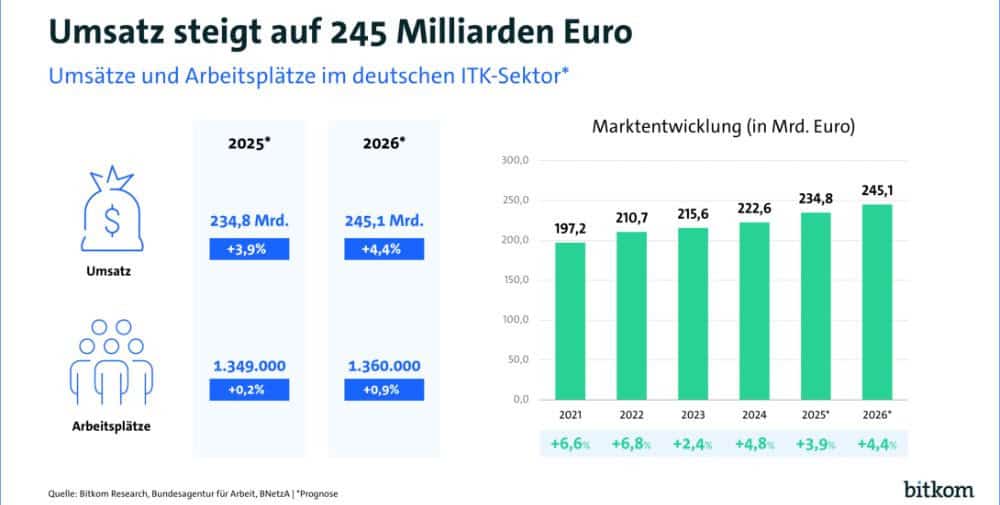
“In times of persistent economic weakness, high costs and geopolitical tensions, the digital economy is proving resilient. The current growth in the market and employment could be doubled if the framework conditions were right. 2026 must be the year of the breakthrough in digital policy,” says Bitkom President Dr. Ralf Wintergerst. “We need to move away from overregulation and bureaucracy and towards quick approvals, practical rules and a genuine digital administration that serves citizens and companies instead of draining their nerves and resources. If you want digitalization, you have to make it possible – for networks and data centers as well as for platforms, artificial intelligence and the data economy.”
Software sales grow by more than 10 percent
The growth of the digital economy will continue to be driven by information technology – above all by software. Bitkom expects IT sales in Germany to reach 170 billion euros in 2026, an increase of 5.8%. The software business is once again developing particularly dynamically, growing by 10.2% to 58.3 billion euros. Software for the operation of public clouds accounts for a significant proportion of this. This cloud software alone is expected to generate revenue of EUR 38.3 billion in 2026, an increase of 16.4% compared to the previous year. Artificial intelligence is also gaining momentum – even though the AI market has had a much smaller volume to date: According to Bitkom calculations, sales of AI platforms will increase by 61 percent to 4.1 billion euros in 2026, having already grown by 62 percent in 2025. IT services are also on the rise (revenue: EUR 54.3 billion, +3.5%); cloud-based services now account for around two thirds of revenue at EUR 35.7 billion. “Cloud and AI are fundamentally changing the software and service markets and are increasingly becoming the standard for companies in all sectors,” says Bitkom President Wintergerst.
The market for IT hardware will also develop positively overall in 2026. Bitkom expects sales to grow by 3.9% to 57.4 billion euros, driven primarily by investments in digital infrastructures. Infrastructure-as-a-Service – i.e. rented server, network and storage capacities – remains the most important growth driver. This area is expected to grow by 21.0% in 2026, once again significantly faster than other segments. Workstations (up 5.1%), mobile PCs (up 4.5%) and servers (up 4.3%) will also record growth. In contrast, consumer electronics (down 3.2%) and tablets (down 3.5%) continued to decline slightly. “The hardware market is benefiting from the shift towards cloud and AI-based architectures,” explains Wintergerst. “Demand is particularly high for high-performance infrastructures and less for individual end devices.”
Telecommunications market grows to over 75 billion euros
Bitkom is forecasting revenue growth of 1.2% to 75.1 billion euros for the telecommunications sub-market in 2026. Telecommunications services will continue to account for the largest share of this, with sales rising by 1.3% to EUR 54.1 billion. In contrast, business with end devices declined slightly (down 1.2% to EUR 12.5 billion), as smartphones are increasingly being used for longer periods of time. Investments in telecommunications infrastructure are developing much more dynamically, increasing by 4.6% to EUR 8.5 billion. “Telecommunications networks are the backbone of the digital economy, society and administration. Almost all households now have 5G, and the expansion of fiber optics is making great strides,” says Wintergerst. “In order to maintain the current pace of expansion, network operators need investment-friendly framework conditions and faster approval procedures. In particular, we are waiting for the upcoming amendment to the Telecommunications Act and hope that it will make things noticeably easier.”
Investment by ICT companies in their own equipment will also remain at a high level in 2026. 22% of companies are planning higher investments than in the previous year, while 58% want to keep their spending constant. This means that a clear majority will maintain their investment level from the previous year. The funds will flow primarily into software and research and development, as well as into equipment and buildings.
Digital sector performs better than the economy as a whole
Despite the overall positive sales trend, the business situation of individual companies is very mixed – this is made clear by the Bitkom-ifo Digital Index, which is calculated on the basis of the current business situation and companies’ business expectations. At the end of 2025, the index was still below the zero line at minus 4.0 points. While companies still rate their current business situation as slightly positive (+1.7 points), business expectations are much more subdued at minus 9.4 points. Many companies are therefore still under considerable pressure. At the same time, the sector is proving more resilient than the economy as a whole: the Bitkom-ifo digital index remains well above the ifo business climate index for Germany, which recently stood at minus 8.5 points.
The USA
Global IT and telecommunications sales are forecast to grow by 6.4% to EUR 5.7 trillion in 2026. The USA will see the strongest growth with an increase of 9.2 percent, followed by China (+5.5 percent), the EU excluding Germany (+5.1 percent), India (+4.9 percent) and the United Kingdom (+4.7 percent). With growth of 4.4%, Germany is two points below the global average, while Japan is lagging behind with 1.1%. 41% of global ICT expenditure is attributable to the USA, which is thus further expanding its dominant position over China. China (11%) and Japan (4.4%) follow at a considerable distance. Germany achieved a global market share of 3.9%, the United Kingdom 3.8% and India 2.4%. The EU, excluding Germany, accounts for 11% of the global ICT market. Wintergerst: “The dynamics of the global markets make it clear that growth is generated above all where investments in digital infrastructures and new technologies are facilitated. For Germany and Europe, this means improving investment conditions here at home.”
From Bitkom’s perspective, 2026 must be the year of the digital breakthrough. Digitalization offers the opportunity to create growth, increase state efficiency and make Germany resilient and crisis-proof. The prerequisites for this are less bureaucracy, smart regulation instead of over-regulation and the swift implementation of projects that have already been decided. For Bitkom, this includes in particular the introduction of the Eudi Wallet as a digital wallet in a year’s time. “The Eudi Wallet is the basic prerequisite for the widespread use of digital identities, secure digital business processes and administrative services – and is therefore a key project for Europe,” says Bitkom President Dr. Ralf Wintergerst. It is also important to publish the data center strategy planned by the coalition, including energy price relief for the energy-intensive digital economy. The further rapid expansion of digital infrastructures and the development of cloud and AI infrastructure are also key. “Digital competitiveness and digital sovereignty will determine whether Germany remains economically successful and politically capable in the future,” said Wintergerst.
– – – – – –
Further links
👉 www.bitkom.org
Graphic: Bitkom