“International data transfers are indispensable for a global economy. However, the often unclear legal situation unsettles many companies,” says Susanne Dehmel, member of the Bitkom Executive Board.
Almost all companies that transfer personal data to non-EU countries do so in order to access cloud services (96%) or communication and video conferencing systems (90%). Two thirds (66%) use global service providers, for example for 24/7 security support. Around a third (38%) use services for billing or database management that transfer data to countries outside the EU. 31 percent have company locations outside the EU, while 18 percent work with partners outside the EU, for example in research and development.
A decision not to process personal data outside the EU would have serious consequences for companies. Three quarters (75 percent) would immediately have higher costs, 71 percent would be at a competitive disadvantage compared to companies from non-EU countries and two thirds (66 percent) warn that global supply chains would then no longer function. 57% would no longer be able to offer certain products or services, and 25% would only be able to do so with poorer quality. 50 percent fear that their global security support would come to an end. 29% would have to restructure their corporate data processing and 23% would fall behind in the innovation competition. Not a single company does not see any of these consequences. “The discussion about data transfers is not about the question of which software to use. An end to international data transfers would have direct and massive consequences for the competitiveness of the German economy,” says Dehmel.
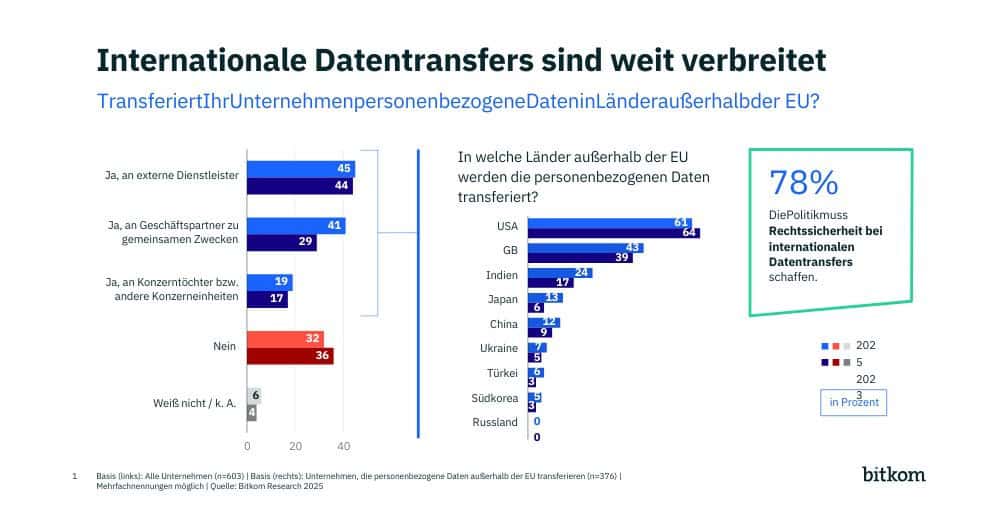
The most common destination for data is the USA. 61% of companies that transfer personal data to non-EU countries transfer it there. Standard contractual clauses are most frequently used as the legal basis for this (80 percent), followed by binding corporate rules (23 percent), the EU-US Data Privacy Framework (21 percent) and consent (12 percent). 19% state that they are currently still converting their data transfer or are discussing how to deal with the discontinuation of previous regulations. After the USA, the UK is the most important country for data transfers with 43 percent, followed by India (24 percent), Japan (13 percent), China (12 percent), Ukraine (7 percent), Turkey (6 percent) and South Korea (5 percent). No companies transfer data to Russia.
– – – – – –
Further links
👉 www.bitkom.org
Photo: Bitkom