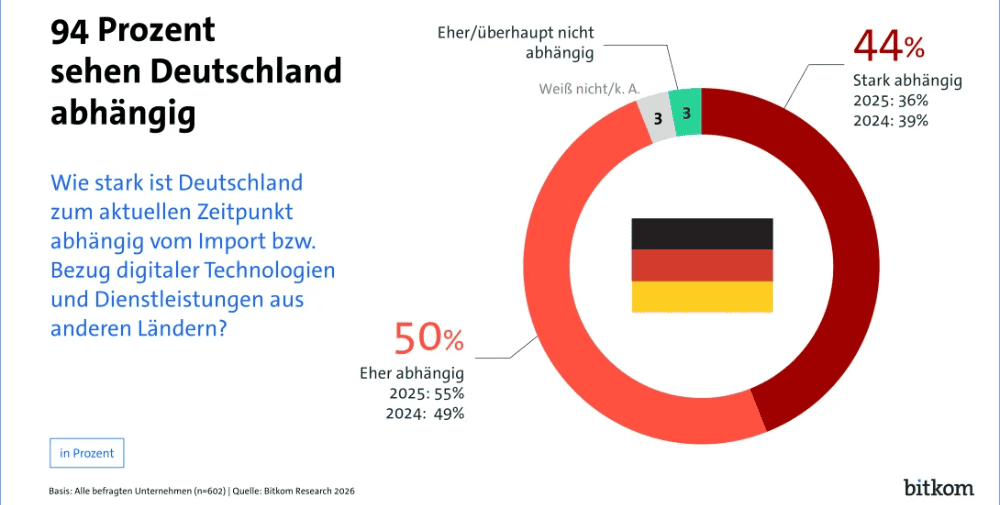
At the same time, dependence remains high: 94 percent of companies rate Germany as highly (44 percent) or somewhat (50 percent) dependent on digital technologies and services from abroad. Two-thirds (66 percent) expect this dependence to continue to increase over the next five years. The assessment is also critical when it comes to their own companies: 94 percent of companies that source digital technologies and services from abroad view themselves as dependent. Nearly half (49 percent) expect their own dependence to continue rising in the future. “The international division of labor is a strength of our economy, but it must not lead to a situation where we are unable to act in the event of a crisis. Digital sovereignty means resilience and is therefore a responsibility for the entire government as well as for every individual company. Policymakers must now set the right priorities and ensure that Germany and Europe become more independent in key digital technologies,” says Bitkom President Dr. Ralf Wintergerst. “This is not about isolation or even self-sufficiency. It’s about reducing one-sided dependencies and being able to respond adequately to pressure.”
A look at the digital infrastructure of the German economy shows that virtually no company can do without tech imports: 96 percent source devices or services from abroad. This is particularly common for digital end devices such as smartphones and laptops (94 percent), digital components and hardware such as chips, semiconductors, or sensors (79 percent), and cloud services (73 percent). Software (68 percent), cybersecurity applications (62 percent), and artificial intelligence (56 percent) are also sourced from abroad by a majority of companies. 45 percent use services such as IT consulting or programming services from providers not based in Germany.
At the same time, the German economy itself is a provider of digital technologies and services; 33 percent of companies export them abroad: most frequently digital services such as programming or IT consulting (24 percent) and software (18 percent). Sixteen percent of companies sell digital components and hardware components, and another 16 percent sell digital devices and machines. The most important market for digital technologies and services is the EU: 86 percent of companies that sell such products or services abroad export to other EU countries. A total of 61 percent export to the U.S., while 54 percent each export to Japan and the United Kingdom.
Digital Imports Primarily from the EU, the U.S., and China – Taiwan’s Importance Is Growing
For its digital imports, the German economy relies on both European and non-European technology hubs. 83 percent of companies that source digital technologies and services from abroad rely on suppliers from the EU—53 percent frequently and another 30 percent on an ad hoc basis. The United States plays an even greater role: 88 percent source digital technologies and services from there, with 62 percent doing so frequently. China follows with a total of 80 percent, 50 percent of which do so frequently. Japan accounts for 33 percent, and the United Kingdom for 24 percent.
High Vulnerability: In the event of a crisis, only a few months remain
Dependence on China is by far the greatest, even ahead of the U.S. Eighty-eight percent of companies that source digital technologies and services from abroad consider themselves dependent on China. Sixty-one percent—nearly two-thirds of these companies—report being very dependent on China, while another 27 percent are somewhat dependent. Regarding the U.S., 47 percent consider themselves highly dependent and 40 percent somewhat dependent. Twenty-three percent feel highly dependent on Taiwan, and 26 percent somewhat dependent.
Concerns among companies are particularly high when it comes to China and the U.S.: 79 percent of German companies say they are concerned about the German economy’s dependence on China—up from 69 percent in 2024. The increase is even more pronounced when it comes to the U.S.: The share of companies concerned about Germany’s digital dependence on the U.S. has risen from 38 to 73 percent within two years.
A disruption in imports would almost always affect core business
Disruptions in the import of digital technologies and services would affect large parts of companies—especially their core business: 93 percent of companies that source digital technologies and services from abroad expect an impact on their production or service delivery, 91 percent on sales and distribution, and 87 percent on logistics and supply chains. Purchasing and procurement (79 percent), customer service (78 percent), and IT operations and technical infrastructure (69 percent) would also be affected. Bitkom President Dr. Ralf Wintergerst: “If digital imports from key source countries are disrupted, it affects not only the IT department but also the core business. Production, sales, and supply chains depend directly on digital technologies and services. Companies must therefore systematically reduce and diversify their dependencies. And policymakers must create the conditions that allow German companies to develop their own capabilities in critical technologies.”
Companies Are Responding with Greater Diversification and Precaution
Many companies have already begun to reduce their digital dependencies and protect themselves against potential disruptions. 44 percent of companies that source digital technologies and services from abroad are increasingly relying on providers from Germany and Europe. 41 percent are maintaining larger inventories of key parts and components to cushion against potential supply bottlenecks. 40 percent are preparing to be able to switch to alternative providers and systems if necessary. 32 percent are building up their own technical expertise, while 31 percent source key products, components, or services from multiple suppliers. 13 percent are increasingly relying on open standards. Only 3 percent have not yet taken any measures.
Price Remains the Most Important Criterion in Supplier Selection
Despite growing awareness of digital dependencies, financial considerations continue to take precedence when selecting foreign business partners. For 97 percent of companies, financial terms are the most important criterion, closely followed by the business partner’s technological expertise at 93 percent. Security aspects also play a major role: 89 percent pay attention to the IT security standards of the partner or supplier company, 82 percent to legal certainty in the business partner’s country, and 78 percent to the influence of foreign governments. In contrast, only 50 percent consider a long-term business relationship and the level of trust with the business partner. Wintergerst: “Companies clearly recognize the importance of security and reliability in their business partners. It is important that companies focus primarily on the long-term stability of their supply chains and also address the question of how well they can switch to alternative suppliers in an emergency.”
Three-quarters of companies are taking risks
Awareness of the risks associated with international dependencies has risen significantly in recent times among companies that source digital technologies or services from abroad or sell them abroad: 73 percent now find themselves forced to take risks regarding the political reliability of their foreign partners’ home countries—up from 53 percent in 2024. 59 percent say they have virtually no way to defend themselves against pressure from foreign partners or governments. In 2024, that figure was 39 percent.
At the same time, companies see only limited opportunities to reduce their dependencies in the short term: 85 percent consider their global value chains to be too tightly intertwined and believe they should be more regionalized. Sixty-eight percent say there is no alternative to existing dependencies on business partners abroad. Wintergerst: “Resilience doesn’t happen overnight. We must lay the groundwork today so that companies have more options tomorrow: through technological strength, reliable partnerships, and a competitive Europe as a business location.””
Accordingly, companies are issuing a clear mandate to policymakers: 97 percent believe that Germany must invest more heavily in key technologies. An equal number are calling for an urgent strengthening of Germany’s digital sovereignty. 84 percent support the EU making greater use of its existing trade defense instruments.
Bitkom Priorities for Greater Digital Sovereignty
From Bitkom’s perspective, five priorities must now be set in Germany and Europe: First, strengthen competitiveness and access to capital—through less bureaucracy, innovation-friendly regulation, and better conditions for venture capital as well as startups and scale-ups. Second, invest specifically in key digital technologies and infrastructure, particularly in semiconductors, AI, cloud technologies, and data centers. Third, strengthen resilience and cybersecurity, including through secure and interoperable systems and open standards. Fourth, further diversify supply chains and technology partnerships and make targeted use of European economic protection instruments. And fifth, strengthen digital skills across all age groups and expand digital education over the long term.
Bitkom President Dr. Ralf Wintergerst: “Digital sovereignty is not a single funding program, but a strategic task for Germany and Europe. We must strengthen our competitiveness, invest in key technologies, and make our digital infrastructure more resilient. At the same time, we need strong international partnerships and a society capable of acting with digital sovereignty. It is now crucial to pursue these priorities over the long term. Only in this way can we create the technological capabilities and choices we need to remain economically and politically capable of acting, even when we are under massive pressure.”
– – – – –
Related Links
👉 www.bitkom.org
Graphic: Bitkom