Germany is currently experiencing perhaps its most exciting technological leap since the invention of the microchip – and quantum research is at the heart of it all. With the national quantum strategy in Berlin, the “Quantum Europe Strategy” in Brussels and billions being invested in data centers, sensor technology and quantum communication, one question is taking center stage: will it be possible this time to turn excellent research into industrial strength and real sovereignty?
Munich is clearly playing in the premier league. Munich Quantum Valley (MQV), supported by TUM, LMU, FAU, the Max Planck Society, the Fraunhofer Society and the Bavarian Academy of Sciences and Humanities, among others, has been established as a quantum ecosystem that is recognized throughout Europe with hundreds of millions in funding from Hightech Agenda Bayern and federal funds. The aim is to create a complete environment for “quantum computers made in Bavaria” – from cutting-edge research to start-up funding and specialized training programmes.
This year’s Technology Transfer Award of the German Physical Society shows how successful Munich already is in this regard. Munich Quantum Valley e.V., QuantumDiamonds GmbH and the TUM School of Natural Sciences were honored for quantum sensor technology, which makes the smallest magnetic fields and currents in integrated circuits visible and thus raises error analysis and measurement technology in semiconductor production to a new level. The technology enables non-destructive inspection of complex chip architectures and is already being piloted with major semiconductor manufacturers worldwide.
This demonstrates that the quantum and semiconductor worlds are not an either-or proposition: Modern quantum sensor technology and quantum computers are based on the same high-precision manufacturing, materials and cleanroom expertise that Europe has built up over decades in microelectronics. Without a strong, innovative microelectronics ecosystem, there will therefore also be no strong, globally competitive quantum ecosystem – both technologies reinforce each other.
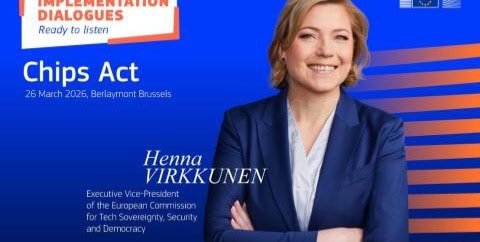
The next signal from Munich fits in with this: QuantumDiamonds is investing 152 million euros in the construction of the world’s first production facility for quantum-based chip inspection systems in the Bavarian capital. This factory is being funded with tens of millions of euros by the federal and state governments as part of the European Chips Act and is explicitly seen as a contribution to European technological sovereignty and the goal of doubling the European semiconductor share to 20 percent by 2030. Even if, as regular readers of the newsletter will know, the 20 percent target is unrealistic, it is fair to say that the measurement technology for the next generation of chips is being built in Munich – with a tailwind from European policy.
But if you look at the German quantum map, you can no longer see a single location. In Berlin, BERLIN QUANTUM is an initiative of universities, research institutes, industry and the Senate that aims to establish the capital as a globally visible hub for quantum photonics and quantum information – including its own hub in Adlershof and tens of millions from the state budget. In parallel, the DLR Quantum Computing Initiative is establishing innovation centers in Hamburg and Ulm, where several prototype quantum computers and manufacturing processes are being developed; Hamburg is already considered one of the most active national hubs with several systems for applications in mobility, AI, materials science and cybersecurity. In addition, there are heavyweights such as the Jülich Research Center, which is working on the entire quantum computer value chain, and Baden-Württemberg can score points with the IBM Quantum Data Center in Ehningen, among other things.
Against this backdrop, it is no contradiction to look to Munich and other hotspots with respect and pleasure – and at the same time not have to hide in Saxony with self-confidence. With the network “Quantum Saxony” (SAX-QT), supported by Fraunhofer IPMS, IWU and several universities, among others, work is being carried out specifically on quantum materials, sensor technology and quantum computing, always with a view to transfer to real microelectronics, mechanical engineering and production applications. Saxony is therefore a second strong quantum pole in the country, embedded in one of the densest semiconductor and ICT ecosystems in Europe.
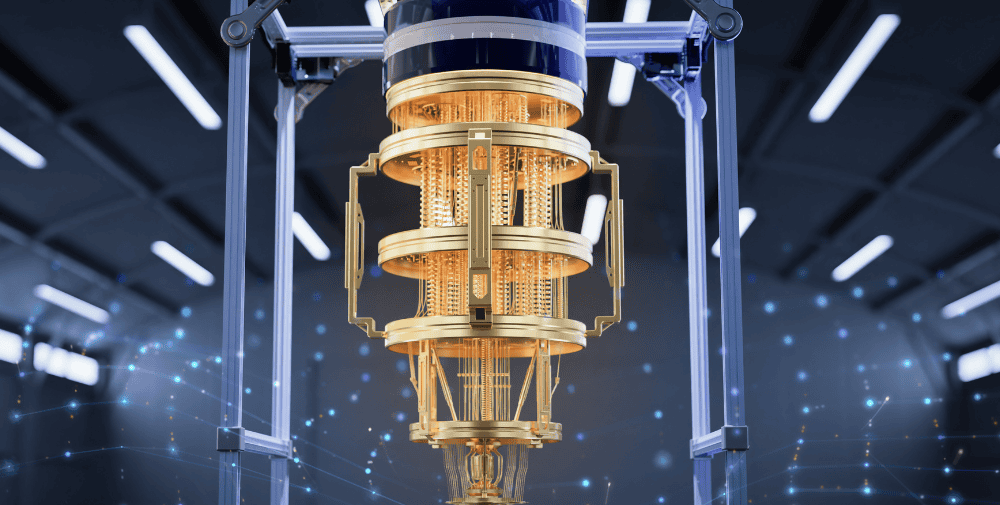
The Leipzig-based start-up SaxonQ provides a particularly vivid example. It is developing mobile quantum computers based on NV centers in diamonds that work at room temperature without cryogenics and are compact enough to be used in vehicles. Such a mobile quantum computer was demonstrated publicly for the first time at Silicon Saxony Day at Dresden Airport in 2022 – documented by reports and images from the community, among other things. Today, a SaxonQ system is one of the first transportable quantum computers to run at room temperature at the Dresden branch of the Fraunhofer IWU, is available to the Saxon research network SAX-QT and is being tested for Industry 4.0 applications in production.
The company is also well positioned in the area of young talent and social anchoring. The joint project QUARKS (“All About QUARKS”) , coordinated at TU Dresden, is funded by the BMBF with over 4.4 million euros and aims to disseminate quantum technologies via schools, universities, training providers, maker spaces and its own information portal. At a time when all quantum hubs are desperately looking for talent, this combination of high-tech and STEM education is a locational advantage – and a model that Berlin, Hamburg and Munich could also take a look at.
It is fitting that TU Dresden was able to reconfirm its status as a University of Excellence just yesterday – congratulations on that too!
Looking to the USA and China: the global benchmark
Those who want to understand why collaboration and critical mass are so important only need to look outwards. The USA has been coordinating its activities since 2018 via the National Quantum Initiative Act, which provides billions for research centers at DOE, NSF and NIST. The reauthorization currently under discussion will extend the programme until 2034 and focus it more strongly on applications, industrial partnerships and international cooperation with allies. At the same time, companies such as Google, IBM, Microsoft and Amazon are driving scaling with their own roadmaps in quantum computing and the quantum cloud – flanked by NIST programs for quantum-safe cryptography.
China is pursuing a different, strongly state-driven approach – but with equally high ambitions. With billions invested in the National Laboratory for Quantum Information Science in Hefei, estimated at up to 10 billion US dollars, and a long-term roadmap for quantum communication, computing and sensing, it is building its own, largely self-sufficient stack. Through the quantum satellite “Micius”, its successor “Jinan-1” and a fiber optic backbone over 10,000 kilometers long, China has built the world’s largest integrated quantum key distribution network – with the long-term goal of a global, space-based quantum-secured communication network. In many assessments, the USA is still leading in quantum computers and parts of sensor technology, while China is ahead in quantum communication – overall a neck-and-neck race with considerable security and industrial policy implications.
Critical mass only through collaboration
In light of this, it would be short-sighted for German and European quantum hubs to think primarily in competition with each other. Neither Munich nor Berlin, Hamburg, Jülich or Saxony will achieve the critical mass alone to keep up technologically and industrially with the huge ecosystems in the USA and China. Only the interplay – joint roadmaps, coordinated pilot lines, interoperable software stacks, coordinated education programs and clever linking with European initiatives such as Quantum Flagship, Chips Act and the Quantum Europe Strategy – will create the density that makes them internationally visible and relevant.
In this sense, Munich Quantum Valley, Quantum Saxony, BERLIN QUANTUM, the DLR initiatives in Hamburg and Ulm and the activities in Jülich and Ehning are not rivals, but building blocks of a single, distributed “quantum location Germany” within an even larger European network. The USA is already explicitly discussing an international quantum cooperation strategy with partners; for Germany and Europe, this means that if you want to have a say globally, you first have to do your homework in terms of networking and coordination at national and European level – and then you can enter into transatlantic and international alliances on an equal footing.
With this in mind, my name is Bösenberg, Frank Bösenberg, and I see more than a quantum of solace. Thank you for reading!