Current environmental observations show that forests and other ecosystems are increasingly affected by drought, disease, and pest infestation. These stresses often cause changes in emitted volatile organic compounds (VOCs). Conventional measurement methods of these compounds rely on time-consuming laboratory analyses, leading to delays in detection. The FastSense project addresses this gap by developing a portable, robust, and highly sensitive system for the rapid and selective detection of low-concentration analytes directly in the field.
Objectives and technical approach
The FastSense project is developing and validating a novel measurement system that combines a fast gas chromatograph with a miniaturized ion mobility spectrometer (GC-IMS). The sensor hardware is supplemented by AI-based algorithms for the automated evaluation of complex three-dimensional measurement data. This enables even the lowest concentrations of relevant substances to be reliably detected and characteristic patterns to be identified in real time. The entire system is designed as a demonstrator and tested under realistic environmental conditions.
Beyond the scope of the project, this innovative system will enable fast, reliable, and mobile detection of chemical markers directly on site. This will allow environmental changes to be detected and assessed at an early stage, for example in the context of forest condition surveys or pollutant monitoring. Additionally, the technology offers potential for applications in civil security, such as the detection of hazardous or explosive substances, as well as for industrial process monitoring.
Project partners
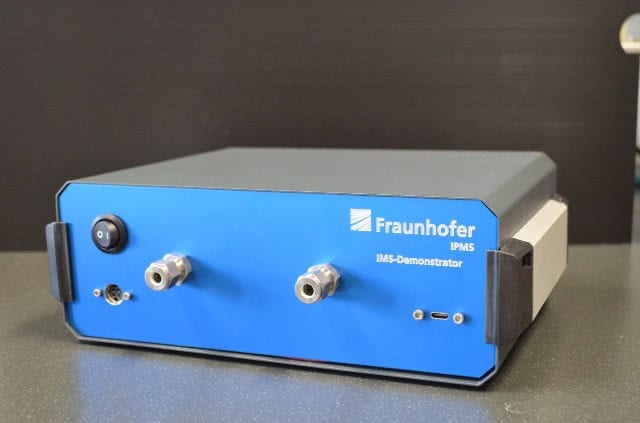
Fraunhofer IPMS is responsible for developing and integrating the core sensor components in the project. The institute contributes its many years of expertise in the miniaturization of electronic and microsystem components and is particularly responsible for the further development of the IMS chip, the associated electronics, and the construction of the overall system. The focus is on coupling the fast gas chromatograph with a powerful, highly selective ion mobility spectrometer and implementing a compact demonstrator.
The Helmholtz Centre for Environmental Research (UFZ) has in-depth expertise in the field of environmental analysis and the application of ion mobility spectrometry. It defines the application-relevant requirements, especially for emission analysis in forest ecosystems, and supports the validation of the system using real environmental samples. In this way, the UFZ ensures that the technologies developed in the project are designed to be practical and offer direct added value for environmental research and monitoring.
The Center for Applied Research and Technology (ZAFT) complements the consortium with its expertise in applied research, the development of hardware and software solutions, and AI-supported data processing. In the FastSense project, ZAFT’s focus is on developing fast, intelligent evaluation algorithms for complex GC-IMS spectra. These methods form the basis for automated interpretation of the measurement data and enable the system to be used on site.
The FastSense cooperation project will run from November 2025 to December 2027 and is co-funded by the European Union and co-financed by tax revenues based on the budget adopted by the Saxon State Parliament.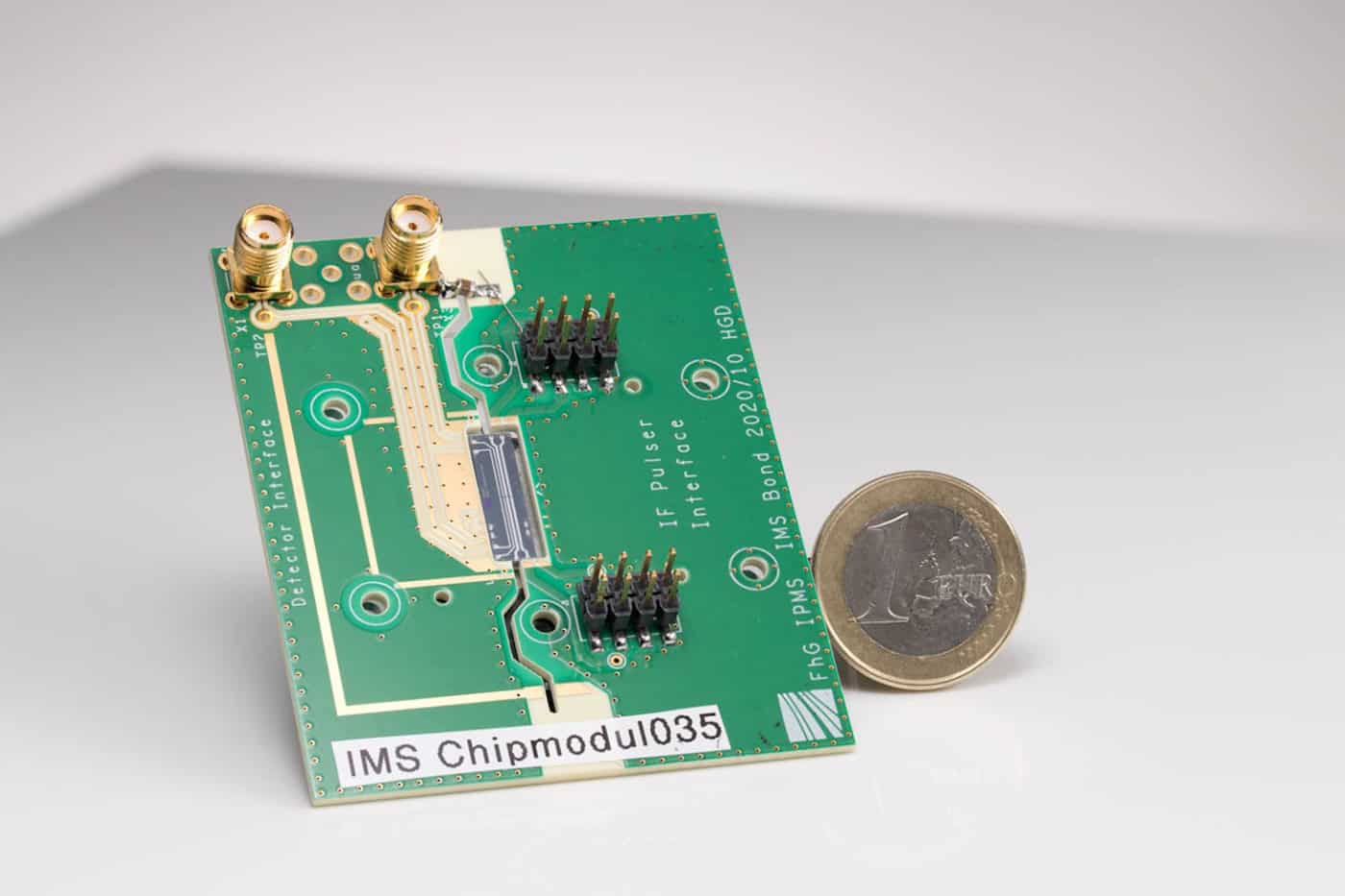
© Fraunhofer IPMS
IMS chip module for easy system integration into an ion mobility spectrometer, Laboratory demonstrator as an ion mobility spectrometer based on a special IMS chip
👉 Press Release