“After three years of the GenAI boom, it is clear that the technology is catching on rapidly, but sustainable productivity gains that can be achieved by transforming core business processes are only emerging in individual cases,” says Benedikt Bonnmann, CEO of adesso SE.
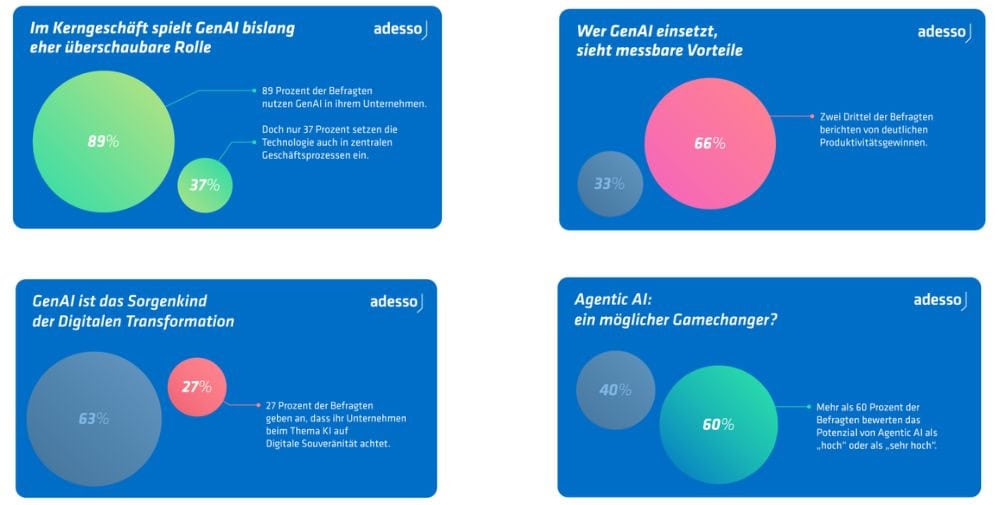
As soon as GenAI is used, the technology generally delivers measurable benefits, the survey proves. Two thirds of those surveyed reported significant productivity gains. One in four even achieved increases of more than ten percent in their area of responsibility.
As a lever for transforming the core business, Agentic AI is moving into focus. The coordinated interaction of specialized AI agents for complex tasks is seen by many as a potential game changer: more than 60 percent of those surveyed rate the potential of AI agents as “high” or “very high”.
A sense of optimism meets legal and knowledge gaps
However, as usage increases, so do the requirements for control and sovereignty. While cultural hurdles, such as reservations or low acceptance among the workforce, hardly play a role in the introduction of GenAI, legal uncertainties, data protection concerns and a lack of AI expertise continue to cause reluctance. In addition, almost a third of managers report shadow AI, i.e. the unplanned or unauthorized use of GenAI outside of defined guard rails. Nevertheless, the business community does not want to let this slow them down and is actively exploiting the opportunities offered by the technology: 70% of companies are planning to increase their AI budgets in the next twelve months.
After the technology hype of the first three years, another aspect now seems to be seeping into the consciousness of business leaders: an AI strategy as part of an overarching IT and digitalization strategy must also take digital sovereignty into account. This becomes clear when asked about Europe’s strategic role: 63% of managers are in favor of a “make strategy”. According to this, Europe should develop its own competitive AI base models instead of relying exclusively on the refinement of non-European models.
Index Digital Sovereignty reveals structural risks with GenAI
The desire for technological independence is also reflected in the findings of the Index Digital Sovereignty (IDS) developed by adesso and the Handelsblatt Research Institute. An accompanying focus report on the topic of AI reveals the structural challenges that have arisen with the rapid introduction of GenAI. According to the report, GenAI currently represents the biggest sovereignty gap in the entire technology stack of many organizations – the analysis refers to it as a “problem child”. A key finding is that 27% of the decision-makers surveyed stated that their company pays little attention to AI sovereignty. In the public sector, it is even almost every second organization.
At the same time, many organizations are heavily dependent on a few, predominantly non-European AI providers. The public sector also often lacks the expertise to develop AI applications independently. While private-sector companies are able to do this in around 83% of cases, this figure is only 62% in the public sector. This increases lock-in risks and reduces future scope for action.
The Digital Sovereignty Index shows: Especially when it comes to GenAI, the most important technology of the future, Germany is lagging behind on issues relating to digital sovereignty.
Benedikt Bonnmann: “Now it also depends on good interaction between companies and politics. We need framework conditions that rely less on regulation and improve the investment climate. This will help both companies to use GenAI and Europe as a business location to develop its own solutions.”
– – – – – –
Further links
👉 www.adesso.de
👉 Focus report of the Digital Sovereignty Index with a focus on AI
Photo: adesso SE