Under the consortium leadership of Bosch, a project team – consisting of Daimler Center for Automotive Information Technology Innovations (DCAITI), Fraunhofer Institute for Open Communication Systems (FOKUS), Fraunhofer Institute for Mechatronic Design Technology (IEM), Saarland University of Applied Sciences – htw saar, Infineon Technologies AG, Technical University of Munich, TÜV SÜD and the University of Ulm – researched how networked traffic systems can be robustly designed, developed and released in the future. The project was funded by the Federal Ministry of Research, Technology and Space.
Thanks to ConnRAD results, turning left becomes safer
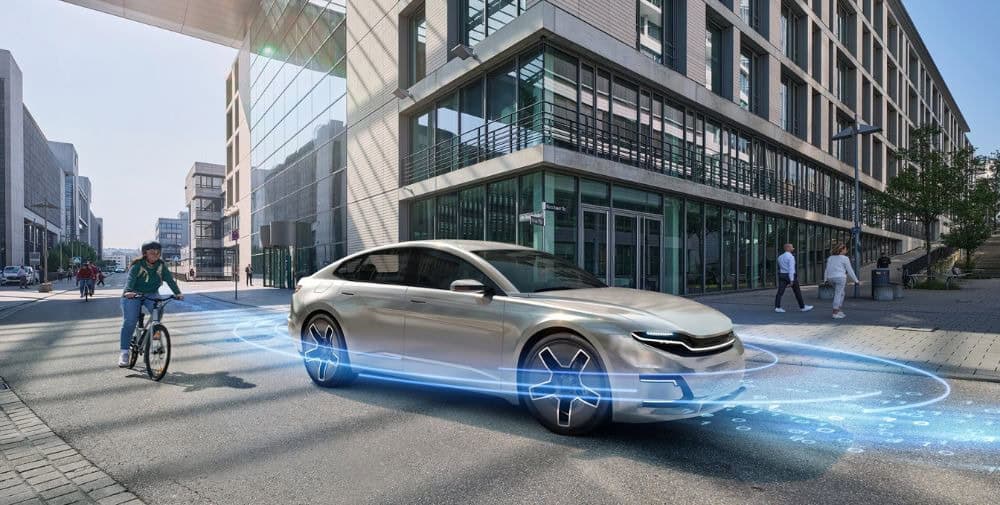
The exchange with other vehicles in the vicinity and with the infrastructure, such as traffic lights, increases the efficiency of automated driving functions. In technical jargon, this is referred to as V2X communication (Vehicle to Everything). However, the reliability of this data can vary greatly. Depending on the traffic situation, weather conditions or the source of the information, it may only be available to a limited extent, in poor quality or even not at all. In order to remain resilient in the face of inadequacies and to make the most of available data, automated driving systems require a quantifiable level of reliability of the information and data channels exchanged.
This is precisely where ConnRAD comes into play: the project team developed mechanisms with which the communication partners in road traffic can prove and evaluate their reliability and suitability. The system of the receiving vehicle then decides on the basis of this assessment whether a communication partner and the transmitted information are sufficiently qualified and trustworthy for safety-critical driving functions. Only then is the received V2X information used for such functions. This enables intelligent filtering of the data and significantly increases the safety of automated driving functions.
A particularly vivid example is turning left at urban intersections, which Bosch, FOKUS and DCAITI made safer in the project. To do this, the surrounding sensors of the road infrastructure – such as radar or lidar systems in this case – communicate directly with the vehicles. The ConnRAD methods enable the vehicle to evaluate the reliability of this infrastructure data by taking its origin and quality into account. Specifically, it was shown that if a vehicle only receives a blanket intersection clearance without metadata, this would lead to an accident if the driver does not intervene. If, on the other hand, the metadata of the surrounding sensors is provided, the vehicle can assess the reliability. If, for example, only one radar signal is provided, which may not be sufficient in particularly complex scenarios, the vehicle will abort the turn. It can only turn off safely when it receives confirmation from several high-quality environment sensors such as radar and lidar. Another example: htw saar evaluates the trustworthiness of V2X communication with plausibility checks to prevent rear-end collisions at the end of traffic jams.
Robust overall system for efficient V2X communication
ConnRAD developed a new type of communication architecture as the basis for a robust and resilient overall system. This takes into account not only aspects of cybersecurity (to protect against attacks) and functional security (for reliable operation), but also relevant regulatory and organizational framework conditions.
A core element of this architecture are extensions to existing message protocols and interfaces. These enable the reliability of the communicated information to be continuously evaluated and verified during operation. Specifically, the quality and reliability of data has been made measurable, assessable and verifiable. This enables the driving system to automatically and reliably initiate suitable countermeasures if the quality of the data decreases – for example, by switching to alternative sources of information or adjusting driving behavior. Project partner Infineon Technologies AG made an important contribution to this: the company developed concepts for hardware-based authentication of communication partners. Inherent signatures of the mobile radio components are used as an unchangeable “fingerprint”, so to speak, by which the data they send can be clearly identified as genuine and originating from this specific hardware. This significantly increases security, as the authenticity and origin of the data is guaranteed directly via the hardware of the communication partners and manipulation is made considerably more difficult.
Teleoperated driving (controlling the vehicle remotely via a secure connection) with limited communication bandwidth was secured by the Technical University of Munich with new approaches. These include, for example, the “Ability Awareness Protocol” in conjunction with trust metrics. This helps the system to clearly allocate its own capabilities to the subsystems and to dynamically recognize and react to limits. There is also “Network Predictive Quality of Service”. This is an approach for the predictive evaluation of network quality in order to be able to react to possible communication problems at an early stage.
The simulation results of the University of Ulm for a probability-based trust assessment also confirm a significant improvement in system resilience. Fraunhofer IEM expanded the development process to systematically incorporate the resilience requirements of distributed driving functions into system development. TÜV SÜD evaluated the legal and regulatory framework conditions. Based on the experience gained and simulations, the ConnRAD partners were able to derive a reference architecture and a comprehensive method kit for the development of resilient driving functions in networked distributed systems. With the ConnRAD approach, scalable approval of safety-relevant driving functions in distributed systems is now possible.
– – – – – –
Further links
👉 www.bosch.de
Photo: Bosch